Fatwa Panel of the Week – Volume 03 Issue 26
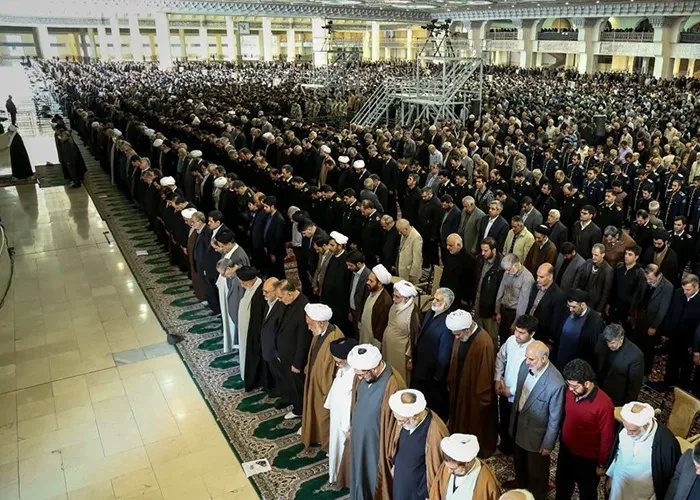
Friday Prayer
According to the fatwas of the Grand Religious Authorities: Shaheed Ayatollah Sayyed Ali Khamenei, Ayatollah Sistani, and Ayatollah Makarem Shirazi (may Allah prolong their blessings):
Fatāwā presented without citing a differing opinion or a specific reference are the common rulings shared by all of the three respected Marāji‘. In cases where the ruling of one Marjaʿ differs from that of the other two, it is indicated in a footnote under the same number, mentioning the Marjaʿ by name.Bottom of Form
The Importance and Status of Friday Prayer
- Friday Prayer (Ṣalāt al-Jumuʿah) is the weekly gathering of Muslims centred upon the remembrance of God and the worship of the Almighty. It is one of the most significant manifestations of the dignity of the Islamic community (Ummah) and the strength of religious governance. Friday Prayer serves to unite Muslims, counter hostile propaganda, and provide an important opportunity for believers to become acquainted with their social responsibilities as well as contemporary issues affecting the Muslim world.
- Friday Prayer, which is performed on Fridays in place of the noon (Ẓuhr) prayer, is considered a wājib takhyīrī (optional obligatory duty) during the present era—the period of the Occultation (Ghaybah) of Imam al-Mahdī (may God hasten his reappearance). This means that a legally responsible Muslim (mukallaf) may choose to perform either the Friday Prayer or the noon prayer.
- It is a recommended precaution (iḥtiyāṭ mustaḥabb) that Friday Prayer should not be neglected whenever an Islamic government founded upon justice is established, insofar as circumstances permit.
- Deliberately abstaining from participation in Friday Prayer out of disregard for its significance is considered religiously reprehensible.
Ayatollah Makarem Shirazi: During the period of the Major Occultation (al-Ghaybah al-Kubrā), Friday Prayer is a wājib takhyīrī, meaning that one has the choice between performing Friday Prayer and the noon prayer. However, when a just Islamic government is in place, it is a matter of obligatory precaution (iḥtiyāṭ wājib) that Friday Prayer should not bae bandoned.
Conditions for the Validity of Friday Prayer
- The conditions required for the validity of Friday Prayer (Ṣalāt al-Jumuʿah) are as follows:
- It must be performed congregationally (jamāʿah).
- A minimum of five participants must be present, consisting of one imam and four congregants.
- All conditions required for the validity of congregational prayer must be observed, such as the proper continuity and connection of the prayer rows.
- There must be a minimum distance of one farsakh between it and any other Friday Prayer congregation, which is approximately 5,125 meters (5.1 km).
- A traveller whose prayer is ordinarily shortened (qaṣr) may participate in Friday Prayer and perform it in place of the noon (Ẓuhr) prayer.
- If two Friday Prayers are held within a distance of less than one farsakh from one another, the prayer that commences first is valid, while the later one is invalid. If both congregations begin simultaneously, then both Friday Prayers are invalid.
Conditions of the Leader of Friday Prayer (Imam al-Jumuʿah)
- All conditions required for the leader of a congregational prayer (Imam al-Jamāʿah)—such as uprightness and justice (ʿadālah)—are likewise required for the Friday Prayer’s leader (Imam al-Jumuʿah).
- If, at the time of following the Friday Prayer leader, a person is satisfied and confident regarding the imam’s justice and integrity, but after the prayer either doubts his justice or becomes certain that he was not just, the prayers previously performed behind him remain valid.
- If the official appointment of a person as Friday Prayer leader gives the congregant confidence and assurance regarding that individual’s justice and integrity, such confidence is sufficient for the validity of following him in prayer.
The Time of Friday Prayer
- The time for Friday Prayer (Ṣalāt al-Jumuʿah) begins at solar noon (zawāl al-shams), that is, the commencement of the noon prayer time (ẓuhr). As a matter of obligatory precaution (iḥtiyāṭ wājib), it should not be delayed beyond the customary early portion of the noon prayer time.
- The Friday Prayer leader (Imam al-Jumuʿah) may deliver the Friday sermons (khuṭbahs) before noon.
Ayatollah Sistani: Delivering the sermons before the noon adhān is problematic. Even if the sermons conclude at the onset of the prayer time, one should not, as a matter of obligatory precaution, suffice with a Friday Prayer whose sermons commenced before the noon adhān, even if only the first sermon was delivered before the adhān.
Ayatollah Makarem Shirazi: The sermons should be delivered after the adhān, as they serve in some respects as a substitute for two units (rakʿahs) of prayer (though not in every respect). Moreover, commencing the sermons before their prescribed time is not viewed favourably by other Muslims and may create the misconception that the prayer itself is being performed before its proper time. If the Friday Prayer leader is compelled to begin the sermons before the prayer time enters, he must repeat the obligatory portions of the sermons after the commencement of the prescribed time, even if only for a few minutes. Nevertheless, it is highly preferable, whenever possible, to refrain from delivering the sermons before their proper time.
Duties and Responsibilities of the Friday Prayer Leader
- It is obligatory that the Friday Prayer leader (Imam al-Jumuʿah) himself—not another person—deliver the sermons (khuṭbahs) while standing. If he is unable to deliver the sermons standing, another qualified individual must lead both the sermons and the Friday Prayer.
- It is obligatory for the Friday Prayer leader to sit briefly after the first sermon and before delivering the second sermon.
- It is not permissible for the Friday preacher to deliver the sermons in a low voice. Rather, as a matter of obligatory precaution (iḥtiyāṭ wājib), he must recite the sermons loudly enough for at least the minimum number required for the validity of Friday Prayer (four congregants) to hear them. Furthermore, it is a recommended precaution (iḥtiyāṭ mustaḥabb) that, particularly during the exhortation and call to piety (taqwā), his voice should reach all those present, even through the use of amplification systems such as loudspeakers.
- In the first sermon, it is obligatory for the preacher to:
- Praise and glorify Allah (ḥamd wa thanāʾ);
- Invoke blessings upon the Prophet Muḥammad (peace and blessings be upon him and his family);
- Exhort the congregation to observe piety (taqwā);
- Recite a short chapter (sūrah) from the Qur’an.
In the second sermon, he must again:
-
- Praise and glorify Allah;
- Invoke blessings upon the Noble Prophet (peace and blessings be upon him and his family).
As a matter of obligatory precaution, he should also:
-
- Exhort the congregation to piety in the second sermon;
- Recite a short chapter from the Qur’an.
It is a recommended precaution that, after invoking blessings upon the Prophet (peace and blessings be upon him and his family), he should also invoke blessings upon the Infallible Imams (peace be upon them) and seek forgiveness for the believers.
Ayatollah Sistani: As a matter of obligatory precaution, the praise of Allah (ḥamd) and the invocation of blessings (ṣalawāt) upon the Noble Prophet (peace and blessings be upon him and his family) and the Infallible Imams (peace be upon them) must be delivered in Arabic. However, the other components of the sermon—such as words of praise and the exhortation to piety—are not required to be in Arabic. Nevertheless, if the majority of those present do not understand Arabic, it is a necessary precaution that the exhortation to piety be delivered in the language understood by the congregation.
Duties of the Congregants
1. As a matter of precaution, worshippers should listen attentively to the Friday sermons (khuṭbahs), remain silent, and refrain from engaging in conversation.
Ayatollah Sistani: Speaking while the Imam is delivering the sermon is discouraged (makrūh). However, if speaking prevents one from listening to the sermon, it is not permissible, as a matter of obligatory precaution (iḥtiyāṭ wājib).
2. It is a recommended precaution (iḥtiyāṭ mustaḥabb) that the congregants face the Imam while the sermons are being delivered and avoid turning away from the qiblah beyond the extent permitted during prayer.
Ayatollah Makarem Shirazi: Congregants should sit facing the qiblah during the Friday sermons, listen attentively, and maintain a posture befitting one engaged in worship. Nevertheless, speaking during the sermons does not invalidate the prayer, although it is contrary to precaution. Likewise, the recitation of takbīrs and religious slogans during the sermons does not affect the validity of the prayer.
3. If a congregant does not attend any portion of the Friday sermons and arrives only when the prayer itself is being performed, then follows the Friday Prayer leader, his prayer is valid and suffices in place of the noon (Ẓuhr) prayer. Even if he joins only moments before the bowing (rukūʿ) of the final rakʿah, he may still join with the intention of Friday Prayer. He should then complete his second rakʿah in the manner prescribed for the second rakʿah of Friday Prayer, and this prayer will suffice in place of the noon prayer.
Miscellaneous Rulings Concerning Friday Prayer
- Friday Prayer (Ṣalāt al-Jumuʿah) is among the important symbols of Islam and one of the clearest manifestations of Muslim unity. Therefore, it is not permissible to engage in any action that may lead to discord among believers or cause division and fragmentation within their ranks.
- A person who does not attend Friday Prayer may perform the noon (Ẓuhr) prayer at the beginning of its prescribed time. It is not obligatory for him to wait until the Friday Prayer has concluded.
The establishment of a congregational noon (Ẓuhr) prayer at the same time that Friday Prayer is being held in another nearby location is, in itself, permissible and does not invalidate either prayer. However, since such an action may be perceived as causing division among the believers, showing disregard for Friday Prayer, or disrespecting the Friday Prayer leader, it is preferable that such a congregation not be established. Indeed, if holding such a congregation would result in discord, harm, or any prohibited consequence, it becomes obligatory to refrain from organizing it
editor's pick

news via inbox
Subscribe to the newsletter.