Everlasting Tales of the Quran – Volume 03 Issue 32
Prophet Ṣāliḥ (peace be upon him) and the People of Thamūd – From the Height of Prosperity to the Fall into Rebellion
The people of Thamūd were one of the ancient Arab nations who lived after the people of ʿĀd. God granted them a highly fertile land in a region known as Al-Ḥijr, located between the Ḥijāz and Greater Syria (Ash-Shām).
They were remarkably advanced in engineering and architecture. The Qur’an states that they built magnificent palaces across the plains and carved secure and enduring homes into the mountains:
” وَاذْكُرُوا إِذْ جَعَلَكُمْ خُلَفَاءَ مِنْ بَعْدِ عَادٍ وَبَوَّأَكُمْ فِي الْأَرْضِ تَتَّخِذُونَ مِنْ سُهُولِهَا قُصُورًا وَتَنْحِتُونَ الْجِبَالَ بُيُوتًا …”
(Al-A‘rāf 7:74)
“And remember when He made you successors after the people of ʿĀd and settled you in the land, where you built splendid palaces on its plains and carved homes into the mountains…”
However, intoxicated by their prosperity and wealth, they fell into idolatry, arrogance, and oppression. The wealthy elite and the arrogant rulers dominated society, and corruption became widespread.
God sent Prophet Ṣāliḥ (peace be upon him)-a noble, respected, and wise man among his own people-as His messenger. Ṣāliḥ called them to Tawḥīd (the worship of the One True God), justice, and abandoning extravagance and corruption.
The people of Thamūd responded to his call with astonishment and denial. They said:
“الُوا يَا صَالِحُ قَدْ كُنْتَ فِينَا مَرْجُوًّا قَبْلَ هَذَا أَتَنْهَانَا أَنْ نَعْبُدَ مَا يَعْبُدُ آبَاؤُنَا …”
(Hūd 11:62)
“O Ṣāliḥ! Before this, you were a man in whom we placed great hope. Do you now forbid us from worshipping what our forefathers worshipped?”
As Ṣāliḥ (peace be upon him) continued inviting them to the truth, the arrogant chiefs and leaders of the tribe eventually demanded that he produce a miracle to prove his claim.
“مَا أَنْتَ إِلَّا بَشَرٌ مِثْلُنَا فَأْتِ بِآيَةٍ إِنْ كُنْتَ مِنَ الصَّادِقِينَ“
(Ash-Shuʿarāʾ 26:154)
“You are nothing more than a human being like us. So bring us a sign if you are one of the truthful.”
According to Islamic narrations, they said:
“If you are truthful, bring forth from this solid mountain a pregnant red-haired she-camel!”
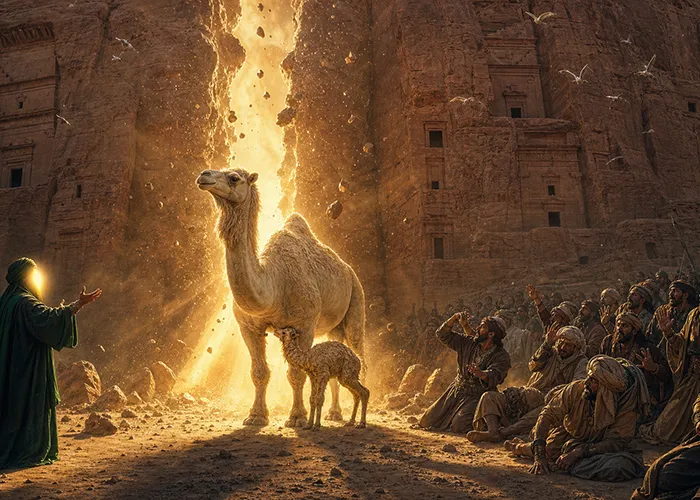
Prophet Ṣāliḥ prayed to God, and by God’s permission the rock split open. A she-camel matching every one of their requested descriptions emerged from it and immediately gave birth.
The Qur’an refers to this miraculous animal as “ناقةُ الله“ (the She-Camel of Allah), a clear sign by which the people would be tested.
According to the Qur’an and authentic Islamic narrations, this she-camel possessed extraordinary and miraculous characteristics, the most significant of which are as follows:
The greatest and most astonishing aspect of this she-camel was the manner of her creation. At the request of the people of Thamūd themselves—who demanded an impossible miracle—she did not come into existence through natural birth. Rather, she emerged directly from the heart of a massive rock and mountain. The rock split apart, and from it came a large, red-haired, pregnant she-camel, which immediately gave birth.
She was an exceptionally enormous camel, unlike any ordinary camel.
Islamic narrations also state that her hair or wool had a reddish hue.
One of God’s most important commands concerning this she-camel was the equitable sharing of the town’s water between her and its people. The Qur’an explicitly states:
“قَالَ هَٰذِهِ نَاقَةٌ لَهَا شِرْبٌ وَلَكُمْ شِرْبُ يَوْمٍ مَعْلُوم“
(Ash-Shuʿarāʾ 26:155)
“He said, ‘This is a she-camel. She has her appointed share of water, and you have your appointed share on a designated day.'”
On the day assigned for the she-camel to drink, she would consume all the water from the town’s main spring or water source.
In return, however, she became an immense blessing for the people. On the very same day that she drank the water, she produced such an abundance of milk that every resident of the town-young and old alike-could fill their containers with fresh milk and even store enough for the following day.
According to Islamic narrations, the presence of this she-camel inspired such awe that, on her appointed day, all the town’s livestock stayed away from the spring out of fear of her majesty, clearing the way for her to drink.
The she-camel of Prophet Ṣāliḥ was not merely a visual miracle; she was a divine test by which the rebellion and obedience of the people of Thamūd would be measured.
Ṣāliḥ commanded that she be allowed to graze freely in God’s land:
“فَذَرُوهَا تَأْكُلْ فِي أَرْضِ اللَّهِ …”
(Al-Aʿrāf 7:73)
“So leave her to graze upon the land of Allah.”
No one was permitted to cause her even the slightest harm:
“( وَلَا تَمَسُّوهَا بِسُوءٍ)”
“And do not touch her with any harm.”
For any aggression against this she-camel would amount to a declaration of war against God and would bring immediate divine punishment.
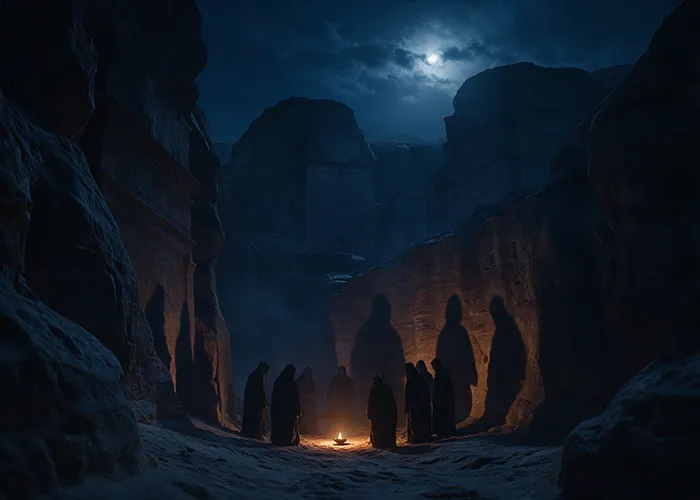
The presence of the she-camel—this living miracle from God—threatened the authority of the arrogant elite and the oppressors. Consequently, a group of the leaders of rebellion devised a plot to kill her.
According to Islamic narrations and Qur’anic exegesis, nine of the principal corrupters-whom the Qur’an describes as:
“تِسْعَةُ رَهْطٍ يُفْسِدُونَ فِي الْأَرْضِ“
held a secret meeting.
They appointed the most wretched man among them, Qidār ibn Sālif-who is described in Islamic narrations as “Ashqā al-Awwalīn” (“the most miserable among the former peoples”)-to carry out the crime.
Lying in ambush along the camel’s path, he first struck her leg, crippling her, and then killed her.
Afterward, they mockingly challenged Prophet Ṣāliḥ, saying:
“فَعَقَرُوا النَّاقَةَ وَعَتَوْا عَنْ أَمْرِ رَبِّهِمْ وَقَالُوا يَا صَالِحُ ائْتِنَا بِمَا تَعِدُنَا إِنْ كُنْتَ مِنَ الْمُرْسَلِينَ“
(Al-Aʿrāf 7:77)
*”So they hamstrung the she-camel, defied the command of their Lord, and said, ‘O Ṣāliḥ! Bring upon us what you have promised us, if you are truly one of the messengers.'”
When Qidār ibn Sālif and his accomplices attacked the she-camel and hamstrung her by striking her leg, her young calf, having witnessed the scene, fled from the rebels. Regarding the calf’s fate, two principal narrations have been transmitted in authoritative Islamic sources:
1. The Camel Calf Ascends the Mountain and Cries Three Times (The More Widely Accepted Narration)
After its mother was killed, the young camel fled in terror and ran to the very mountain from which its mother had miraculously emerged. It climbed to the top of the rock and cried out three times. After the third cry, by God’s permission, the rock split open, and the young camel entered into the mountain and disappeared from sight.
According to Qur’anic exegesis, Prophet Ṣāliḥ (peace be upon him) told the people:
“The divine punishment has been delayed for three days—the same number as the cries of this young camel.”
Thus, the camel calf’s three cries marked the beginning of the three-day countdown before the descent of God’s punishment.
2. The Slaughter of the Camel Calf by the Rebels (A Second Narration)
Other historical and traditional narrations state that, after hamstringing and killing the she-camel, the rebels of Thamūd pursued her young calf, captured it, slaughtered it as well, and divided its meat among themselves.
However, the first narration has been regarded by the majority of prominent Qur’anic commentators and scholars of Hadith as the stronger and more authentic account, as it better corresponds with the wisdom behind the three-day respite and the signs that preceded the punishment.
According to the narrations, unmistakable signs of the impending punishment appeared during those three days:
- Day One: The faces of the rebels turned yellow.
- Day Two: Their faces became red.
- Day Three: Their faces turned black.
At dawn on the third day, the divine punishment descended.
It came as a combination of “صَيْحَة“ (a tremendous heavenly blast or mighty cry), lightning, and “رَجْفَة“ (a violent earthquake). The force of the heavenly blast and the earthquake was so overwhelming that their hearts burst within their chests, and every one of them collapsed face down inside their homes and died.
God saved Prophet Ṣāliḥ (peace be upon him) and his small band of faithful followers from this devastating punishment.
The Qur’an concludes the story with a deeply moving scene. Prophet Ṣāliḥ looked upon the lifeless bodies of his people and said:
“فَتَوَلَّى عَنْهُمْ وَقَالَ يَا قَوْمِ لَقَدْ أَبْلَغْتُكُمْ رِسَالَةَ رَبِّي وَنَصَحْتُ لَكُمْ وَلَكِنْ لَا تُحِبُّونَ النَّاصِحِينَ“
(Al-Aʿrāf 7:79)
“Then he turned away from them and said: ‘O my people! I certainly conveyed to you the message of my Lord and gave you sincere advice, but you do not love those who offer sincere counsel.’ “
Social and Psychological Lessons from This Story
1. Prosperity Without Moral Stability Is the Beginning of Decline
Wealth, technology, and engineering-even achievements such as carving homes into mountains-are beneficial only when they serve human and moral development. When material progress is not accompanied by ethical and spiritual growth, societies become trapped in the illusion of self-sufficiency and collective arrogance. Material power and technological advancement should never distract people from their personal and social responsibilities, for material achievements alone cannot prevent the collapse of civilizations.
2. Silence in the Face of Corruption Is Not Neutrality—It Is Complicity
Only one man-Qidār ibn Sālif-hamstrung the she-camel, yet the divine punishment engulfed the entire nation. Why? Because the majority witnessed the crime, approved of it inwardly, and remained silent.
A society that chooses silence in the face of injustice, corruption, or the misconduct of a powerful minority gradually assumes moral responsibility for that corruption, and its destructive consequences eventually affect everyone.
3. Justice in the Distribution of Resources Is the True Test of Any Society
The miracle of the she-camel was inseparably linked to God’s command that water be shared fairly. The rebellion of the elite reached its peak when they were required to share natural resources that they had previously monopolized with the she-camel and the rest of the community.
The true moral character of a society—or of those who govern it—is revealed when justice, equal rights, and the fair distribution of resources are put to the test. Monopolization has always been the spark that ignites destruction.
4. Eliminating the Problem Does Not Change the Truth
Instead of accepting the truth and reforming themselves, the people of Thamūd decided to destroy the she-camel—the very sign of God’s truth—in order to silence their troubled consciences.
In both personal and social life, silencing critics, ignoring warning signs, and denying reality do not eliminate mistakes; they merely accelerate the process of decline.
5. Irrational Stubbornness Blinds Human Reason
After killing the she-camel, instead of apologizing and repenting, the people arrogantly challenged Ṣāliḥ:
“If you are truthful, then bring us the punishment!”
The psychology of stubbornness shows that when pride dominates a person, he may persist in falsehood even at the cost of his own destruction. Awakening from this state of mental obstinacy before reaching the point of no return is essential.
6. God’s Forbearance Is a Final Opportunity, Not Negligence
Even after their grave crime, God granted them three days in the hope that they would come to their senses, repent, and change their course. Instead, they mocked this opportunity.
The opportunities for self-correction that arise in our lives should never be mistaken for divine neglect. Every chance to reform is limited, and it should not be squandered through complacency or false confidence.
Sources of the Story
The Holy Qur’an
- Sūrah Al-Aʿrāf (7:73–79)
- Sūrah Hūd (11:61–68)
- Sūrah Ash-Shuʿarāʾ (26:141–159)
- Sūrah Al-Qamar (54:23–31)
- Sūrah Ash-Shams (91:11–15)
Classical Qur’anic Commentaries and Authoritative Islamic Sources
- Tafsīr al-Mīzān — ʿAllāmah Muḥammad Ḥusayn Ṭabāṭabāʾī
- Tafsīr Nemūneh (Tafsīr Namooneh) — Ayatollah Nāṣir Makārim Shīrāzī
- Kamāl al-Dīn — Shaykh al-Ṣadūq
- Nahj al-Balāghah, Sermon 201 — The analysis of Imam ʿAlī (peace be upon him) regarding the role of public approval and collective silence in the punishment of the people of Thamūd:
“إنّما عَقَرَ ناقَةَ ثَمودَ رَجُلٌ واحِدٌ فَعَمَّهُمُ اللّهُ بالعَذابِ لمّا عَمُّوهُ بالرِّضا…”
“Only one man hamstrung the she-camel of Thamūd, yet Allah encompassed them all with punishment because they all approved of his deed.”
editor's pick

news via inbox
Subscribe to the newsletter.