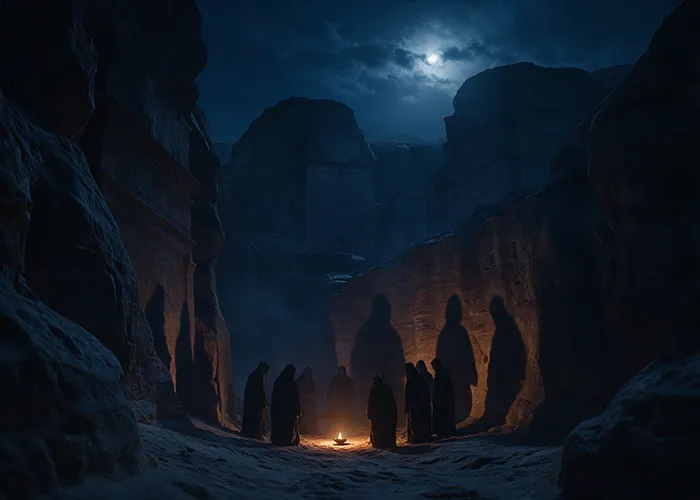
Everlasting Tales of the Quran – Volume 03 Issue 24
The Epic of the Year of the Elephant: The Fall of Abraha’s Army and the Protection of the Kaaba
Yemen: A Battlefield Between Two Great Empires
In the sixth century CE, the world was shaped by the rivalry of two great superpowers: the Eastern Roman (Byzantine) Empire, whose people were predominantly Christian, and the Sasanian Empire of Persia, whose official religion was Zoroastrianism. Yemen was one of the wealthiest and most strategically significant regions of the Arabian Peninsula, and the story of Abraha formed part of a broader geopolitical struggle between the great empires of the age.
Due to its access to both maritime and overland trade routes—including the Spice Route and the Silk Road – Yemen held immense strategic value for both powers. Before Abraha rose to prominence, Yemen was ruled by a Jewish king named Dhu Nuwas, who was fiercely hostile toward the Christian population and subjected them to severe persecution. This event is referenced in the Holy Qur’an in Surah Al-Buruj through the story of the “People of the Ditch” (Ashab al-Ukhdud).
The persecution prompted the Byzantine Empire to encourage the Negus (Najashi), the ruler of Abyssinia (present-day Ethiopia) – the nearest Christian kingdom to Yemen – to intervene militarily in order to protect the Christians and secure influence over this strategically important region. Abraha entered Yemen as one of the commanders of the Abyssinian expeditionary force.
Abraha’s Rebellion and the Reaction of the Negus
Abraha was an extraordinarily ambitious man. Following the defeat of Dhu Nuwas, he was appointed deputy governor of Yemen. However, he was not satisfied with this position. After gaining the support of the military, he overthrew his superior and proclaimed himself the sole ruler of Yemen.
When news of this rebellion reached the Negus, he was enraged. Historical reports state that the Negus swore he would invade Yemen, shave Abraha’s head, and carry away the soil of Yemen as a sign of humiliation.
Abraha, however, was a shrewd politician. By reaffirming his loyalty and agreeing to pay a substantial tribute, he succeeded in appeasing the Abyssinian king. Impressed by his political skill and perhaps tempted by the prospect of receiving considerable tribute, the Negus pardoned him and officially recognized him as the legitimate and autonomous ruler of Yemen.
Al-Qullays Church: An Attempt to Change the Religious Map of Arabia
After consolidating his authority, Abraha began constructing the magnificent Church of Al-Qullays in Sana’a. Historians record that it was adorned with colourful marble, dazzling gold embellishments, and expensive timber imported from Abyssinia.
Through this grand project, Abraha sought both to gain the favour of the Negus and the Byzantine Emperor and to undermine Mecca, which was his greatest commercial and cultural rival to the north. Yet he overlooked one crucial reality: the authenticity of the Arab tribes’ attachment to the Kaaba and their deep emotional connection to it.
For the Arabs, the Kaaba was far more than a stone structure. It was regarded as the legacy of Prophet Abraham (Ibrahim) and a source of immense pride and identity. When Abraha’s economic and cultural efforts failed to redirect pilgrims toward Yemen, he realized that the Kaaba represented a major political obstacle to unifying Arabia under his rule. Consumed by anger, he made a fateful decision: “I shall raze the Kaaba to the ground.”
The March Toward Mecca: Faith Confronts Arrogance
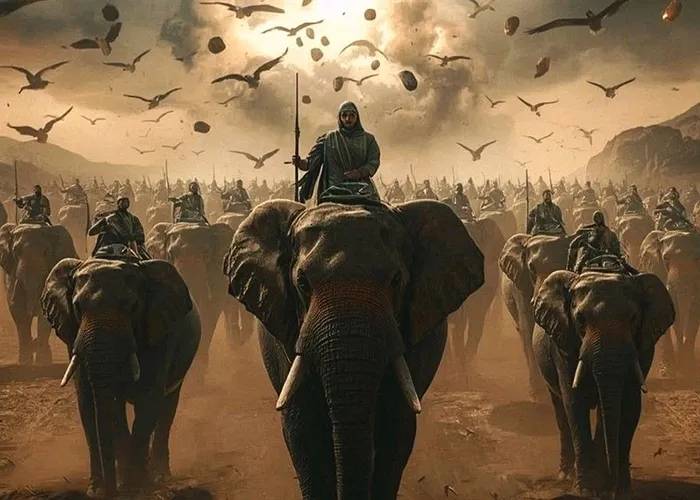
Abraha assembled a vast and unprecedented military force. The most terrifying element of his army was its contingent of massive war elephants, creatures unlike anything the Arabs had ever seen.
As the army approached Mecca, fear spread throughout the city. Along the way, Abraha’s soldiers seized the property of local inhabitants, including two hundred camels belonging to Abd al-Muttalib (peace be upon him), the chief of Mecca and grandfather of the Prophet Muhammad (peace be upon him).
With remarkable dignity and composure, Abd al-Muttalib (peace be upon him) entered Abraha’s camp to request the return of his camels. Struck by his noble appearance and commanding presence, Abraha descended from his throne and sat beside him.
However, when Abd al-Muttalib (peace be upon him) requested only the return of his camels, Abraha mockingly replied: “You speak about your camels, yet you say nothing about the Kaaba, your sacred sanctuary, which I have come to destroy.”
Abd al-Muttalib (peace be upon him) then delivered a response that has echoed through history and shook the foundations of Abraha’s pride:
«أَنَا رَبُّ الْإِبِلِ، وَلِلْبَيْتِ رَبٌّ يَحْمِيهِ»
“I am the owner of the camels, and this House has a Lord who will protect it.”
After recovering his camels, Abd al-Muttalib (peace be upon him) returned to Mecca, grasped the ring of the Kaaba’s door in supplication, and instructed the people to seek refuge in the surrounding mountains, where they would witness the judgment of God.
The Storm of Sijjil and the Fate of the Devoured Stubble
At dawn the following day, Abraha’s army prepared for its final assault. The elephants were directed toward the Kaaba, but to everyone’s astonishment, they refused to advance. No matter what their handlers did, the animals would not move toward the Sacred House. Yet whenever they were turned in the direction of Yemen, they moved swiftly.
At that very moment, the sky above Mecca suddenly darkened.
Flocks upon flocks of small birds, known as Ababil, appeared overhead. The Almighty describes this extraordinary scene in verses 1–3 of Surah Al-Fil:
«أَلَمْ تَرَ كَيْفَ فَعَلَ رَبُّكَ بِأَصْحَابِ الْفِيلِ»
“Have you not seen how your Lord dealt with the Companions of the Elephant?”
«أَلَمْ يَجْعَلْ كَيْدَهُمْ فِي تَضْلِيلٍ»
“Did He not cause their scheme to go astray?”
«وَأَرْسَلَ عَلَيْهِمْ طَيْرًا أَبَابِيلَ»
“And He sent against them flocks of birds.”
These birds carried an unusual weapon. Each bird bore three small stones of hardened baked clay known as sijjil, one in its beak and two in its claws.
The birds flew above the army and released the stones. By divine command, these tiny projectiles struck with miraculous force, piercing armour, horses, elephants, and warriors alike. As stated in verses 4 and 5 of Surah Al-Fil:
«تَرْمِيهِم بِحِجَارَةٍ مِّن سِجِّيلٍ»
“Striking them with stones of baked clay.”
«فَجَعَلَهُمْ كَعَصْفٍ مَّأْكُولٍ»
“Then He made them like chewed-up straw.”
Within moments, Abraha’s mighty army was utterly destroyed. Abraha himself, gravely wounded and physically broken, managed to return to Yemen, where he eventually met a humiliating end. The Kaaba remained completely unharmed, and that year became known in history as the Year of the Elephant (ʿĀm al-Fīl), a year remembered as a symbol of the triumph of truth over falsehood and traditionally associated with the birth of the Prophet Muhammad (peace and blessings be upon him).
Yemen After Abraha
Interestingly, following the destruction of Abraha’s army near Mecca, the rule of his dynasty in Yemen gradually weakened. A few years later, the people of Yemen, having grown weary of the oppression and misrule of Abraha’s successors, sought assistance from the Sasanian Empire of Persia.
Khosrow I Anushirvan, the Persian king, dispatched an army under the command of Vahriz to Yemen. The Persian forces defeated the Abyssinians, and Yemen remained under Persian protection and influence until the emergence of Islam.
Lessons from This Story
This remarkable historical episode is far more than a passing event. It serves as a profound school of spiritual and moral instruction, revealing divine principles in the governance of human affairs. From the rise and fall of the events surrounding the Year of the Elephant, valuable lessons can be drawn for both individual and collective life.
The Futility of Material Power Before the Divine Will
This story reminds humanity not to become arrogant because of wealth, status, or worldly power. By the command of God, even the weakest of creatures can overcome and destroy the mightiest of tyrants.
Wise Reliance Upon God and Understanding One’s Responsibilities
The conduct of Abd al-Muttalib (peace be upon him) teaches an important principle: human beings are obligated to fulfil their responsibilities to the best of their abilities. However, when circumstances move beyond their control, they should place their trust in God and face the future with the serenity that comes from faith rather than with anxiety and despair.
The Power of Authentic Spiritual Bonds Over Material Splendour
The magnificent architecture of the Church of Al-Qullays illustrates that outward grandeur, material attractions, and impressive displays can never replace authenticity, truth, and the deep spiritual and emotional bonds that connect people to what they truly value.
The Fate of Oppression and Evil Schemes
Oppression and attempts to destroy sacred values ultimately lead to self-destruction and ruin. Those who dig pits for others or plot against truth and justice often fall into their own traps before anyone else.
Hope in the Darkest of Times
Even in the most difficult moments of life and during the greatest crises facing a society, hope should never be abandoned. The power of God always extends beyond the apparent dead ends and limitations of human capability.
References
- The Holy Qur’an: Surah Al-Fil (105:1–5), together with references to the historical background in Surah Al-Buruj concerning the People of the Ditch (Ashab al-Ukhdud).
- Tafsir-e Nemuneh (An Exemplar Commentary) by Ayatollah Naser Makarem Shirazi, particularly the commentary on Surah Al-Fil and discussions regarding the historical origins of Al-Qullays Church and the dialogue between Abd al-Muttalib (peace be upon him) and Abraha.
- Tafsir al-Mizan by Allama Sayyid Muhammad Husayn Tabataba’i, especially its examination of historical reports and the circumstances surrounding the revelation of Surah Al-Fil.
- Tarikh al-Rusul wa al-Muluk (History of Prophets and Kings) by Muhammad ibn Jarir al-Tabari, Volume II, in the sections dealing with Abraha’s rule in Yemen and the details of his military expedition against Mecca.
- Al-Sirah al-Nabawiyyah (The Prophetic Biography) by Ibn Hisham, Volume I, including the accounts concerning the lineage of the Prophet Muhammad (peace be upon him), the Year of the Elephant, and the dialogue between Abd al-Muttalib (peace be upon him) and Abraha.
- Furugh-e Abadiyyat (The Eternal Light) by Ayatollah Ja’far Subhani, particularly the introductory chapters discussing pre-Islamic Arabia and the story of the Companions of the Elephant
editor's pick

news via inbox
Subscribe to the newsletter.