Everlasting Tales of the Quran – Volume 03 Issue 22
The Longing for a Child: The Story of Prophet Abraham, Hagar, and Ishmael (peace be upon them)
From the time Prophet Abraham (peace be upon him) and Sarah (peace be upon her) were married, they had no children. They were both remarkably patient people, completely submissive to the Divine Decree; yet they never ceased praying for a child, even as they continued to grow older.
Abraham suggested to Sarah that she give him her maidservant, Hagar, in marriage, so that perhaps God might grant them a child and an heir through her. Sarah agreed, believing it to be a wise decision.
Despite greater efforts and more sincere prayers, many years passed, and still no sign of a child appeared from either woman. Yet they kept hope alive in their hearts, for they knew that God sometimes delays answering the prayers of His most patient servants because He knows they will continue to pray more earnestly and passionately, and He loves to hear the supplications of His servants.
The Answer to Their Prayers
One day Sarah looked at Abraham and said, “You have grown old. Why do you not once again ask God to grant you a child who will be a source of joy for us? God has chosen you as His intimate friend, and if He wills, He will answer your prayer.”
With a heart both broken and renewed with hope, Abraham turned toward the heavens and prayed: «رَبِّ هَبْ لِي مِنَ الصَّالِحِينَ» “My Lord, grant me a righteous child.” God then gave him glad tidings that He would bless him with a forbearing and virtuous son: «فَبَشَّرْنَاهُ بِغُلَامٍ حَلِيمٍ» “So We gave him glad tidings of a gentle and forbearing boy.”
The Birth of Ishmael
Three more years passed before Abraham’s prayer was fulfilled. Contrary to Sarah’s expectation, and to her deep sorrow, the answer to Abraham’s prayer came not through Sarah, but through Hagar. Hagar bore him a son, whom they named Ishmael.
Sarah’s Sorrow
Abraham’s household became filled with joy, yet hidden sorrow grew within Sarah’s heart. Despite her faith and nobility, she felt distressed by what had happened. God, who knows the secrets within the hearts of His servants, willed to create a path toward peace and a greater wisdom. Thus, He commanded Abraham to take Hagar and her infant son to another land – not because they had committed any wrong, but to bring comfort to Sarah on the one hand, and to fulfil the Divine plan concerning Ishmael and his descendants on the other.
Abraham asked, “My Lord, where shall I take them?” God replied, “To My Sacred Sanctuary, to the first place I created upon the earth – to Bakkah.” God sent the angel Gabriel along with a mount called al-Burāq to carry Abraham, Hagar, and Ishmael to Bakkah. Before their departure, Sarah took a pledge from Abraham that he would not dismount at the place where he left them and that he would return to her immediately. Abraham accepted because of the covenant he had made with her when they married.
The Journey to Bakkah
Whenever they passed through a fertile land filled with trees and pasture, Abraham would ask Gabriel, “Is this the place?” Gabriel would answer, “No, we must go farther.” At last, they arrived in Bakkah. Al-Burāq set them down in a barren desert among ruins that looked like a mound of reddish earth.
Because of the promise he had made to Sarah, Abraham remained mounted upon al-Burāq and did not dismount. Hagar looked at him anxiously and said, “O Abraham! Why are you leaving us in a place where there is neither companion, nor water, nor pasture?” With tearful eyes, Abraham replied, “The One who commanded me to leave you here will protect and care for you.” Then he turned toward the House of God and whispered this prayer:
«رَبَّنَا إِنِّي أَسْكَنْتُ مِنْ ذُرِّيَّتِي بِوَادٍ غَيْرِ ذِي زَرْعٍ عِندَ بَيْتِكَ الْمُحَرَّمِ…»
“Our Lord, I have settled some of my descendants in a valley without cultivation, near Your Sacred House…”
Gabriel also said, “Abraham has entrusted you to the One who is sufficient for you.” Then they departed and left them there.
The Search for Water
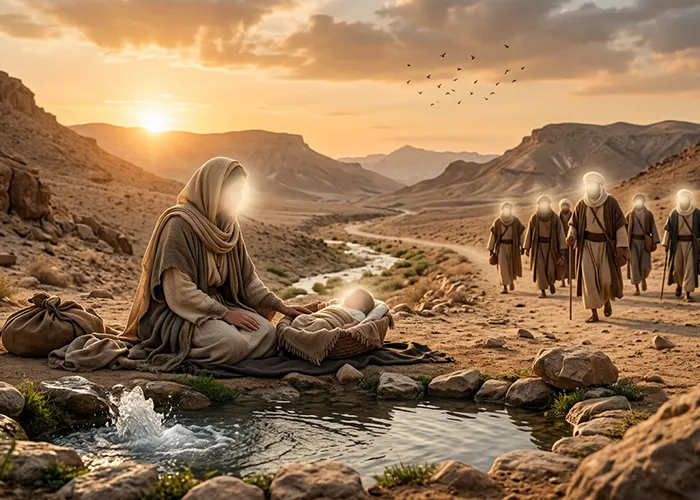
Near those ruins there stood only a withered tree. Hagar used her cloak to make a small shade and laid the child beneath it. As the sun rose higher, Ishmael grew thirsty. In search of water, Hagar climbed the nearest hill, which she later learned was called Ṣafā, and cried out, “Is there any friend in this valley?” From there she could not see Ishmael, so she returned. Then she noticed a mirage on the opposite hill, Marwah, and ran toward it; but when she arrived, she realized it was nothing. Again, she could not see Ishmael, so she returned once more. Seven times she went back and forth between Ṣafā and Marwah. Exhausted and distressed, when she finally returned to Ishmael, she saw water miraculously springing forth and gathering beside his feet. She quickly surrounded it with sand to contain the flow. This water later became known as Zamzam.
The Covenant with Jurhum
In the plain near ‘Arafāt, the nomadic tribe of Jurhum had encamped. They noticed birds circling in the distance and realized there must be water there. They sent several men to investigate. They found Hagar and Ishmael beside a spring and asked, “Who are you?” Hagar replied, “I am the servant of Abraham, the Friend of God, and this is his son. God commanded him to leave us here.” They asked, “Would you permit us to settle near you?” Hagar answered, “Until Abraham returns, I allow it.” Three days later Abraham returned to visit them. Hagar asked his permission, and he gladly agreed. Then he prayed:
«رَبِّ اجْعَلْ هذا بَلَداً آمِناً وَ ارْزُقْ أَهْلَهُ مِنَ الثَّمَراتِ مَنْ آمَنَ مِنْهُمْ بِاللَّـهِ وَ الْيَوْمِ الْآخِرِ قالَ وَ مَنْ كَفَرَ فَأُمَتِّعُهُ قَلِيلاً ثُمَّ أَضْطَرُّهُ إِلى عَذابِ النَّارِ وَ بِئْسَ الْمَصِيرُ» (البقرة ۱۲۶)
“My Lord, make this a secure city and provide its people those who believe in God and the Last Day—with fruits and sustenance.” God replied: “And whoever disbelieves, I shall let him enjoy for a little while, then I shall drive him to the punishment of the Fire and wretched is that destination.”
The tribe of Jurhum settled in Bakkah and became a source of comfort and support for Hagar. Each family of Jurhum gifted a sheep to Ishmael. This growing flock sustained Hagar and Ishmael until Ishmael grew older and became capable of managing his own livelihood.
Caravans that had once avoided Bakkah because of the lack of water now saw birds and signs of the spring. Hagar and Ishmael provided them with water and, in return, received food and necessary supplies. This brought joy to Abraham and Hagar, for from the very first day God had fulfilled His promise to care for them.
Abraham’s Dream
Abraham loved Ishmael deeply and regarded him as his only inheritance. One night he saw in a dream that he must do something impossible for any human being to bear. In the morning he awakened his son and said: «يَا بُنَيَّ إِنِّي أَرَىٰ فِي الْمَنَامِ أَنِّي أَذْبَحُكَ فَانظُرْ مَاذَا تَرَىٰ» “My son, I have seen in a dream that I must sacrifice you. What do you think?”
Because Abraham was a prophet, his dreams were divine revelation, and he knew this was a command from God. Yet since God was testing him, he also wished to test his son. With astonishing calmness, Ishmael replied: «يَا أَبَتِ افْعَلْ مَا تُؤْمَرُ ۖ سَتَجِدُنِي إِن شَاءَ اللَّهُ مِنَ الصَّابِرِينَ» “Father, do as you are commanded. God willing, you will find me among the patient.”
He did not hesitate even for a moment. Though still young, he knew who his father was, and who God was, and he understood that God sees wisdom where human beings cannot. Then he added, “I ask only that you tie up my hands and feet so that I do not struggle; gather up your clothes so my blood will not stain them, and my mother will not see it; sharpen the blade and pass it swiftly across my throat so death may be easier for me, for death is difficult.”
With tearful eyes Abraham said, “What a magnificent helper you are to me in fulfilling God’s command.”
Satan’s Conversation with Abraham
Abraham and Ishmael set out toward Minā under the pretence of gathering firewood, for God had commanded that the sacrifice be performed there. Along the way, Satan appeared in the form of an old man and said, “O Abraham, what do you intend to do with this boy?” Abraham replied, “I must sacrifice him.” The old man exclaimed, “Glory be to God! Would you kill a boy who has committed no sin?” Abraham answered, “God has commanded me.” The old man said, “No, God forbids such a thing. It is Satan who commands you to do this.” Abraham replied, “No. The One who raised me to this station is the One who commanded me. I will speak with you no further.”
When they reached Minā, the old man spoke again: “O Abraham! You are a leader, and people follow your example. If you kill your son, others will kill their sons as well.” But Abraham had resolved to obey only God’s command. Then the old man disappeared.
Satan’s Conversation with Hagar
Meanwhile Hagar was occupied with her tasks when the same old man approached her and said, “Do you know what that old man I saw is doing?” Hagar replied, “He is my husband and the boy with him is my son.” The old man said, “I saw that old man lay your son upon the ground and place a blade upon his throat to sacrifice him!” Hagar answered, “You are lying. Abraham is the most merciful of people. How could he sacrifice his own son?” The old man swore, “By the Lord of the heavens and the earth and the Lord of this sanctuary, I saw him lay your son on the ground and place a knife upon his throat.” Hagar asked, “Why would he do such a thing?” The old man replied, “He believes his Lord commanded him to do it.” Calmly Hagar said, “Then he is right to obey his Lord.”
The Sacrifice of Ishmael
At Minā, Abraham bound Ishmael’s hands and feet and gathered his garments as Ishmael had requested. He sharpened the blade and turned Ishmael’s face toward the ruins of the Ka‘bah. With tearful eyes and a steadfast heart, he drew the blade across his son’s throat. He expected to witness the signs of death, but to his amazement, the blade did not cut, and Ishmael remained calm and unharmed. At that very moment, a call came from God: «يَا إِبْرَاهِيمُ قَدْ صَدَّقْتَ الرُّؤْيَا»“O Abraham! You have fulfilled the vision.”
Then God said: «وَفَدَيْنَاهُ بِذِبْحٍ عَظِيمٍ» “And We ransomed him with a mighty sacrifice.”
“We subjected you to a severe trial so that you would be prepared for the greatest rewards in Paradise. This was the clear test I promised you years ago when I said: I shall grant you a forbearing son, and then I shall test your obedience through him.”
The Ram Sent in His Place
Gabriel brought a magnificent ram from Mount Thabīr and presented it to Abraham. Gabriel told him that this noble animal would replace Ishmael as the sacrifice offered to God. Overwhelmed with relief and joy, Abraham untied his son and embraced him with eyes filled with tears of happiness. Then together they sacrificed the ram and praised God.
The Highest Rank
From almost the beginning of his life, Abraham faced some of the hardest trials any human being could endure. As a child he was forced to live in a cave. He was cast into a massive fire. He was driven away from his family and homeland. Until old age he was denied the blessing of children, and when at last he was granted a son, he was commanded to sacrifice him. Yet throughout all these trials, Abraham remained unwavering in his devotion to God. God rewarded him accordingly: He made him first a prophet, then a messenger, and then His intimate friend (Khalīl).
After this great trial, God granted Abraham an even higher station and made him a leader for humanity: «إِنِّي جَاعِلُكَ لِلنَّاسِ إِمَامًا» “Indeed, I am making you an Imam and leader for mankind.” Abraham asked: «قَالَ وَمِن ذُرِّيَّتِي» “And from my descendants as well?” God replied: «قَالَ لَا يَنَالُ عَهْدِي الظَّالِمِينَ» “My covenant does not extend to the wrongdoers among them.”
Thus, God promised him that there would indeed be leaders among his descendants, while also informing him that some among his progeny would become unjust and would therefore be deprived of this exalted station.
Enduring Lessons from This Story:
- Beautiful Patience and Hope Without Despair
Perseverance in prayer: Abraham (peace be upon him) and Sarah (peace be upon her) waited many years for a child, and despite their old age, they never stopped praying. This teaches us not to lose hope too quickly before God. The wisdom behind delayed answers: Sometimes God delays answering prayers so that His servant may continue speaking intimately with Him, for God loves hearing the voices of His servants.
- Complete Submission to Divine Decree (The True Meaning of Islam)
Contentment with God’s command: Abraham, Hagar, and Ishmael embodied the highest level of submission. When Hagar learned that the command came from God, she became calm. When Ishmael was told he was to be sacrificed, he said: “You will find me among the patient.” This shows that true peace is attained through surrendering to God’s wisdom.
- Faithfulness to Covenants and Promises
Commitment in married life: Although Prophet Abraham (pbuh) was one of the greatest prophets, he remained faithful to the promise he had made to Sarah at the time of their marriage. Even when leaving Hagar and Ishmael in Bakkah, he did not dismount from his ride so as to honour his promise to Sarah. This is a profound lesson in preserving ethics and loyalty within the family.
- Absolute Trust in God and Its Reward in the Hardest Circumstances
Alone in a barren desert: Leaving a wife and infant in a dry valley without water or vegetation appeared, materially speaking, to mean certain death. Yet Abraham and Hagar’s trust in God transformed that barren land into the flowing spring of Zamzam and a refuge for caravans the city of Mecca.
God’s sufficiency: As Gabriel said, whoever entrusts themselves to God will find Him sufficient: «حَسْبُنَا اللَّهُ وَنِعْمَ الْوَکِیلُ»“Allah is sufficient for us, and He is the best disposer of affairs.”
- Effort and Action Alongside Trust in God
The striving between Safa and Marwah: Despite her reliance on God, Hagar did not remain passive. She ran seven times between the two hills searching for water. The miracle of Zamzam occurred only after she had exhausted all human effort. This teaches us that miracles come after effort not instead of it.
- Raising a Righteous and Courageous Child
The character and faith of Ishmael (pbuh): Ishmael’s response to his father upon hearing about the sacrifice reflects the pinnacle of divine upbringing. Not only did he refrain from protesting or fleeing, but he even suggested ways to make the task easier for his father (such as sharpening the blade and gathering his clothes). This highlights the importance of lawful sustenance and monotheistic upbringing.
- Vigilance Against Satan’s Temptations
Recognizing the enemy in critical moments: Satan approached Abraham, Hagar, and Ishmael at the most emotional and sensitive moments — disguised as an old man — attempting to plant doubt in their hearts through arguments such as the innocence of the child, maternal emotions, and fear of people’s judgment. Yet all three firmly rejected him. This teaches us that on the path of truth, we must close our ears to Satan’s seemingly “reasonable” whispers.
- The Philosophy Behind Divine Tests
Tests as a means of elevation: God had no need for Ishmael’s life or blood. Rather, He wished to test Abraham’s heart to see whether his love for Ishmael had surpassed his love for God. The moment Abraham proved through action that he loved God more than his son, the trial ended. The difficult tests in life are not meant to destroy us, but to refine and purify us.
- Leadership (Imamate) Is a Covenant Beyond Blood Relations
The station of leadership and the condition of justice: At the end of the story, when Abraham attained the مقام of Imamate and asked for it to continue among his descendants, God explicitly declared:
“My covenant does not extend to the wrongdoers.” This is a profound social and political lesson: divine and lofty positions are not inherited through lineage or favouritism, but are granted based on piety, merit, and justice.
Sources of This Story:
- Surah As-Saffat, verses 100 onward
- Surah Ibrahim, verse 37
- Surah Al-Baqarah, verses 124–129
- Tafsir al-Qummi, Ali ibn Ibrahim, vol. 1, p. 94
- Bihar al-Anwar, vol. 12, p. 131
- Al-Kafi, vol. 4, Book of Hajj, chapter on the history of the Kaaba
- ‘Ilal al-Shara’i, Shaykh al-Saduq, vol. 2, p. 423
- Tafsir Majma‘ al-Bayan, Shaykh al-Tabarsi, vol. 1, p. 203
editor's pick

news via inbox
Subscribe to the newsletter.