Everlasting Tales of the Quran – Volume 03 Issue 30
The Epic Life of Prophet Aaron (Harun): From Pharaoh’s Palace to Mount Hor
The remarkable and eventful life of Prophet Aaron (Harun, pbuh), the elder brother of Prophet Moses (Musa, pbuh), is the story of a man who, from the heart of ancient Egypt to the vast wilderness of Sinai, became a symbol of loyalty, eloquence, patience under injustice, and wise leadership in times of crisis. It is the story of two devoted brothers whose united mission brought the mighty empire of Pharaoh to its knees and enabled them to stand firm against some of the greatest trials faced by the Children of Israel.
The Almighty praises these two brothers in the Qur’an:
“وَلَقَدْ مَنَنَّا عَلَىٰ مُوسَىٰ وَهَارُونَ * وَنَجَّيْنَاهُمَا وَقَوْمَهُمَا مِنَ الْكَرْبِ الْعَظِيمِ”
“Indeed, We bestowed Our favor upon Moses and Aaron, and We delivered them and their people from the great distress.”
(Qur’an 37:114–115)
The Beginning of the Mission: Moses’ Prayer and the Virtues of Aaron
When Prophet Moses (pbuh) was commissioned on Mount Sinai to confront the tyrannical Pharaoh, he was granted the miracles of the staff and the shining hand. Yet he knew that overthrowing Pharaoh’s regime required more than miracles alone. He needed a powerful spokesman-a clear and persuasive voice-to convey God’s message with eloquence so that Pharaoh would not ridicule him because of his speech impediment.
He therefore turned to God in prayer; a supplication beautifully recorded in Surah Ta-Ha. After asking God to grant him confidence and ease in his mission, he prayed that his brother Aaron be appointed as his minister and supporter, trusting fully in Aaron’s eloquence and abilities:
“وَاجْعَلْ لِي وَزِيرًا مِنْ أَهْلِي ، هَارُونَ أَخِي ، اشْدُدْ بِهِ أَزْرِي ، وَأَشْرِكْهُ فِي أَمْرِي”
“And appoint for me a minister from among my family-Aaron, my brother. Strengthen me through him and let him share in my mission.”
(Qur’an 20:29–32)
Elsewhere, Moses explicitly acknowledges Aaron’s gift of eloquence:
“وَأَخِي هَارُونُ هُوَ أَفْصَحُ مِنِّي لِسَانًا فَأَرْسِلْهُ مَعِيَ رِدْءًا يُصَدِّقُنِي ۖ إِنِّي أَخَافُ أَنْ يُكَذِّبُونِ”
“My brother Aaron is more eloquent in speech than I am. So, send him with me as my supporter to confirm my words, for I fear that they will deny me.”
(Qur’an 28:34)
God’s Response and the Beginning of a Shared Mission
God knew the sincerity of Moses and the exceptional qualities of Aaron. Aaron had remained in Egypt among the Children of Israel. He was known as a man of wisdom, gentle character, remarkable eloquence, and deep affection among his people.
God immediately answered Moses’ prayer and relieved him of the burden of facing Pharaoh alone:
“قَالَ قَدْ أُوتِيتَ سُؤْلَكَ يَا مُوسَىٰ”
“He said, ‘Your request has been granted, O Moses.”
(Qur’an 20:36)
In another verse, God responds in even more encouraging words:
“قَالَ سَنَشُدُّ عَضُدَكَ بِأَخِيكَ وَنَجْعَلُ لَكُمَا سُلْطَانًا فَلَا يَصِلُونَ إِلَيْكُمَا ۚ بِآيَاتِنَا أَنتُمَا وَمَنِ اتَّبَعَكُمَا الْغَالِبُونَ”
“He said, ‘We shall strengthen your arm through your brother, and We shall grant both of you authority, so they will not be able to harm you. By Our signs, you and those who follow you shall be victorious.”
(Qur’an 28:35)
According to Islamic tradition, God revealed to Aaron in Egypt that he should go out to meet his brother. Aaron welcomed Moses with complete sincerity, showing not the slightest trace of jealousy, rivalry, or desire for status, despite the fact that his younger brother had been chosen as the principal messenger.
Aaron embodied gentleness, patience, wisdom, and persuasive speech. Together, the two brothers entered Pharaoh’s palace and challenged the foundations of his oppressive empire. Through powerful arguments and unwavering proclamation of God’s oneness, they confronted Pharaoh until, by God’s will, the Children of Israel were finally delivered from his tyranny.
Moses’ Absence and Aaron’s Greatest Test: The Trial of the Samiri
After Pharaoh’s destruction, the miraculous crossing of the sea, and the settlement of the Children of Israel in the Sinai wilderness, Moses departed for Mount Sinai for a thirty-day communion with God. Before leaving, he entrusted the leadership of the community to his brother, as the Qur’an states:
“…وَقَالَ مُوسَىٰ لِأَخِيهِ هَارُونَ اخْلُفْنِي فِي قَوْمِي وَأَصْلِحْ وَلَا تَتَّبِعْ سَبِيلَ الْمُفْسِدِينَ”
“…And Moses said to his brother Aaron, ‘Take my place among my people, maintain righteousness, and do not follow the way of those who spread corruption.'”
(Qur’an 7:142)
By God’s command, however, Moses’ absence was extended by ten more days, making a total of forty. During this period, Aaron served as the recognized leader of the Children of Israel. The prolonged absence created the conditions for a grave trial.
The Deviation of the Children of Israel and Aaron’s Firm Stand
During Moses’ absence, a deceitful man known as the Samiri, a skilled craftsman, exploited the people’s uncertainty by spreading the rumour that Moses had abandoned them.
He collected their gold ornaments, melted them down, and fashioned a golden calf. According to the Qur’an, it was: “عِجْلًا جَسَدًا لَهُ خُوَارٌ” “a calf in the form of a body that emitted a lowing sound” (Qur’an 20:88). Islamic tradition explains that he had constructed hidden passages inside the statue so that when the wind passed through them, it produced a sound resembling the mooing of a living calf.
Having lived for many years under Pharaoh’s rule, the Children of Israel had been deeply influenced by Egyptian religious culture, including the veneration of the sacred Apis bull. Captivated by this impressive visual and auditory spectacle, many of them lost their judgment, gathered around the calf, and were persuaded to worship it.
Aaron stood firmly against this grave deviation and called out to them:
“وَلَقَدْ قَالَ لَهُمْ هَارُونُ مِنْ قَبْلُ يَا قَوْمِ إِنَّمَا فُتِنْتُمْ بِهِ ۖ وَإِنَّ رَبَّكُمُ الرَّحْمَٰنُ فَاتَّبِعُونِي وَأَطِيعُوا أَمْرِي”
“Aaron had already said to them, ‘O my people, you are only being tested through this. Indeed, your Lord is the Most Merciful. So follow me and obey my command.”
(Qur’an 20:90)
But the tide of temptation had blinded reason. Aaron remained beloved only so long as he did not oppose the people’s desires. The moment he stood against their passions, the very people who had admired him turned against him, threatening him with death.
Aaron found himself facing an agonizing dilemma. He could lead the faithful minority into civil war-a conflict that might have ended in the destruction of the entire nation-or he could exercise patience in order to preserve the unity of the community until Moses returned.
Choosing the latter, Aaron endured the hardship with remarkable restraint. To prevent division and bloodshed, he patiently managed the crisis and preserved what remained of the community until his brother’s return.
Moses’ Angry Return and Aaron’s Defence
When Moses (pbuh) returned carrying the Tablets of the Torah and found his people worshipping the golden calf, he was overcome with righteous anger. His first reaction was to confront Aaron, seizing him by the head and pulling him toward himself. In the midst of this painful ordeal, Aaron responded with humility and composure, saying:
“…قَالَ ابْنَ أُمَّ إِنَّ الْقَوْمَ اسْتَضْعَفُونِي وَكَادُوا يَقْتُلُونَنِي فَلَا تُشْمِتْ بِيَ الْأَعْدَاءَ وَلَا تَجْعَلْنِي مَعَ الْقَوْمِ الظَّالِمِينَ”
“…He said, ‘O son of my mother! Indeed, these people overpowered me and were on the verge of killing me. So do not let my enemies rejoice over me, and do not count me among the wrongdoing people.”
(Qur’an 7:150)
Aaron also explained why he had refrained from using force against the rebels:
“قَالَ يَا ابْنَ أُمَّ لَا تَأْخُذْ بِلِحْيَتِي وَلَا بِرَأْسِي ۖ إِنِّي خَشِيتُ أَنْ تَقُولَ فَرَّقْتَ بَيْنَ بَنِي إِسْرَائِيلَ وَلَمْ تَرْقُبْ قَوْلِي”
“He said, ‘O son of my mother! Do not seize me by my beard or by my head. I feared that you would say: “You have caused division among the Children of Israel and did not heed my instruction.” (Qur’an 20:94)
With these words, Moses realized that his brother had done everything within his power and that the true instigator of the corruption was the Samiri. Moses then prayed for both himself and his brother:
” قَالَ رَبِّ اغْفِرْ لِي وَلِأَخِي وَأَدْخِلْنَا فِي رَحْمَتِكَ ۖ وَأَنْتَ أَرْحَمُ الرَّاحِمِينَ”
“He said, ‘My Lord, forgive me and my brother, and admit us into Your mercy, for You are the Most Merciful of the merciful.”
(Qur’an 7:151)
A Solitary Passing on Mount Hor
Years later, during the long period in which the Children of Israel wandered in the wilderness, Aaron’s earthly life drew to its close. According to Islamic tradition, God revealed to Moses that he should take his brother to Mount Hor, where Aaron’s soul would be taken.
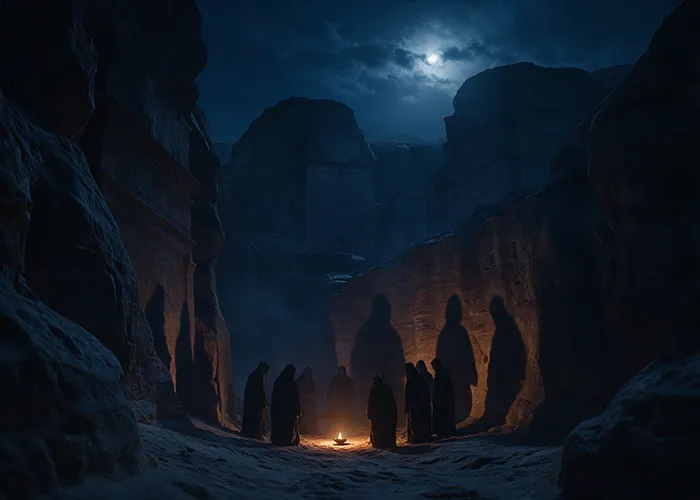
The two brothers ascended the mountain together. There they came upon a wondrous chamber containing a magnificent bed covered with beautiful furnishings, from which emanated a heavenly fragrance.
Seeing this place of serenity, Aaron said, “My brother, I am weary. How comforting this bed appears. I would like to rest upon it.”
Moses replied, “Then rest.”
As Aaron lay down upon the bed, the Angel of Death appeared. Aaron turned to Moses and said, “My brother, it seems that my appointed time has come. Surrender me to the will of God.”
Moses embraced his beloved brother as Aaron’s blessed soul departed peacefully from his body. Then, according to the narration, the chamber and the bed ascended into the heavens and disappeared. After his passing, the angels washed and shrouded Aaron’s body, and he was buried on Mount Hor.
The People’s Accusation and the Testimony of the Angels
Because of his gentle character, compassion, and kindness, Aaron was deeply loved by the Children of Israel. When Moses returned alone from the mountain, old resentments and the habitual suspicion of some among the Israelites resurfaced. A number of them accused Moses of having killed his own brother, believing that Aaron had been more beloved by the people.
To establish the truth, God brought forth a miracle so that everyone would know that Aaron had died naturally by God’s decree and that Moses bore no responsibility whatsoever for his death. Once the truth became evident, Moses was vindicated, and the Children of Israel mourned Aaron’s passing.
Islamic tradition preserves two narrations concerning this miracle:
- According to the first narration, God commanded the angels to bring Aaron’s body before the people upon a bier. A heavenly proclamation then declared that Aaron had died a natural death by God’s decree, thereby confirming Moses’ innocence.
- According to the second narration, God brought the people to Aaron’s grave, and by God’s permission Aaron spoke from within his grave, confirming the truthfulness of Moses’ account and clearing him of every accusation.
Lessons and Reflections
- The importance of teamwork and institutional leadership: Great missions are not accomplished by isolated individuals. Building trustworthy teams and cultivating capable assistants has always been the way of God’s prophets.
- The courage of self-awareness and humility: Despite his exalted rank, Moses openly acknowledged his own limitation in speech and recognized his brother’s superior eloquence so that God’s message could be conveyed in the most effective manner.
- Freedom from jealousy: Aaron accepted, without the slightest trace of rivalry or envy, the role of minister and supporter to his younger brother, dedicating all of his abilities to the success of their shared mission.
- Preserving the unity of the community: Aaron’s response to the crisis of the golden calf demonstrates that, at times, preventing civil strife and preserving the very existence of the community requires patience rather than armed confrontation.
- Temptation can blind reason: The story of the Samiri illustrates how, during periods of social upheaval, intense emotions, rumours, and powerful visual and auditory spectacles can overwhelm rational judgment. In such circumstances, guiding people back to the truth demands both steadfastness and patience.
Selected Sources
A. Qur’anic References
- Surah Ta-Ha (20): Verses 11–36 (the call at the sacred valley, Moses’ prayer, and Aaron’s appointment as his minister); verses 90–94 (Aaron’s confrontation with the Samiri and his dialogue with Moses).
- Surah Al-Qasas (28): Verses 34–35 (Moses’ acknowledgment of Aaron’s eloquence and his request for Aaron’s assistance).
- Surah Ash-Shu’ara (26): Verses 11–15 (Moses’ concern regarding his speech and God’s reassurance).
- Surah Al-A’raf (7): Verses 150–151 (Aaron’s explanation to Moses and Moses’ prayer for forgiveness).
- Surah Az-Zukhruf (43): Verse 52 (Pharaoh’s mockery of Moses’ speech).
B. Shi’a Classical Sources
- Shaykh al-Saduq, ‘Ilal al-Shara’i’, Vol. 1, p. 68, Chapter 53: narration from Imam Ja’far al-Sadiq concerning the ascent of Mount Hor, the passing of Aaron, and the accusation made by the Children of Israel.
- Allama al-Majlisi, Bihar al-Anwar, Vol. 13, p. 366, Hadith 7 (Kitab Tarikh al-Anbiya’), relating the accounts of Moses and Aaron.
- Al-Tabarsi, Majma’ al-Bayan: commentary on the relevant verses of Surahs Ta-Ha and Az-Zukhruf, including the account of Moses’ childhood and the incident of the burning coal in Pharaoh’s palace.
- Allama al-Tabataba’i, Tafsir al-Mizan, Vols. 14 and 16: theological analysis of Aaron’s ministry and his leadership during the crisis of the golden calf.
- Tafsir al-Qummi: by Ali ibn Ibrahim al-Qummi, Vol. 1, p. 169 (under the commentary of Surah al-Ma’idah, discussing the wandering of the Children of Israel in the wilderness of Tih and the passing of Aaron and Moses, peace be upon them).
- Majma’ al-Bayan Exegesis: by Allama al-Tabarsi, under the verses related to the wilderness of Tih.
- Al-Huwayzi, Tafsir Nur al-Thaqalayn, Vol. 2, p. 541: narrations concerning the Israelites’ wandering in the wilderness.
editor's pick

news via inbox
Subscribe to the newsletter.