Everlasting Tales of the Quran – Volume 03 Issue 26
The Story of the Descent (Hubut) of Adam and Eve (Peace Be Upon Them)
Human beings, as seekers of truth, have always endeavored to understand the origins of their existence and the mystery of creation. The story of Adam and Eve (peace be upon them), as the beginning of human life, occupies a unique place in the history of creation. The Holy Qur’an addresses this subject repeatedly and from various perspectives, elucidating its different dimensions.
In this section of The Everlasting Tales of the Qur’an, we examine the story of the descent of Adam and Eve (peace be upon them): what transpired after Iblis (Satan) disobeyed God and was expelled from the Divine Presence, and how these events ultimately led to the descent of Adam and Eve to the earth and their entry into the material world.
The Privileges Granted to Iblis in Light of Divine Justice
When Iblis was expelled from the Divine Presence, he appealed to God’s justice and said, “What will become of my long years of worship?” God replied, “My justice does not allow anyone’s due to be wasted. In return for those acts of worship, ask for whatever worldly powers you desire.”
Iblis requested a number of privileges, and in accordance with Divine Justice, God granted him certain abilities. Among them were:
- A prolonged lifespan until the Appointed Day.
- The power to tempt and influence the hidden dimensions of human beings.
- The ability to multiply his offspring extensively.
- The capacity to remain unseen and to assume different forms.
- The ability to tempt people from various directions.
- Participation in people’s wealth and children by leading them toward unlawful acts.
The Divine Balance: Humanity’s Superiority over Satan
Upon seeing these powers, Adam (peace be upon him) asked God how his descendants would be able to withstand such an enemy. God, in His mercy, granted humanity blessings far greater and more effective:
- Multiplication of rewards for good deeds, while each sin is recorded only once.
- Reward for a righteous intention, even if it is never carried out.
- The door of repentance remaining open until the final moments of life.
- Forgiveness of sins through seeking Divine pardon.
- The companionship and support of God’s angels.
- The gift of intellect and a God-seeking innate nature (fitrah), over which Satan has no authority.
- The possibility of seeking intercession and benefiting from the mediation of God’s chosen servants.
Conclusion
Satan was given many outward and quantitative tools, but God granted humanity qualitative and destiny-shaping treasures such as intellect, repentance, mercy, multiplied rewards, and spiritual intercession.
For this reason, the Holy Qur’an declares:
“إِنَّ كَيْدَ الشَّيْطَانِ كَانَ ضَعِيفًا“
“Indeed, the scheme of Satan has always been weak.”
(Surah An-Nisā’, 4:76)
For in comparison with the vastness of Divine mercy and guidance, Satan’s power is never absolute or invincible.
Once this balance of power had been established and Iblis had received his arsenal of temptations, the stage was set for one of the most significant dramas in the history of creation a test that would send humanity from the secure cradle of heaven into the complex battlefield of earth.
Descent (Hubut): A Fall or an Ascent?
The Heavenly Quarantine: Training Before Flight
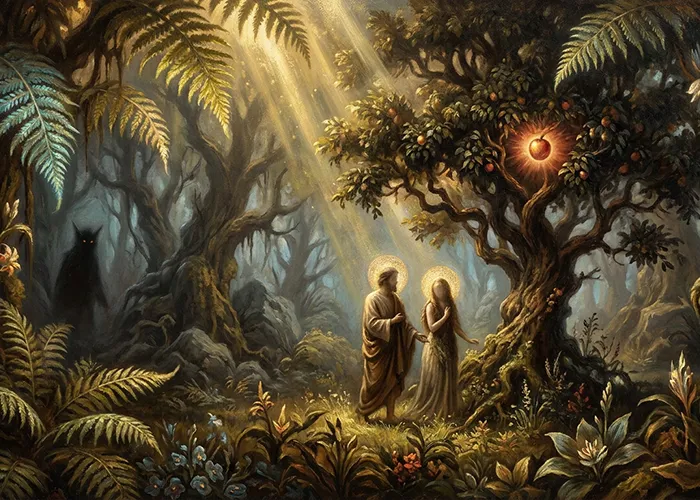
After creating Adam and Eve, God settled them in a magnificent, lush, and carefree garden—a heavenly, intermediary paradise where there was neither biting cold nor oppressive heat, neither hunger nor sorrow.
The Compassionate Lord said to them:
“The entire garden is at your disposal. Eat and drink freely and pleasantly from wherever you wish…”
Yet in one corner of this paradise stood a single prohibition sign a brief command and a great test:
«وَلَا تَقْرَبَا هَٰذِهِ الشَّجَرَةَ فَتَكُونَا مِنَ الظَّالِمِينَ»
“And do not approach this tree, lest you become among the wrongdoers.”
(Surah Al-Baqarah, 2:35)
In various narrations, this forbidden tree is sometimes identified as wheat, sometimes as an apple, and in a deeper spiritual sense as the tree associated with knowledge and envy regarding the exalted rank of the Family of Muhammad (peace be upon them).
This prohibition was the touchstone of human free will. Humanity had been created for life on earth, but before descending into the earthly realm, Adam needed an intensive period of preparation. He had to encounter his enemy in a controlled environment.
Infiltrating the Fortress: Iblis’ Psychological Warfare
Iblis, who had been expelled because of Adam, harbored boundless resentment. He swore to destroy this new masterpiece of God.
There was, however, one obstacle: he had no right to enter that pure paradise openly. According to narrations, Iblis resorted to deception. Using his ability to assume different forms, he disguised himself as a beautiful creature or, according to some interpretations, entered hidden within the mouth of a serpent or deceived the peacock and thus gained access to Adam and Eve.
He immediately launched a psychological assault, targeting two profound and natural human desires: the longing for immortality and the attraction to supreme power.
In a gentle and seemingly sincere tone, he said:
“Do you know why God has forbidden you from this tree? Only because if you eat from it, you will become powerful angels, or you will attain eternal life, and no one will ever be able to expel you from here.”
(Surah Al-A‘rāf, 7:20)
At first, Adam and Eve resisted. But then Iblis delivered his decisive blow: he swore falsely by the Name of God. Having lived among truthful angels, Adam and Eve could not imagine that any creature would dare swear falsely by God Himself. They assumed this being must genuinely care for their welfare if he was invoking God’s Name on their behalf.
Tasting the Fruit and the Collapse of the Heavenly Veil
Eve, and then Adam, reached out and tasted the forbidden fruit. The moment its taste penetrated their being, a tremendous transformation overtook them:
- Their luminous heavenly garments fell away.
- Material awareness emerged, and for the first time they became conscious of their physical nakedness and bodily nature.
Filled with shame and modesty, they hurried about, gathering broad leaves from the trees of Paradise (such as fig leaves) to cover themselves. Then a voice resounded throughout Paradise:
«أَلَمْ أَنْهَكُمَا عَنْ تِلْكُمَا الشَّجَرَةِ…؟!»
“Did I not forbid you from that tree and tell you that Satan is your manifest enemy?”
(Surah Al-A‘rāf, 7:22)
Ashamed and trembling, Adam and Eve realized their mistake. Unlike Iblis, who responded to sin with arrogance, they immediately humbled themselves and said:
«قَالَا رَبَّنَا ظَلَمْنَا أَنْفُسَنَا وَإِنْ لَمْ تَغْفِرْ لَنَا وَتَرْحَمْنَا لَنَكُونَنَّ مِنَ الْخَاسِرِينَ»
“Our Lord! We have wronged ourselves, and if You do not forgive us and have mercy upon us, we will surely be among the losers.”
(Surah Al-A‘rāf, 7:23)
The Command to Descend to Earth
The now-materialized bodies of Adam and Eve were no longer compatible with the pure and subtle nature of Paradise.
The heaviness of matter drew them toward the earth. Then the decisive Divine command was issued:
«اهْبِطُوا بَعْضُكُمْ لِبَعْضٍ عَدُوٌّ وَلَكُمْ فِي الْأَرْضِ مُسْتَقَرٌّ وَمَتَاعٌ إِلَىٰ حِينٍ»
“Descend, all of you, while being enemies to one another; and on the earth you shall have a dwelling place and provision for a time.”
(Surah Al-Baqarah, 2:36)
Adam and Eve were cast down from that verdant height to the dark soil of earth.
Ancient narrations describe that:
- Adam (peace be upon him) descended upon Mount Safa in present-day Makkah.
- Eve (peace be upon her) descended upon Mount Marwah.
- Iblis was cast down in a distant and inhospitable region.
Tears Upon the Earth and the Activation of the Lifeline of Mercy
Earth was dark and rugged. Unlike Paradise, obtaining even a morsel of food required effort and toil.
Adam fell upon the ground and wept bitterly. Commentaries state that he remained in prostration for years according to some reports forty days, and according to others even longer crying out of remorse for violating God’s command.
It was then that God activated the great privilege He had previously promised.
The angel Gabriel descended and taught Adam certain sacred words.
Surah Al-Baqarah, verse 37 states:
«فَتَلَقَّىٰ آدَمُ مِنْ رَبِّهِ كَلِمَاتٍ فَتَابَ عَلَيْهِ»
“Then Adam received words from his Lord, and He accepted his repentance.”
What were these words?
According to well-known narrations, Gabriel taught Adam to invoke God through these blessed names:
“يا حميدُ بحقِّ محمد، يا عاليُ بحقِّ علي، يا فاطرُ بحقِّ فاطمة، يا محسنُ بحقِّ الحسن و يا قديمَ الاحسان بحقِّ الحسين…”
“O Praiseworthy One, for the sake of Muhammad; O Most High, for the sake of Ali; O Creator, for the sake of Fatimah; O Beneficent One, for the sake of Hasan; O Eternal Source of Goodness, for the sake of Husayn…”
Adam uttered these names while weeping.
When he reached the name of Husayn (peace be upon him), his heart broke and his tears flowed more intensely.
He asked, “Gabriel, who is this final light whose name has filled my heart with sorrow?”
Gabriel then related to Adam the tragedy of Karbala, and Adam wept upon the earth for his future descendant.
In honor of these sacred lights and Adam’s sincere humility, God forgave him and chose him as the first prophet upon the earth.
Educational Reflection: What Is the Philosophy of the Descent?
Contrary to common assumptions, the descent (Hubut) was not a punishment or a penalty; it was God’s original plan.
Before creating Adam, God had already declared:
“I am placing a vicegerent upon the earth.”
Therefore, Adam belonged to the earth from the very beginning.
The initial paradise served as a training simulation so that humanity, before entering the real world, could:
- Experience the delight of Paradise and thus always long for its true home and strive to return.
- Learn the tactics of its enemy, Iblis.
- Understand that the governing law of this world is the law of choice and responsibility.
Humanity came to earth in order to ascend, through free will, the ladder of perfection in the difficult school of nature overcoming desire, anger, and satanic temptation and ultimately attain a Paradise far greater than the first: a Paradise earned through devotion, struggle, and faithful servitude.
Sources and Narrational References
- Al-Kāfī, Vol. 2, “Book of Faith and Disbelief,” Chapter on Repentance, Hadith 2.
- Tafsīr al-Qummī, Vol. 1, commentary on the verses of Surah Al-A‘rāf and Surah Al-Isrā’ (verse 64).
- Nahj al-Balāghah, Sermon 192 (Al-Qāṣi‘ah Sermon).
- Tafsīr al-Qummī, Vol. 1, commentary on the verses of Surah Al-Baqarah.
- Bihār al-Anwār, Vol. 11, “The Stories of Adam and Eve and Their Descent to Earth.”
- Nahj al-Balāghah, Sermon 1, on the wisdom of Adam’s residence in Paradise and his descent to earth.
editor's pick

news via inbox
Subscribe to the newsletter.