Everlasting Tales of the Quran – Volume 03 Issue 36
Letting Go of His Most Cherished Possession: The Silent Epic of Abu Talhah
The warm sun of Medina cast its light and shade over the dense branches of the palm trees. Among all the gardens surrounding the city, one garden, situated opposite the Prophet’s Mosque, was something special: a lush and flourishing garden known as Bi’r Ḥāʾ (Bīr Ḥāʾ).
The owner of this garden, Abu Talhah al-Ansari, was one of the prominent and charitable men of Medina. He loved his garden dearly. Every day, when a cool breeze passed through the palm grove, Abu Talhah would go to the clear, sweet spring that bubbled up in the heart of the garden. The water of this spring was so refreshing that even the Messenger of Allah (peace be upon him) would sometimes enter the garden at Abu Talhah’s invitation, sit beneath the broad shade of its trees, and drink from its sweet water. For Abu Talhah, seeing the Messenger of Allah in his garden and witnessing the smile of satisfaction on his face was a source of double joy.
Bi’r Ḥāʾ was not merely Abu Talhah’s most valuable material possession; it was also the most beloved and cherished part of his life. Days passed until, one evening, the Prophet (peace be upon him) recited to the people the newly revealed verses of Surah Āl ʿImrān. A calm yet deeply resonant voice filled the space of the mosque:
لَنْ تَنَالُوا الْبِرَّ حَتَّىٰ تُنْفِقُوا مِمَّا تُحِبُّونَ ۚ وَمَا تُنْفِقُوا مِنْ شَيْءٍ فَإِنَّ اللَّهَ بِهِ عَلِيمٌ
“You will never attain true righteousness until you spend from what you love; and whatever you spend, surely Allah knows it well.” (Āl ʿImrān 3:92)
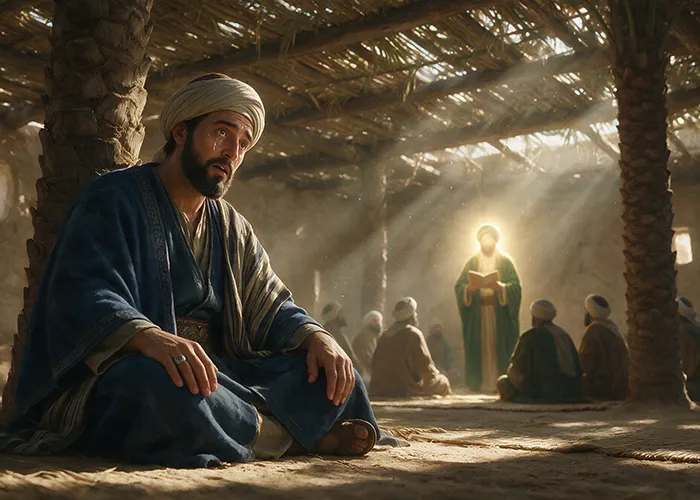
Abu Talhah was sitting in a corner of the mosque. These words fell upon his soul like rain. The verse made it clear that giving away surplus wealth, or things to which one has little attachment, does not bring a person to the highest degree of righteousness. The condition for attaining the reality of al-birr -true and complete righteousness- is to let go of that very thing to which one’s heart is attached. Abu Talhah’s mind immediately turned to Bi’r Ḥāʾ: its fruitful trees, its peaceful shade, and its crystal-clear spring. For a moment, the heaviness of worldly attachment could have held him back. Yet the light shining in his eyes revealed that a momentous decision had already been made.
He rose, made his way through the crowd, and approached the Prophet (peace be upon him). Standing before the Messenger of Allah, he said in a firm yet eager voice:
“O Messenger of Allah! Allah says in His Book that we will not attain true righteousness unless we spend from what we love. You know that among all my possessions, nothing is more beloved and dear to me than the garden of Bi’r Ḥāʾ. So I now give this garden in the way of Allah and as charity for those in need. I seek its reward and its provision for the Hereafter from my Lord alone. This garden is at your disposal; distribute it in whatever manner Allah has commanded you.”
The eyes of the Noble Prophet (peace be upon him) shone with appreciation for such sincerity, faith, and conscious self-sacrifice. A smile appeared upon his blessed lips, and he said:
“Well done! This is a profitable wealth and a blessed transaction -a transaction that will never incur a loss.”
The Prophet (peace be upon him) then suggested that, in order to strengthen family ties and meet the needs of his close relatives, Abu Talhah distribute this great gift among his relatives and those in need among his own family. Abu Talhah joyfully accepted the Prophet’s suggestion. He left the mosque with a heart lightened and filled with peace and distributed among his relatives the garden that had been his most cherished possession for years. By letting go of Bi’r Ḥāʾ, he demonstrated that sometimes, in order to attain eternal goodness and blessing, one must break the bonds of attachment to the most precious possessions of this world.
Educational and Practical Lessons from This Story:
Moral and Character-Building Principles
The true value of charity does not lie in giving away surplus or low-value possessions. Rather, it lies in one’s ability to let go of the things one loves in pursuit of higher goals.
Abu Talhah acted immediately after hearing the verse and understanding its meaning. Not allowing a gap to arise between knowledge and action is one of the defining features of Qur’anic education and character formation.
Transforming a temporary material possession into lasting spiritual capital -into al-bāqiyāt al-ṣāliḥāt (lasting righteous deeds)- and the Prophet’s description of this act as a “profitable transaction” demonstrate the transformation in the horizon of vision of a believing person.
Practical and Managerial Lessons in Charity
The Prophet (peace be upon him) suggested that Abu Talhah distribute the garden among those in need among his relatives. This indicates that, in planning charitable and support programs, addressing the needs of one’s relatives and immediate social network takes precedence over others.
Abu Talhah placed the garden entirely at the disposal of the authority and leader of the community so that the resources could be directed and managed according to the common good.
Breaking excessive emotional attachment to possessions and material wealth frees a person from the anxiety of loss and brings inner peace and lightness of heart.
Methods of Role Modelling
Presenting a concrete example from the conduct of a Companion transforms an abstract concept such as al-birr (complete righteousness) into behaviour that is understandable and tangible for the audience. The verse first establishes the goal:
لَنْ تَنَالُوا الْبِرَّ
(“You will never attain righteousness”)
thereby creating motivation and then identifies the path toward it:
حَتَّىٰ تُنْفِقُوا مِمَّا تُحِبُّونَ
(“until you spend from what you love”).
Preventing Class Divisions and Social Fault Lines
Charity functions as a kind of equalizing mechanism within the economy and society. If wealth circulates only among a particular group -as the Qur’an states in verse 7 of Surah al-Hashr:
كَيْ لَا يَكُونَ دُولَةً بَيْنَ الْأَغْنِيَاءِ مِنْكُمْ
“So that it may not merely circulate among the wealthy among you.”
society becomes divided into two poles: a small, extremely affluent minority and a large, deprived majority. Such a deep divide creates fertile ground for anger, resentment, and a sense of injustice.
Reducing Crime and Promoting Psychological and Public Security
When the basic needs of disadvantaged people are not met and they feel that they are unseen within the structure of society, the conditions for deviance, theft, and social crime increase. Charity and community-based support foster a sense of solidarity and, by alleviating some essential needs, reduce the motivation for criminal behavior.
The Qur’an’s Explicit Warning: Failure to Give Charity as a Cause of Societal Ruin
The Noble Qur’an, in verse 195 of Surah al-Baqarah, establishes a direct connection between abandoning charitable giving and destruction:
وَأَنْفِقُوا فِي سَبِيلِ اللَّهِ وَلَا تُلْقُوا بِأَيْدِيكُمْ إِلَى التَّهْلُكَةِ…
“And spend in the way of Allah, and do not cast yourselves into destruction with your own hands…”(al-Baqarah 2:195)
If the wealthy refrain from spending in the way of Allah and helping those in need, poverty spreads, resentment takes root in people’s hearts, and the fabric of society begins to unravel. The insecurity that follows will ultimately affect the wealthy themselves as well, leading society toward destruction.
The Difference Between a Compassionate, Responsible Society and a Self-Centered Society
The self-centered society (absolute individualism)
Human relationships are defined on the basis of one-sided self-interest. In such an environment, public trust declines and social capital is destroyed.
The compassionate and responsible society (founded upon charitable giving)
Such a society is built upon human solidarity, compassion, and mutual support. In this model, people are not merely burdens upon one another; rather, in times of economic and social crisis, they become one another’s refuge and support.
Final Reflection
The story of Abu Talhah is not merely a personal account of sacrifice; it is a model for the health of collective life. Charity is like injecting the “blood of compassion” into the veins of society. Without it, society becomes a jungle in which the logic of “survival of the strongest” prevails. In such a society, disintegration and chaos ultimately become its inevitable destiny.
Hadith and Tafsir Sources
Majmaʿ al-Bayān fī Tafsīr al-Qurʾān, by ʿAllāmah al-Ṭabrisī, commentary on verse 92 of Surah Āl ʿImrān. (He narrates this story from Jābir ibn ʿAbd Allāh al-Anṣārī and Anas ibn Mālik.)
Tafsīr Nemūneh, by Ayatollah Nāṣir Makārem Shīrāzī, Vol. 3, commentary on verse 92 of Surah Āl ʿImrān.
al-Tafsīr al-Ṣāfī, by Fayḍ al-Kāshānī, Vol. 1, commentary on the relevant verse.
Biḥār al-Anwār, by ʿAllāmah al-Majlisī, sections concerning the conduct of the Companions and spending in the way of Allah.
Ṣaḥīḥ al-Bukhārī, Kitāb al-Zakāh, chapter “Al-Zakāh ʿalā al-Aqārib” (Charity/Zakāt for Relatives), Hadith 1461; also in Kitāb al-Tafsīr, under Surah Āl ʿImrān.
Ṣaḥīḥ Muslim, Kitāb al-Zakāh, chapter “Faḍl al-Nafaqah wa al-Ṣadaqah ʿalā al-Aqārib wa al-Zawj wa al-Awlād” (The Virtue of Spending and Giving Charity to Relatives, Spouse, and Children), Hadith 998.
Sunan al-Nasāʾī, Kitāb al-Waṣāyā, chapter “Tafsīr Qawl Allāh ʿAzza wa Jalla: Lan Tanālū al-Birr…,” Hadith 3604.
Muwaṭṭaʾ Imām Mālik, Kitāb al-Jāmiʿ, chapter “Mā Jāʾa fī al-Ṣadaqah,” Hadith 1711.
Tafsīr al-Ṭabarī (Jāmiʿ al-Bayān), by Muḥammad ibn Jarīr al-Ṭabarī, commentary on verse 92 of Surah Āl ʿImrān.
Tafsīr Ibn Kathīr, by Ismāʿīl ibn Kathīr, commentary on verse 92 of Surah Āl ʿImrān.
al-Durr al-Manthūr, by Jalāl al-Dīn al-Suyūṭī, Vol. 2, commentary on the relevant verse.
Asbāb al-Nuzūl, by ʿAlī ibn Aḥmad al-Wāḥidī al-Naysābūrī, commentary concerning verse 92 of Surah Āl ʿImrān.
editor's pick

news via inbox
Subscribe to the newsletter.