Everlasting Tales of the Quran – Volume 03 Issue 44
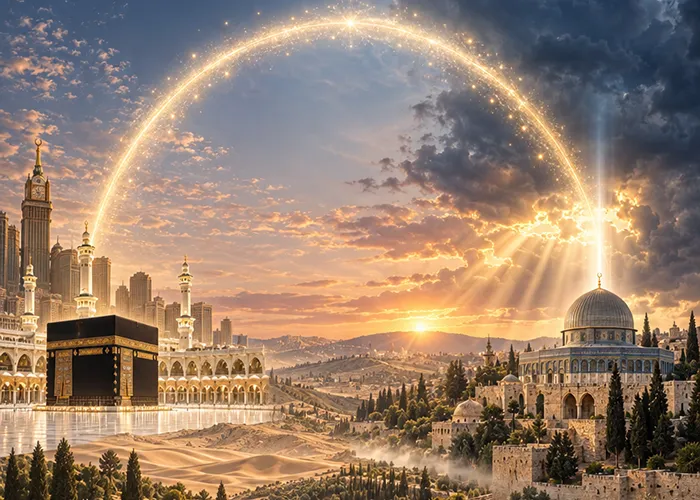
The Story of the Holy Land: From the Migration of Abraham to the Ascension of the Beloved Prophet (PBUH) (4)
From the Footsteps of Muhammad (PBUH) to the Ascent into the Heavenly Realm
The Night Whose Darkness Was Brighter Than the Sun
Centuries had passed since the ascension of Prophet Jesus (peace be upon him), and Makkah remained immersed in the deep darkness of the Age of Ignorance and idolatry. The Final Prophet, Muhammad (peace be upon him), had endured years of hardship. The boycott in the Valley of Abu Talib and the loss of his two great supporters, Lady Khadijah (peace be upon her) and Hazrat Abu Talib (pbuh), had left a profound sorrow in his blessed heart.
On one of those momentous nights, while the Prophet (PBUH) was in seclusion at the Sacred Mosque or in his own home, the Trustworthy Angel Gabriel descended upon him. The time had come for the most extraordinary journey in human history -a journey that would begin beside the Kaaba and lead to the heart of the Holy Land:
سُبْحَانَ الَّذِي أَسْرَىٰ بِعَبْدِهِ لَيْلًا مِّنَ الْمَسْجِدِ الْحَرَامِ إِلَى الْمَسْجِدِ الْأَقْصَى الَّذِي بَارَكْنَا حَوْلَهُ…
(Surah Al-Isra, 17:1)
Glory be to Him who took His servant by night from the Sacred Mosque to the Farthest Mosque, whose surroundings We have blessed, so that We might show him some of Our signs. Indeed, He alone is the All-Hearing, the All-Seeing.
Arrival upon the Sacred Soil of Jerusalem
Buraq, the heavenly steed of the Prophet (PBUH), traversed the distance between Makkah and the region of Greater Syria in a remarkably short time. The Prophet (PBUH) then arrived at the precincts of Al-Masjid Al-Aqsa, in the sacred land of Jerusalem.
This was the very land that preserved the memory of Abraham’s footsteps, the prostrations of David and Solomon (peace be upon them), the devout worship of Mary (peace be upon her), and the miracles of Jesus (peace be upon him). Now, the Final Prophet (PBUH) was setting foot upon a land where successive generations of divine Prophets (pbut) had prepared the way for his advent and prophethood.
On that blessed night, the pure souls of the Prophets of God (pbut) gathered at Al-Masjid Al-Aqsa. The Prophet of Islam (PBUH) stood as the leader of all the messengers, and they performed their prayers behind him. That night, Jerusalem witnessed one of the most magnificent manifestations of the unity of the Prophets (pbut) and the continuity of the divine mission.
The Sacred Rock: A Bridge between Earth and Heaven
Following the prayer in Jerusalem, one particular site in this land acquired a special and enduring place in human history: the Sacred Rock of Jerusalem, associated with the beginning of the Prophet’s (PBUH) ascent through the heavens.
Accompanied by Gabriel, the Prophet (PBUH) ascended from Al-Masjid Al-Aqsa towards the heavens. He passed through the various levels of heaven, met the Prophets of God (pbut), and proceeded to the Lote Tree of the Utmost Boundary (Sidrat al-Muntaha), a station beyond which even Gabriel could not advance.
عِنْدَ سِدْرَةِ الْمُنْتَهَىٰ … لَقَدْ رَأَىٰ مِنْ آيَاتِ رَبِّهِ الْكُبْرَىٰ
(Surah An-Najm, 53:14–18)
At the Lote Tree of the Utmost Boundary, near which lies the Garden of Abode, his gaze neither swerved nor exceeded its limit. Indeed, he witnessed some of the greatest signs of his Lord.
Thus, Al-Masjid Al-Aqsa and the Holy Land became a gateway between the earthly realm and the celestial realm -a bridge connecting the earth to the heavens and the visible world to the unseen kingdom of divine majesty.
The First Qiblah and an Eternal Legacy
Upon the Prophet’s (PBUH) return from the Ascension (Mi’raj), Jerusalem’s special position in Islamic tradition became even more firmly established. This land was not only the first Qiblah of the Muslims but also one of the greatest symbols of the connection between the divine missions entrusted to God’s Prophets (pbut).
The Qur’anic account of the Holy Land begins with the migration of Abraham (peace be upon him); continues through the struggles of the people of Moses (peace be upon him); reaches the height of its glory in the time of David and Solomon (peace be upon them); acquires a renewed radiance through the purity of Mary and the miracles of Jesus (peace be upon them); and ultimately becomes a unifying link among the monotheistic faiths through the footsteps of the Final Prophet (PBUH) and his Ascension from Al-Masjid Al-Aqsa.
It is the very land of which God declared:
الَّذِي بَارَكْنَا حَوْلَهُ
“Whose surroundings We have blessed.”
Mystery of the Change of Qiblah: From Al-Masjid Al-Aqsa to the Kaaba
Seventeen Months of Prayer towards Jerusalem
Following the Prophet’s migration to Madinah and the establishment of the first Muslim community, the Muslims continued to perform their prayers facing Jerusalem. Approximately sixteen to seventeen months had passed since the Prophet’s arrival in Madinah, and Al-Masjid Al-Aqsa remained the Qiblah of the Muslims.
This reflected Islam’s profound connection with the tradition of all previous Prophets (pbut) and the continuity of the path of monotheism from Abraham, David, Solomon, and Jesus (peace be upon them all) to the Final Prophet, Muhammad (PBUH).
The Taunts of Others and the Messenger of God’s Anticipation
As the Muslims established themselves in Madinah, some among the People of the Book began to taunt them out of prejudice, saying: “Muhammad and his followers have no independence of their own. They pray facing our Qiblah, and without it, they do not know in which direction to worship.”
These remarks were not motivated by a sincere search for truth; rather, they were intended to undermine the morale of the Muslims. The Noble Prophet (PBUH) was saddened by such conduct, yet he continued to await the divine command. He would repeatedly turn his gaze towards the heavens, waiting for revelation -a period of anticipation that would culminate in the establishment of an independent identity for the Muslim community.
The Historic Prayer at Masjid Dhul-Qiblatayn
In the middle of Sha’ban in the second year after the Hijrah, the Prophet (PBUH) was performing the noon prayer at the Mosque of Banu Salim, which later became known as Masjid Dhul-Qiblatayn, the Mosque of the Two Qiblahs. Two units (rak’ahs) of the prayer had been completed, and the Muslims were standing facing Jerusalem.
At that very moment, Gabriel descended and conveyed the divine command. In the middle of the prayer, the Prophet (PBUH) turned towards Al-Masjid Al-Haram, and the Muslims immediately followed his lead. At that moment, the verse commanding the change of Qiblah was revealed:
قَدْ نَرَىٰ تَقَلُّبَ وَجْهِكَ فِي السَّمَاءِ ۖ فَلَنُوَلِّيَنَّكَ قِبْلَةً تَرْضَاهَا…
(Surah Al-Baqarah, 2:144)
Indeed, We see you turning your face towards the sky. We shall surely turn you towards a Qiblah that will please you. So turn your face towards Al-Masjid Al-Haram.
That prayer became one of the most remarkable events in Islamic history: the first two units were performed facing Jerusalem, while the remaining two were performed facing the Kaaba.
The Great Test of Submission
The change of Qiblah provoked numerous reactions in Madinah. The Jews and the hypocrites expressed astonishment and objection, asking: “What has turned them away from the Qiblah they used to face?”
In response, the Noble Qur’an emphasised that the East and the West belong entirely to God, and that true worth lies in obedience to His command, not in attachment to a particular geographical direction:
سَيَقُولُ السُّفَهَاءُ مِنَ النَّاسِ مَا وَلَّاهُمْ عَن قِبْلَتِهِمُ الَّتِي كَانُوا عَلَيْهَا ۚ قُل لِّلَّهِ الْمَشْرِقُ وَالْمَغْرِبُ…
(Surah Al-Baqarah, 2:142–143)
The foolish among the people will say, “What has turned them away from the Qiblah they used to face?” Say, “To Allah belong the East and the West. He guides whom He wills to a straight path.”
The Qur’an then revealed the fundamental wisdom behind this change in the continuation of verse 143:
وَمَا جَعَلْنَا الْقِبْلَةَ الَّتِي كُنتَ عَلَيْهَا إِلَّا لِنَعْلَمَ مَن يَتَّبِعُ الرَّسُولَ مِمَّن يَنقَلِبُ عَلَىٰ عَقِبَيْهِ…
We had appointed the former Qiblah only to distinguish those who truly follow the Messenger from those who turn back on their heels.
Educational and Ethical Lessons
- Ascension and Relief after Life’s Most Difficult Trials
The event of the Mi’raj took place shortly after the Year of Sorrow (‘Am al-Huzn), following the deaths of Lady Khadijah (peace be upon her) and Abu Talib (peace be upon him), as well as the hardship of the boycott in the Valley of Abu Talib.
Educational lesson: Great divine openings and spiritual ascents often follow periods of patience and perseverance through life’s most difficult trials. A person should never lose hope at the height of hardship.
- The Unity and Continuity of Monotheism throughout History
The Final Prophet (PBUH) leading all the Prophets of God (pbut) in prayer at Al-Masjid Al-Aqsa demonstrates the continuity and interconnectedness of the heavenly religions.
Educational lesson: A true monotheist views all the Prophets (pbut) and reformers of the past with a broad perspective and due respect. This teaching nurtures a spirit of truth-seeking and unity while rejecting blind ethnic prejudice and narrow-mindedness within society.
- Absolute Servitude to God and the Rejection of Rigid Geographical and Formalistic Attachments
The wisdom behind the change of Qiblah demonstrated that the geographical directions of East, West, North, and South have no inherent sacred status in themselves. Rather, it is God’s command that gives a place its religious significance.
Educational lesson: A true believer is devoted to the command of God and submits to the truth, rather than becoming attached to habits, conventions, or outward forms. The 180-degree turn during prayer symbolises the highest degree of spiritual discipline and complete obedience to the truth.
- The Independence of the Muslim Community’s Identity and the Rejection of Dependency
The change of Qiblah marked a turning point in affirming the Muslims’ independence in worship and religious identity in the face of the disparaging taunts of their opponents.
Educational lesson: A living and flourishing community must not allow its identity and authentic symbols to become dependent upon, or defined by, the opinions and ridicule of others, even while respecting history and other communities. Preserving an independent identity is essential to fulfilling the ideal of the Moderate Community (Ummatan Wasatan).
- The Connection between the Two Sacred Centres: Makkah and Jerusalem
Through the events of the Mi’raj and the change of Qiblah, the two spiritual centres of the Islamic world came to be understood within a single sacred framework: the Kaaba as the everlasting direction of prayer, and Al-Masjid Al-Aqsa as the site of the Prophet’s Ascension and the place where the Prophets (pbut) gathered.
Educational lesson: Honouring all sacred symbols and safeguarding the dignity of the divine trusts entrusted to humanity throughout history are enduring responsibilities of all who believe in the One God.
Thus, the narrative of the Holy Land reaches its conclusion: a land sanctified by the footsteps of the Prophets (pbut) and transformed into a bridge between earth and heaven. Today, as the heart of this land suffers from pain, injustice, and hardship, we look forward to the day when God’s promise is fulfilled and Jerusalem, freed from the shadow of oppression, once again becomes a secure and spiritual sanctuary for the monotheists and freedom-loving people of the world.
References
The Noble Qur’an
- Surah Al-Isra, Verse 1: The Prophet’s (PBUH) Night Journey from Al-Masjid Al-Haram to Al-Masjid Al-Aqsa, beginning with: سُبْحَانَ الَّذِي أَسْرَىٰ بِعَبْدِهِ لَيْلًا…
- Surah An-Najm, Verses 14–18: The description of the Prophet’s (PBUH) Ascension to the Lote Tree of the Utmost Boundary (Sidrat al-Muntaha) and his witnessing of the great signs of God.
- Surah Al-Baqarah, Verses 142–145: The change of Qiblah from Jerusalem to the Kaaba, the response to those who questioned the change, and the wisdom behind this test of submission.
Hadith, Qur’anic Exegesis, and Historical Sources
- Tafsir al-Mizan, by Allamah Muhammad Husayn Tabataba’i: The commentary on Surah Al-Isra, verse 1, discussing the reality of the Mi’raj and the sanctity of Jerusalem, and the commentary on Surah Al-Baqarah, verses 142–145, explaining the wisdom behind the change of Qiblah.
- Tafsir Nemuneh, by Ayatollah Naser Makarem Shirazi: The commentary on Surah Al-Isra, verse 1, and Surah Al-Baqarah, verses 142–144, examining the historical significance of the Mosque of the Two Qiblahs and the independence of the Muslim community.
- Al-Sirah al-Nabawiyyah, by Ibn Hisham, Volume 2: Narrations concerning the events of the Isra and Mi’raj, including the Prophet’s (PBUH) leading the Prophets (pbut) in prayer in Jerusalem.
- Bihar al-Anwar, by Allamah Muhammad Baqir al-Majlisi: Volume 18, the sections on the Mi’raj, and Volume 19, the section on the change of Qiblah and the construction of the Mosque of the Two Qiblahs.
- Al-Tabaqat al-Kubra, by Ibn Sa’d, Volume 1: Accounts of events in the second year after the Hijrah, including details of the historic noon prayer at the Mosque of Banu Salim, later known as Masjid Dhul-Qiblatayn.
editor's pick

news via inbox
Subscribe to the newsletter.