Everlasting Tales of the Quran – Volume 03 Issue 42
The Story of the Holy Land: From the Migration of Prophet Abraham (pbuh), the Friend of God, to the Ascension of Prophet Muhammad (pbuh), the Beloved of God (2)
From David’s Sling to the Splendour of Solomon
The Return of Darkness and the Ominous Shadow of Goliath
Many years had passed since the Children of Israel had entered the Holy Land. Over time, however, new generations fell prey to pride, deviation, and division. This weakness and fragmentation paved the way for the invasion of oppressive peoples. They attacked the cities of the Children of Israel, seized the Ark of the Covenant – the sacred chest inherited from Moses and Aaron – and drove the people from their homes and homeland.
Meanwhile, a mighty and tyrannical commander named Goliath, one of the leaders of the Amalekites and the mighty oppressors, gained control over vast areas of the Holy Land. Deeply humiliated, the Children of Israel approached Samuel, the Prophet (pbut) of their time, and said, “Appoint a commander for us so that we may fight in the way of God under his banner.”
God chose Talut (Saul), a man of wisdom and strength but limited wealth, to lead them. As Talut’s army set out to confront Goliath’s enormous forces, divine trials began, and many soldiers fell away during this process of spiritual testing. Only a small group remained. When the two armies lined up against each other on the plains of Palestine, fear cast its shadow over Talut’s soldiers:
فَلَمَّا جَاوَزَهُ هُوَ وَالَّذِينَ آمَنُوا مَعَهُ قَالُوا لَا طَاقَةَ لَنَا الْيَوْمَ بِجَالُوتَ وَجُنُودِهِ ۚ قَالَ الَّذِينَ يَظُنُّونَ أَنَّهُم مُّلَاقُو اللَّهِ كَم مِّن فِئَةٍ قَلِيلَةٍ غَلَبَتْ فِئَةً كَثِيرَةً بِإِذْنِ اللَّهِ ۗ وَاللَّهُ مَعَ الصَّابِرِينَ
When he and those who believed with him had crossed it, they said, ‘We have no strength today to face Goliath and his soldiers.’ But those who were certain that they would meet God said, ‘How many a small group has overcome a large group by God’s permission! And God is with those who persevere.’ (Surah Al-Baqarah, 2:249)
A Pebble That Changed the Course of History
Goliath’s army stood arrayed against the believers, clad in iron armour and radiating terrifying might. Armoured and arrogant, Goliath stepped onto the battlefield and challenged anyone to face him. Fear had overwhelmed the hearts of the soldiers, and no one dared to step forward. The believers raised their hands in prayer:
وَلَمَّا بَرَزُوا لِجَالُوتَ وَجُنُودِهِ قَالُوا رَبَّنَا أَفْرِغْ عَلَيْنَا صَبْرًا وَثَبِّتْ أَقْدَامَنَا وَانصُرْنَا عَلَى الْقَوْمِ الْكَافِرِينَ
And when they advanced to face Goliath and his soldiers, they said, ‘Our Lord, pour patience upon us, make our feet firm, and grant us victory over the disbelieving people.’ (Surah Al-Baqarah, 2:250)
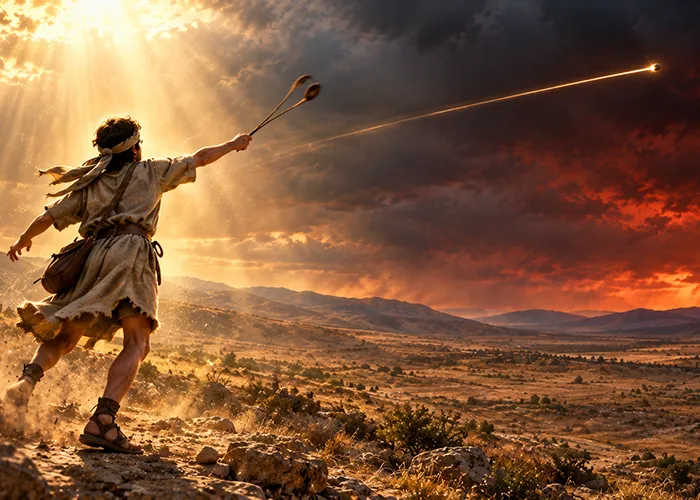
Amid this scene, Prophet David (pbuh) -a young shepherd from the lineage of Levi, son of Prophet Jacob (pbuh) – stepped onto the battlefield carrying a simple sling and a few stones. Seeing this unarmoured youth, Goliath mocked him. But Prophet David (pbuh), steadfast in his faith, placed a stone in his sling, swung it, and released it.
The stone struck Goliath squarely in the forehead, penetrating his defences and bringing him crashing to the ground. With Goliath’s fall, his mighty army collapsed, and the oppressive domination over the Holy Land came to an end:
فَهَزَمُوهُم بِإِذْنِ اللَّهِ وَقَتَلَ دَاوُودُ جَالُوتَ وَآتَاهُ اللَّهُ الْمُلْكَ وَالْحِكْمَةَ وَعَلَّمَهُ مِمَّا يَشَاءُ…
So, they defeated them by God’s permission, and David killed Goliath. God granted him kingship and wisdom and taught him whatever He willed. (Surah Al-Baqarah, 2:251)
The Age of the Psalms: The Mountains Join Prophet David (Peace Be Upon Him) in Praise
As Prophet David (pbuh) became renowned, he ascended to the throne and made Bayt al-Maqdis (Jerusalem) the centre of his divinely guided rule. Prophet David (pbuh) was not merely a just king; he was also a Prophet (pbut) blessed with a heavenly voice. When he recited the Psalms among the hills and rocky outcrops of Jerusalem, nature joined him in harmony, and iron softened in his hands:
وَلَقَدْ آتَيْنَا دَاوُودَ مِنَّا فَضْلًا ۖ يَا جِبَالُ أَوِّبِي مَعَهُ وَالطَّيْرَ ۖ وَأَلَنَّا لَهُ الْحَدِيدَ
Indeed, We bestowed a grace upon David from Us: ‘O mountains and birds, join him in glorifying God!’ And We made iron soft for him. (Surah Saba, 34:10)
David’s reign (peace be upon him), the Holy Land experienced the blessings of security, monotheism, and genuine justice. The foundations were laid for one of the most magnificent kingdoms in human history.
The Pinnacle of Solomonic Splendour: A Temple atop a Hill
After Prophet David (pbuh), his son Prophet Solomon (peace be upon him) ascended the throne. God granted him knowledge of the speech of birds, dominion over the winds, and the service of the jinn. Solomon transformed Jerusalem into the centre of a monotheistic empire whose influence extended far beyond its borders.
Under his command, sanctuaries, magnificent temples, and extraordinary structures were erected in Jerusalem. The wind, glass, and molten metals were all placed in the service of developing and beautifying this land:
فَسَخَّرْنَا لَهُ الرِّيحَ تَجْرِي بِأَمْرِهِ رُخَاءً حَيْثُ أَصَابَ * وَالشَّيَاطِينَ كُلَّ بَنَّاءٍ وَغَوَّاصٍ
So We subjected the wind to him, flowing gently at his command wherever he directed it, and the devils [among the jinn] -every builder and diver among them.
(Surah Sad, 38:36–37)
Elsewhere, the Qur’an states:
يَعْمَلُونَ لَهُ مَا يَشَاءُ مِن مَّحَارِيبَ وَتَمَاثِيلَ وَجِفَانٍ كَالْجَوَابِ وَقُدُورٍ رَّاسِيَاتٍ…
They made for him whatever he wished: sanctuaries, statues, basins as large as reservoirs, and firmly fixed cauldrons… (Surah Saba, 34:13)
During Solomon’s reign (peace be upon him), the Holy Land became a centre of monotheism and spirituality and the home of one of the most extraordinary civilizations in history -a land over which divine justice held sway and from which blessings spread throughout the world.
The Decline of Splendour and an Everlasting Legacy
With the death of Solomon (peace be upon him), the age of manifest miracles and the unparalleled splendour of the Solomonic kingdom came to an end. Yet what endured in history was a lasting symbol of faith and trust in God: a land that reminds us that when its people remain steadfast in justice and faith, even the mightiest tyrants – like Goliath – can be brought down before them, and the gates of heaven can be opened to them.
Moral and Ethical Lessons
- The Powerlessness of Material Might in the Face of Faith (The Lesson of the Sling): Prophet David (pbuh), unarmoured and facing Goliath, who was armed to the teeth, reminds us that we must not be intimidated by appearances when confronting great challenges. A small stone, when guided by faith and precise aim, can bring down even the mightiest fortresses.
- The Importance of Discipline and Spiritual Testing in Pursuit of a Goal: The test at the river, which Talut’s army faced, teaches self-restraint and spiritual discipline. Great victories belong to those who overcome fleeting desires and impulses -the very people exemplified by the Qur’anic words, “How many a small group…” (كَم مِّن فِئَةٍ قَلِيلَةٍ).
- The Union of Spirituality and Civilizational Power (The Age of Solomon): The kingdom of Solomon (peace be upon him) demonstrated that power, wealth, and knowledge, when placed in the hands of righteous servants of God, are not incompatible with monotheism. On the contrary, they can become instruments for building a prosperous, just, and God-cantered civilization.
References
Verses from the Holy Qur’an
- Surah Al-Baqarah, verses 246–251
- Surah Saba, verses 10–13
- Surah Sad, verses 30–40
Hadith and Historical Sources
- Tafsir al-Mizan, commentary on Surah Al-Baqarah, verses 246–251, and Surah Saba, verses 10–13.
- Bihar al-Anwar by Allama Muhammad Baqir al-Majlisi, Volume 14, section on the stories of Prophets David and Solomon (peace be upon them) and the construction of Bayt al-Maqdis.
- Tarikh al-Tabari, Volume 1, accounts of the reigns of Prophets David and Solomon (peace be upon them) and the construction of the Temple and sanctuaries in Jerusalem.
- Qisas al-Anbiya by Ibn Kathir, sections recounting the lives of Prophets David and Solomon (peace be upon them both).
editor's pick

news via inbox
Subscribe to the newsletter.