Everlasting Tales of the Quran – Volume 03 Issue 34
Beginning the Journey and Searching for the Teacher
One day, Prophet Moses (peace be upon him), following a divine calling, set out with his young companion, Joshua ibn Nun (Yusha‘ ibn Nun), in search of a servant of God who had been granted “mercy from Our Presence and special knowledge from Our own.” Their destination was “Majma‘ al-Bahrayn” (the meeting place of the two seas).
فَوَجَدَا عَبْدًا مِّنْ عِبَادِنَا آتَیْنَاهُ رَحْمَةً مِّنْ عِندِنَا وَعَلَّمْنَاهُ مِن لَّدُنَّا عِلْمًا
(Al-Kahf: 65)
“Then they found one of Our servants, to whom We had granted mercy from Us and taught knowledge from Our presence.”
When Moses (peace be upon him) found him, he humbly said:
هَلْ أَتَّبِعُکَ عَلَى أَن تُعَلِّمَنِ مِمَّا عُلِّمْتَ رُشْدًا
(Al-Kahf: 66)
“May I follow you so that you may teach me some of the guidance and right knowledge that you have been taught?”
The righteous servant replied that Moses would never be able to remain patient with him, asking how he could be patient with matters whose reality and inner meaning he did not know. Moses (peace be upon him), however, promised that he would remain patient and would not disobey his instructions. The teacher then said:
قَالَ فَإِنِ اتَّبَعْتَنِي فَلَا تَسْأَلْنِي عَنْ شَيْءٍ حَتَّىٰ أُحْدِثَ لَكَ مِنْهُ ذِكْرًا
(Al-Kahf: 70)
“He said: ‘Then, if you follow me, do not ask me about anything until I myself explain it to you.’”
Three Events and Three Profound Lessons
Their journey together began, and three extraordinary events occurred that tested Prophet Moses’ (peace be upon him) patience.
- Damaging the Boat
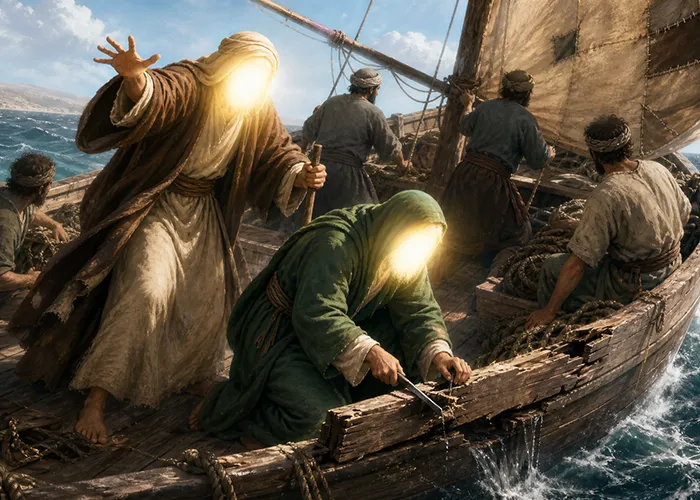
They boarded a boat belonging to a group of poor people who transported them without asking for any payment. Suddenly, the righteous servant broke one of the boat’s planks and damaged the vessel. Moses (peace be upon him) could not contain himself and objected:
“Did you damage the boat in order to drown its people? Indeed, you have done a terrible thing!”
The teacher reminded him:
“Did I not tell you that you would never be able to remain patient with me?”
Moses (peace be upon him) apologized and asked him not to hold his mistake against him.
- Killing the Young Man
They continued on their journey until they encountered a young man. Without any apparent explanation, the righteous servant killed him. Moses (peace be upon him) was deeply shocked and said:
“Have you killed an innocent person who had killed no one? Indeed, you have done a truly grave and unacceptable thing!”
The teacher once again said:
“Did I not tell you that you would never be able to remain patient with me?”
Moses replied:
“If I ask you about anything after this, then do not accompany me any further.”
- Rebuilding the Wall of the Unhospitable City
They entered a town and asked its people for food, but the inhabitants refused to show them hospitality. Meanwhile, the teacher saw a wall that was about to collapse and began repairing and restoring it.
Moses (peace be upon him), surprised by the people’s lack of hospitality, said:
“If you had wished, you could have taken a payment for this work, so that we could have obtained some food with it.”
Separation and the Revelation of the Hidden Wisdom
At this point, the time came for the two to part ways, because the conditions of their companionship had come to an end. Before separating, however, the righteous servant revealed the secrets behind his actions and explained the hidden wisdom and meaning of the three events.
قَالَ هَٰذَا فِرَاقُ بَیْنِی وَبَیْنِکَ ۚ سَأُنَبِّئُکَ بِتَأْوِیلِ مَا لَمْ تَسْتَطِع عَّلَیْهِ صَبْرًا
(Al-Kahf: 78)
“He said: ‘This is the parting between me and you. I will now inform you of the interpretation and inner meaning of that which you were unable to bear patiently.’”
First, he explained:
أَمَّا السَّفِینَةُ فَکَانَتْ لِمَسَاکِینَ یَعْمَلُونَ فِی الْبَحْرِ فَأَرَدتُّ أَنْ أَعِیبَهَا وَکَانَ وَرَاءَهُم مَّلِکٌ یَأْخُذُ کُلَّ سَفِینَةٍ غَصْبًا
(Al-Kahf: 79)
“As for the boat, it belonged to poor people who worked at sea. I intended to damage it because there was a king behind them who was seizing every sound boat by force.”
Regarding the killing of the young man, he explained:
وَأَمَّا الْغُلَامُ فَکَانَ أَبَوَاهُ مُؤْمِنَیْنِ فَخَشِینَا أَن یُرْهِقَهُمَا طُغْیَانًا وَکُفْرًا * فَأَرَدْنَا أَن یُبْدِلَهُمَا رَبُّهُمَا خَیْرًا مِّنْهُ زَکَاةً وَأَقْرَبَ رُحْمًا
(Al-Kahf: 80–81)
“And as for the young man, his parents were believers, and we feared that he would burden them with transgression and disbelief. So we intended that their Lord should replace him for them with one better than him in purity and closer in affection.”
Finally, regarding the rebuilding of the wall, he explained:
وَأَمَّا الْجِدَارُ فَکَانَ لِغُلَامَیْنِ یَتِیمَیْنِ فِی الْمَدِینَةِ وَکَانَ تَحْتَهُ کَنزٌ لَّهُمَا وَکَانَ أَبُوهُمَا صَالِحًا فَأَرَادَ رَبُّکَ أَن یَبْلُغَا أَشُدَّهُمَا وَیَسْتَخْرِجَا کَنزَهُمَا رَحْمَةً مِّن رَّبِّکَ
(Al-Kahf: 82)
“And as for the wall, it belonged to two orphan boys in the city, and beneath it was a treasure belonging to them. Their father had been righteous, so your Lord intended that they should reach maturity and then bring forth their treasure, as a mercy from your Lord.”
And finally, he emphasized:
…وَمَا فَعَلْتُهُ عَنْ أَمْرِی ۚ ذَٰلِکَ تَأْوِیلُ مَا لَمْ تَسْطِع عَّلَیْهِ صَبْرًا
(Al-Kahf: 82)
“And I did not do these things of my own accord. This is the interpretation and inner meaning of that which you were unable to bear patiently.”
Three Profound and Strategic Messages from the Story
- The limitations of human knowledge: Human knowledge is based largely on outward appearances, whereas the events of the world unfold according to God’s hidden and creative wisdom.
- Beauty within life’s hardships: Sometimes a painful event -such as damage to one’s property or the loss of something valuable- may actually protect us from a greater calamity or lead to a greater good in the future.
- The blessing of righteous parents: The righteousness and good deeds of the father of the two orphans resulted in God protecting their children and safeguarding their property even after their father’s death.
In the end, the righteous servant concluded with a short and memorable statement:
وَمَا فَعَلْتُهُ عَنْ أَمْرِی
“And I did not do these things of my own accord.”
Rather, all of these actions were carried out according to the plan and command of the Wise Lord.
The Question
Question: Killing a child because of a sin that he has not yet committed is not permissible in Islam. So why did the righteous servant do this?
The short and clear answer, based on Islamic teachings, is that under Islamic law and its legal principles, it is absolutely impermissible to punish or kill any human being -especially a child or young person- for a sin that they have not committed, or merely because they might commit it in the future.
So why does this event occur in the Qur’anic story?
Islamic scholars and Qur’anic commentators have identified several important points and distinctions in addressing this question.
- The Difference Between “Sharia” and “Takwīn” -Two Different Types of Divine Mission
Within Islamic theological thought, a distinction is made between two dimensions of divine will and action:
- Tashrī‘ (Divine Legislation / Sharia): Prophets such as Moses (peace be upon him) and Muhammad (peace be upon him) were entrusted with Sharia, meaning divine law. Sharia operates according to outward circumstances, legal principles, and human judicial procedures. Under Sharia, no one may be punished for a crime before it has been committed. This is why Prophet Moses (peace be upon him), as a prophet entrusted with divine law, strongly objected to the act and described it as “نُكْرًا” (nukran) -something deeply wrong and unacceptable according to outward legal standards.
- Takwīn (The Divine Creative Order / Ontological Reality): In this story, Khidr (peace be upon him) was carrying out a specific divine mission within the realm of Takwīn, rather than acting as a religious judge or legal authority. Human beings die every day through various causes -illness, accidents, earthquakes, and so forth- and these deaths all occur within God’s creative will and wisdom. Khidr’s action, therefore, was a divinely ordained death occurring at a particular time, rather than a criminal punishment imposed through a court of law.
In other words, Khidr (peace be upon him) was not acting as a judge issuing a sentence of retribution. Rather, his role in this particular event was analogous to that of the Angel of Death (‘Azra’il), who takes a person’s soul at a time determined by God and according to His command.
- The Young Man Was Not Being Punished for a Sin
According to Islamic belief, children and those who have not reached maturity or legal responsibility are innocent and not accountable for sins in the same manner as legally responsible adults.
- The young man was not “punished” for a sin he had not committed, because punishment can only be justified after an actual wrongdoing has occurred.
- Rather, his death brought his worldly life to an end before he could become a source of transgression and disbelief. From a theological perspective, this can be understood as a divine mercy toward the young man himself, allowing him to leave this world in a state of innocence and not face punishment in the Hereafter.
- A Trial and Replacement for the Believing Parents
The Qur’an explicitly states that the young man’s parents were believers:
فَخَشِینَا أَن یُرْهِقَهُمَا طُغْیَانًا وَکُفْرًا
“For we feared that he would burden them with transgression and disbelief.”
According to this explanation, by ending the young man’s worldly life, God protected his believing parents from being led into spiritual deviation and the collapse of their faith. Furthermore, as stated in the following verse, God granted them another child who was better in purity and closer in affection.
Conclusion
The story of Moses and Khidr (pbut), is presented to teach us that human knowledge is limited to outward appearances, and that we cannot judge all of God’s actions and the wisdom underlying His creative order according to human standards alone.
- At the level of society and Islamic jurisprudence: No human being has the right to punish another person by invoking this story or on the basis of the possibility that the person may commit a sin in the future.
- At the level of divine wisdom: God, who has absolute ownership over human life, may, on the basis of His complete knowledge of the future, cause a person’s life to end in order to bring about a greater good or avert a greater evil.
The Most Important Educational and Character-Building Lessons from the Story
- The Ethics and Etiquette of Being a Student – Humility Before a Teacher
- Humility in the pursuit of knowledge, even for the greatest of teachers: Prophet Moses (peace be upon him), despite being an Ulū al-‘Azm prophet, a bearer of divine law, and a recipient of scripture, willingly undertook the hardship of travel when he learned that another person possessed knowledge that he did not. He spoke with the utmost respect:
“May I follow you so that you may teach me some of what you have been taught?”
- Accepting the conditions and rules of learning: A student should accept the rules of the educational environment established by the teacher and remain committed to them.
- Acknowledging mistakes and apologizing: When Moses (peace be upon him) judged according to outward appearances and broke his commitment, he immediately apologized and said:
“Do not hold me accountable for my forgetfulness.”
- Principles and Methods of Teaching
- Assessing the student’s capacity: From the very beginning, the teacher assessed the student’s capacity and ability to remain patient. A teacher should evaluate a learner’s mental and psychological readiness before presenting complex or demanding material.
- Problem-based teaching and experiential learning: The teacher did not teach the concept of the “wisdom behind events” through theory or lectures. Instead, he involved Moses (peace be upon him) in three practical and concrete experiences, allowing him to personally encounter the challenge and experience its impact.
- Creating a problem and stimulating curiosity: The teacher’s actions appeared, on the surface, to be completely contradictory and unexpected. This created cognitive conflict in Moses’ mind and intensified his desire to discover the truth.
- Clarification and final feedback: The teacher did not leave his student in a state of confusion. At the end of the journey, he resolved all of the questions in Moses’ mind and explained the rationale and wisdom behind each of his actions.
- Epistemological and Cognitive Lessons for the Learner
- The difference between “surface information” and “underlying wisdom”: Genuine learning means moving beyond raw data and outward appearances toward a deeper level of understanding, analysis, and wisdom.
- The value of patience and perseverance in the learning process: Many complex and profound concepts cannot be understood immediately. Hasty judgment can prevent us from discovering the truth.
- The limits of human knowledge: No human being or scholar can claim to have attained knowledge of every dimension of reality. There are always higher levels of knowledge.
وَفَوْقَ کُلِّ ذِی عِلْمٍ عَلِیمٌ
(Yusuf 12:76)
“And above every possessor of knowledge is one more knowledgeable.”
- Management and Decision-Making Lessons
- Choosing the lesser harm to prevent the greater harm: Sometimes, in order to prevent a greater and irreversible loss -such as the complete seizure of the boat- it is necessary to accept a smaller and controlled loss, such as damaging part of it.
- Doing good and acting professionally without expecting immediate recognition: Repairing the wall in a city whose inhabitants had refused them hospitality demonstrates that doing what is right and protecting valuable assets -such as the property of orphans- should not depend on the behavior or gratitude of those around us.
Qur’anic Sources
The principal and only direct Qur’anic source for this account is Surah al-Kahf (Qur’an 18:60–82). The verses can be thematically divided as follows:
- Verses 60–65: The beginning of the journey, traveling toward Majma‘ al-Bahrayn, the episode of the fish coming to life, and the encounter with the righteous servant.
- Verses 66–70: The conversation between Prophet Moses (peace be upon him) and Khidr (peace be upon him), Moses’ request to become his student, and the condition that he not object to his actions.
- Verses 71–77: The three events: damaging the boat, killing the young man, and rebuilding the wall in the inhospitable city.
- Verses 78–82: The announcement of their separation and the revelation of the hidden wisdom and interpretations behind all three events.
Hadith and Traditional Sources
- Sahih al-Bukhari and Sahih Muslim
A detailed hadith narrated from Ibn Abbas, through Ubayy ibn Ka‘b, from the Prophet Muhammad (peace and blessings be upon him), explains that Moses’ journey was prompted by a question concerning whether anyone possessed greater knowledge than him, followed by the divine command to travel to Majma‘ al-Bahrayn.
(Sahih al-Bukhari, Book of Knowledge, chapter concerning what has been mentioned regarding Majma‘ al-Bahrayn / Sahih Muslim, Book of Virtues.)
- Bihar al-Anwar -Allamah al-Majlisi, Volume 13, Chapter 11- قصة موسى و الخضر علیهما السلام و ما جرى بینهما “The story of Moses and Khidr, peace be upon them, and what transpired between them.”
This chapter contains numerous narrations from the Ahl al-Bayt (peace be upon them) concerning the mystical, theological, and ethical dimensions of this encounter.
- Tafsir Nur al-Thaqalayn – al-Huwayzi, and Tafsir al-Burhan – al-Bahrani
Under verses 60–82 of Surah al-Kahf, these commentaries cite a narration from Imam Ja‘far al-Sadiq (peace be upon him) stating that, in place of the young man, God granted the believing parents a daughter, from whose descendants prophets and divine proofs were born.
- ‘Ilal al-Shara’i‘ – Shaykh al-Saduq, Volume 1, Chapter on the Reasons Behind Khidr’s Actions
This work examines the rational and transmitted explanations for Khidr’s three actions and relates them to the divine patterns and laws governing creation.
Contemporary Exegetical and Analytical Sources
- Tafsir al-Mizan – Allamah Muhammad Husayn Tabataba’i, Volume 13, commentary on Surah al-Kahf:One of the most comprehensive philosophical, theological, transmitted, and mystical analyses of the distinction between the realms of Takwīn (creation/ontological order) and Tashrī‘ (divine legislation) as reflected in this story.
- Tafsir Nemuneh – Ayatollah Naser Makarem Shirazi, Volume 12, commentary on Surah al-Kahf: An accessible treatment of the educational and managerial lessons of the story, as well as responses to questions concerning its legal and theological implications.
editor's pick

news via inbox
Subscribe to the newsletter.