Everlasting Tales of the Quran – Volume 03 Issue 27
A Mystic at the Pinnacle of the Heavens: Balaam son of Beor (Bal’am Ba’ura)
Throughout the history of the Prophets (pbut), there are countless remarkable accounts of the confrontation between truth and falsehood. Yet the story of today’s figure is of a different nature. This is not the story of Moses (peace be upon him) struggle against Pharaoh or Korah (Qarun). Rather, it is the story of a distinguished scholar who rose from within the very camp of monotheism to oppose God’s divine proof (Ḥujjah), ultimately earning a place in the depths of Hell.
A Mystic at the Pinnacle of the Heavens
At the time when Prophet Moses (peace be upon him) had delivered the Children of Israel from the grip of Pharaoh and was leading them toward the Promised Land (Greater Syria and Canaan), there lived in a region known as al-Sham or al-Balqā’ a renowned scholar named Balaam son of Beor (Bal’am Ba’ura).
Balaam was far more than an ordinary ascetic or reformer. He was the heir to the sacred knowledge of the previous Prophets (pbut). Islamic exegetical sources relate that God had bestowed upon him His Book and His divine signs. He had attained such spiritual purity and nearness to God that whenever he raised his hands in supplication, his prayers were answered immediately. The common people regarded him as their refuge and spiritual guide, while numerous students gathered around him to learn the mysteries of divine knowledge. He was even entrusted with knowledge of part of God’s Greatest Name (al-Ism al-Aʿẓam) a power capable of altering the course of history.
The King’s Temptation and the First Steps Toward Ruin
Balaam’s greatest trial began when Pharaoh, in pursuit of Moses (pbuh) and his followers, encountered him. Seeking his assistance, Pharaoh offered him lavish gifts and immense wealth. He requested:
“Pray to God that Moses and his companions may fall into our hands.”
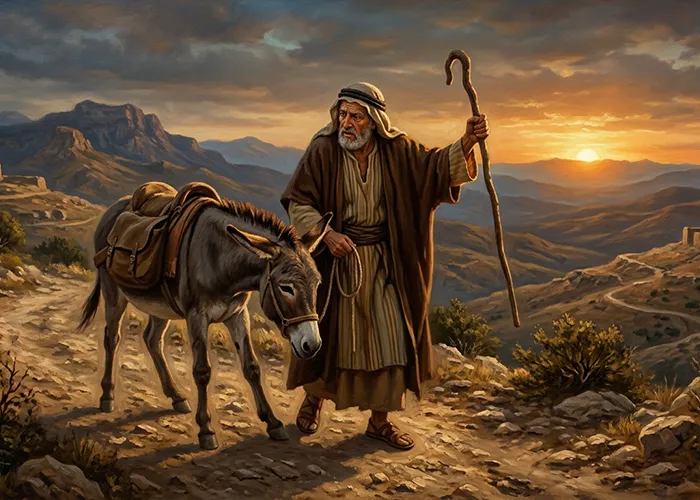
Balaam mounted his donkey to set out in search of Moses (pbuh). However, the animal refused to move. Balaam began beating it mercilessly. By God’s permission, the donkey was suddenly granted speech and cried out, “Woe to you! Why are you striking me? Do you intend to make me accompany you so that you may curse the Prophet of God (pbuh) and a people who believe in Him?”
Upon hearing these words, Balaam flew into even greater rage and beat the animal until it died. At that very moment, the knowledge of the Greatest Name of God was taken away from him. The Holy Qur’an portrays this moment of spiritual collapse in one of its most powerful metaphors:
“وَاتْلُ عَلَيْهِمْ نَبَأَ الَّذِي آتَيْنَاهُ آيَاتِنَا فَانْسَلَخَ مِنْهَا فَأَتْبَعَهُ الشَّيْطَانُ فَكَانَ مِنَ الْغَاوِينَ“
(Al-A’raf 7:175)
“And relate to them the story of the one to whom We gave Our signs, but he stripped himself of them; so Satan pursued him, and he became one of those who went astray.”
God then declares explicitly that Balaam possessed every opportunity to attain spiritual elevation through divine knowledge, yet he deliberately chose worldly degradation:
“وَلَوْ شِئْنَا لَرَفَعْنَاهُ بِهَا وَلَكِنَّهُ أَخْلَدَ إِلَى الْأَرْضِ وَاتَّبَعَ هَوَاهُ فَمَثَلُهُ كَمَثَلِ الْكَلْبِ إِنْ تَحْمِلْ عَلَيْهِ يَلْهَثْ أَوْ تَتْرُكْهُ يَلْهَثْ…”
(Al-A’raf 7:176)
“Had We willed, We would certainly have elevated him by means of these signs; but he clung to the earth and followed his own desires. Thus, his likeness is that of a dog: if you drive it away, it pants; and if you leave it alone, it still pants…”
Why the Metaphor of a Panting Dog? (يَلْهَث)
According to both Tafsir al-Mizan and Tafsir Nemuneh, this verse presents one of the Qur’an’s most profound psychological analyses of scholars who become enslaved by worldly desires. A dog possesses a unique physiological characteristic: even when it is neither thirsty nor burdened, and even while resting comfortably in the shade, it continues panting with its tongue hanging out. The point of comparison is therefore an insatiable thirst.
Balaam had reached such an advanced stage of worldly attachment that the clarity of the truth no longer mattered to him. His greed had become absolute. Whether people advised him or left him alone made no difference. Like a dog trapped in its constant panting, he was consumed by an endless craving for worldly gain. His knowledge did not bring him peace; instead, it only intensified his greed and spiritual hunger.
In the final act of his betrayal, Balaam advised the king, “Now that my prayers have lost their effect, the only way to weaken Moses’ army is to send beautiful women carrying merchandise into their camp. They will tempt the men of the Children of Israel into adultery and corruption. If even one of them commits fornication, God’s punishment will descend upon them.”
The scheme proved effective. Moral corruption spread through part of Moses’ camp, and a devastating plague claimed the lives of thousands among the Children of Israel. Balaam himself, however, died disgraced and humiliated, with a tormented soul and an eternal thirst for worldly desires, passing away in a state of disbelief.
The Role of the Elite in Society’s Downfall and Its Connection to Karbala
The story of Balaam son of Beor is a perfect reflection of the concept of the deviation of the elite. The elite are those whose knowledge, religious authority, or social standing grants them the power to shape the direction of society. When such individuals become attached to worldly interests “أَخْلَدَ إِلَى الْأَرْضِ“ (“he clung to the earth”) conceal the truth or fail to act when their leadership is needed most, they lead society across its most dangerous moral red lines.
The tragedy of Karbala represents the ultimate consequence of a society whose influential figures fell into various forms of deviation and miscalculation, dragging the entire community toward catastrophe:
- Judge Shurayh – The symbol of religious justification for oppression. The chief judge of Kufa accepted bribes from Ibn Ziyad and issued a religious ruling that legitimized the killing of Imam Husayn (peace be upon him).
- Umar ibn Sa’d – The symbol of greed and conscious compromise with falsehood. Fully aware of Imam Husayn’s rightful status, he nevertheless chose the governorship of Rayy over loyalty to the grandson of the Prophet (pbuh). Like Balaam, he sold his eternal destiny for worldly ambition.
- Abdullah ibn Umar – The symbol of complacency and politically convenient silence. Although he did not raise his sword against Imam Husayn (peace be upon him), his refusal to support him created hesitation and weakness among the wider Muslim community.
- Shimr ibn Dhi al-Jawshan – The symbol of a tragic end after apparent righteousness. Once a veteran fighter at the Battle of Siffin, jealousy and hatred gradually corrupted his heart until he became the direct murderer of Imam Husayn (pbuh).
- Sulayman ibn Surad al-Khuza’i – The symbol of sincere but shortsighted leadership. As the leader of the Shi’ites of Kufa, his greatest failure was his inability to recognize the decisive moment. When Muslim ibn Aqil stood abandoned in Kufa and Imam Husayn (pbuh) was surrounded in Karbala, he failed to act in time. Although he later led the Movement of the Penitents (Tawwabun) and was martyred, his repentance could never restore the severed head of the Imam (pbuh) to his body.
Lessons from Balaam son of Beor for Our Daily Lives
The story of Balaam son of Beor is far more than a historical tragedy concerning political or religious elites. It serves as a profound psychological and ethical guide for every individual striving for spiritual and personal growth. Hidden within this narrative are three spiritual “viruses” capable of destroying a person’s life even at the height of religious devotion and worldly success.
- The Danger ofʿUjb(Self-Admiration and Spiritual Pride)
When Balaam realized that his prayers were consistently answered and that crowds gathered around him in admiration, he became afflicted with ʿujb self-conceit born of spiritual achievement. He came to believe that he had reached an invulnerable spiritual rank.
Practical Lesson:
Whenever we begin to think that we are purer, more knowledgeable, more faithful, or more successful than others, we have already taken the first step toward our own downfall. Intellectual or religious arrogance is among the greatest veils over the human heart, blinding a person to his own faults. No one should become complacent about his present spiritual condition, for a blessed ending (ḥusn al-khātimah) is not a permanent possession but a lifelong process requiring constant vigilance.
- Envy: The Hidden Fuel of Everyday Conflicts
A major factor behind Balaam’s opposition to Prophet Moses (peace be upon him) was a concealed jealousy toward Moses’ divine mission and God-given authority. He could not bear to see another person entrusted with the leadership of God’s community.
Practical Lesson:
In daily life, envy destroys families, friendships, workplaces, and academic environments. Rather than directing our emotional energy toward self-improvement, jealousy consumes us with the desire to see others lose what they possess. Balaam’s story reminds us that envy is powerful enough to transform a saintly man whose prayers were answered into a criminal.
- Hidden Worldliness and the “Just This Once” Syndrome
Balaam’s downfall did not begin with a dramatic act of rebellion. It began with a seemingly harmless justification, “I will accept the king’s gifts, utter one brief curse, then repent afterward and return to worship.”
He failed to realize that once one willingly steps into the territory of falsehood, finding the way back becomes exceedingly difficult.
Practical Lesson:
Major moral failures in our lives whether violating the rights of others, accepting bribes, lying, betraying trust, or trampling on people’s rights rarely begin with a single dramatic decision. Rather, they almost always start with the familiar excuses: “Just this once” or “It’s necessary under the circumstances.” Worldliness does not necessarily mean living in palaces or accumulating vast wealth. It means consistently choosing immediate material gain over moral principles and the dictates of conscience in our everyday decisions.
Conclusion
The story of Balaam son of Beor teaches us that knowing the truth is not the same as standing firmly by the truth. Balaam recognized the truth, yet he lacked the courage and sincerity to remain faithful to it.
To avoid sharing his fate, every person regardless of the level of knowledge, expertise, or spirituality they attain needs two indispensable wings:
- Humility before God and His creation, which protects the soul from the disease of self-admiration (ʿujb); and
- Constant vigilance over one’s lower desires, preventing the heart from developing the insatiable craving that the Qur’an so vividly compares to the endless panting of a dog.
Only through these two virtues can knowledge become a means of elevation rather than a cause of ruin.
Selected References
- The Holy Qur’an, Surah Al-A’raf (7), verses175–176.
- Tafsir al-Mizan, Allamah Muhammad Husayn Tabataba’i, Vol. 8 (commentary on the verses concerning Balaam and the metaphor of spiritual degeneration).
- Tafsir Nemuneh, Ayatollah Naser Makarem Shirazi, Vol. 7 (analysis of insatiable greed and the corruption of religious elites).
- Bihar al-Anwar, Allamah al-Majlisi, Vol. 13 (accounts of Balaam); Vols. 44–45 (history of Karbala, Judge Shurayh, Umar ibn Sa’d, and the Movement of the Penitents led by Sulayman ibn Surad).
- Tarikh al-Umam wa al-Muluk (History of al-Tabari), Muhammad ibn Jarir al-Tabari, Vol. 5 (events of 60–61 AH, the activities of the Shi’ites of Kufa, and the correspondence of Sulayman ibn Surad al-Khuza’i).
- Al-Futuh, Ibn A’tham al-Kufi, Vol. 5 (detailed account of the positions adopted by the notables of Kufa and Sulayman ibn Surad’s failure to support Muslim ibn Aqil in time).
- Rijal al-Tusi, Shaykh al-Tusi (biographical studies of the companions of Imam Husayn (peace be upon him) and Abdullah ibn Umar).
editor's pick

news via inbox
Subscribe to the newsletter.