
Editorial – volume 03 Issue 24
The Calendar as a Moral Classroom
Introduction:
As the lunar year turns, this issue gathers events that are not merely to be remembered, but to be lived. Each one asks Muslims to turn history into integrity, worship into service, and knowledge into better conduct.
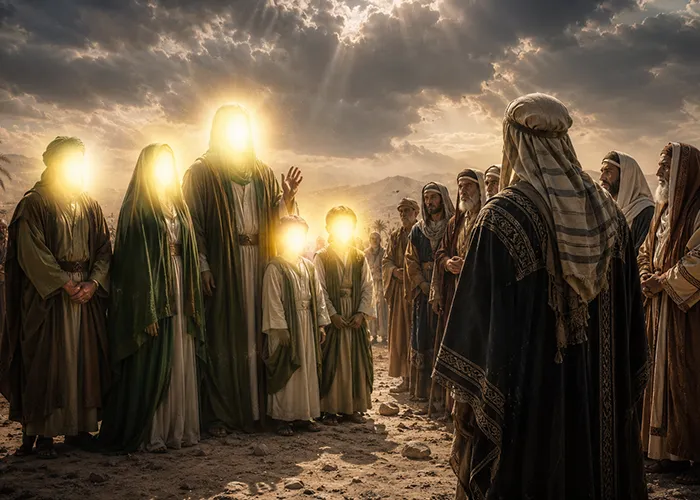
24 Dhu al-Hijjah: The Mubahalah with the Christians of Najrān; Revelation of the Verse of Purity
The Qur’an refers to the Prophet’s challenge to a Christian delegation from Najrān after debate over the nature of Jesus, inviting both sides to a solemn prayer in which truth would be made manifest. Muslim tafsīr literature links this passage with the celebrated episode of Mubāhalah and also places great emphasis on the verse of purity associated with the Prophet’s household.
Message for Today:
The Prophet’s reliance (peace be upon him) in the event of Mubahala – by the will of Almighty God – was on his faithful family. Safeguard your own faith and the faith of your family members and children as an unparalleled asset, especially in a time when irreligion has become widespread.
24 Dhu al-Hijjah: Imam ʿAlī’s Gift of His Ring in Rukūʿ (Āyat al-Wilāyah)
Well-known commentary on Qur’an 5:55 preserves the well-known narration that Imam ʿAlī(a.s) gave his ring to a needy person while bowing in prayer, an act later read by many Muslims as deeply symbolic of faith expressed through generosity. The verse itself joins devotion, charity, and loyalty under one moral canopy:
إِنَّمَا وَلِيُّكُمُ اللَّهُ وَرَسُولُهُ وَالَّذِينَ آمَنُوا الَّذِينَ يُقِيمُونَ الصَّلَاةَ وَيُؤْتُونَ الزَّكَاةَ وَهُمْ رَاكِعُونَ
“Your true guardians are God, His Messenger, and the believers who establish prayer and give alms with humility.” (Quran – 5:55)
Message for Today:
Complete and give lasting impact to your acts of worship by helping those in need.
24 Dhu al-Hijjah: The Rise of the Sarbedārān
The Sarbedaran Movement was a historic Shi’a religious uprising in Sabzevar during the 8th century AH (14th century CE). It emerged in opposition to Mongol oppression and brought an end to more than a century of Mongol domination over Iran.
Message for Today:
Do not remain silent in the face of oppression. Sometimes, at the very least, we can resist an oppressor by refusing to buy their goods.
27 Dhu al-Hijjah: The End of Umayyad Rule
The Umayyad Caliphate, founded by Muawiyah ibn Abi Sufyan in 41 AH, continued its disgraceful rule for 91 years. Throughout this period, it committed numerous acts of oppression, injustice, and bloodshed against Muslims. The fall of the Umayyad regime demonstrated that the ultimate fate of tyranny, injustice, and arrogance is a painful one, and that the end of oppressors and the haughty is marked by hardship, suffering, and humiliation even in this world.
Message for Today:
Do not be discouraged by the false grandeur of oppressors in today’s world. Their end will be painful.
28 Dhu al-Hijjah: The Incident of al-Ḥarra
The Battle of al-Ḥarra, fought in 683 CE, took place between the forces of Yazid I on one side and the Anṣār and Muhājirūn residing in Medina who opposed his caliphate on the other. Despite the military strength of the Muslims of Medina, the city ultimately fell after the betrayal of one of the groups living there. Yazid’s forces then entered Medina and carried out widespread looting and bloodshed.
Message for Today:
Be vigilant against traitors and against those who, despite outwardly identifying as Muslims, act foolishly and undermine the well-being of Muslim societies.
28 Dhu al-Hijjah: The Death of Mulla Hādī Sabzevārī
Hājjī Hādī Sabzevārī was an Iranian teacher and philosopher who advanced the hikmah tradition of Islamic philosophy and founded a school that drew students from far beyond his native city. His intellectual legacy lay in fusing revelation, gnosis, and philosophy into a disciplined tradition of thought.
Message for Today:
Seek knowledge that deepens worship and makes the mind more humble.
29 Dhu al-Hijjah: The Passing of Āyatullāh Muḥammad Hādī Maʿrifat
Ayatollah Muhammad Hadi Maʿrifat was a distinguished contemporary Shiʿi scholar and Qur’anic expert, known for his work on the history, exegesis, and sciences of the Qur’an. His books helped many readers approach the Qur’an with both fidelity and analytical care.
Message for Today:
Make learning, understanding, and living by the teachings of the Holy Qur’an the highest priority in your life and in the lives of your family members.
1 Muharram: The Beginning of the Hijri Lunar Year
The Hijri lunar calendar is reckoned from the migration (Hijrah) of the Noble Prophet of Islam (peace be upon him) from Mecca to Medina, and its first year begins with the first day of Muḥarram. Thus, this calendar does not begin with a birth or a coronation, but with migration, sacrifice, and the establishment of a community of believers devoted to God.
Message for Today:
Begin the year with repentance, purpose, and a clearer sense of mission.
1 Muharram: Abraha’s March on Mecca
Abraha was an Ethiopian Christian viceroy in Yemen, famous in Islamic tradition for the failed expedition against Mecca in the year of the Prophet’s birth. Muslim memory associates this event with divine protection of the Sacred House and with the surah of the Elephant.
Message for Today:
Do not be dazzled by power; place your trust in God, not in force.
1 Muharram: The Boycott and Confinement in Shiʿb Abī Ṭālib
The boycott of Banū Hāshim forced the Prophet (pbuh) and his companions into Shiʿb Abī Ṭālib, where they endured years of economic and social pressure. Islamic historical memory preserves it as a time of deprivation, solidarity, and endurance under siege.
Message for Today:
When pressure comes, remain united, faithful, and generous to one another.
1 Muharram: The Prophet’s Instruction for Zakat Collection
With the establishment of the Muslim community in Madīnah, zakāt became an organised institution rather than a private act of generosity. The Prophet Muhammad (peace be upon him) appointed collectors to gather it, ensuring that wealth was purified and redistributed in a fair and orderly manner. The Qur’an directly addresses the Prophet’s role in collecting zakāt:
خُذْ مِنْ أَمْوَالِهِمْ صَدَقَةً تُطَهِّرُهُمْ وَتُزَكِّيهِمْ بِهَا
“Take from their wealth a charity by which you purify them and cause them increase.” (Qur’an 9:103)
This verse shows that zakāt is not merely a social duty, but a means of purification for both the giver and the community.
Message for Today:
Make your wealth cleaner by making your community less needy.
26 Khordad: The Commemoration of Moḥtasham Kāshānī, Day of Devotional Poetry
Moḥtasham Kāshānī was a Persian poet of the Safavid period whose fame rests especially on his elegy for Imām Ḥusayn (a.s) at Karbalā. His verses became deeply woven into Muharram culture and remain among the most recognized works of classical devotional poetry.
Message for Today:
Use words that awaken conscience and deepen love for truth.
editor's pick

news via inbox
Subscribe to the newsletter.