
Everlasting Tales of the Quran – Volume 03 Issue 38
Victory Without a Sword: The Epic of Peace at Hudaybiyyah
In Islamic culture, peace is not an emergency tactic; it is a fundamental principle and a divine value. The Holy Qur’an describes peace and reconciliation as the “absolute good”:
وَالصُّلْحُ خَيْرٌ (النساء ۱۲۸)
And reconciliation is best. (Qur’an 4:128)
It also calls upon believers to enter fully into peace:
ادْخُلُوا فِي السِّلْمِ كَافَّةً (البقره ۲۰۸)
Enter into peace, all of you. (Qur’an 2:208)
The Treaty of Hudaybiyyah, concluded in the sixth year after the Hijrah, is the most prominent practical example of this teaching in the life of the Prophet (pbuh). It was a peace agreement that the Qur’an described not as a retreat, but as a “manifest victory.” This account is based on that very event.
The Pilgrims in Ihram Set Out
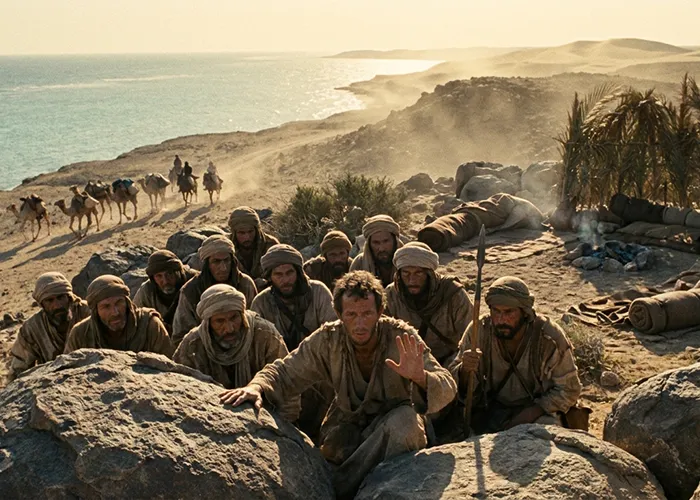
Fourteen hundred Muslims, wearing ihram and intending to visit the House of God, set out with the Prophet Muhammad (peace be upon him) from Medina toward Mecca. The journey was based on a true vision that the Prophet (pbuh) had seen -a vision of circumambulating the Kaaba and having their heads shaved. But the Quraysh, fearing another defeat, blocked the way. Cavalry under the command of Khalid ibn al-Walid was stationed along the route, and the caravan was forced to stop in the area of Hudaybiyyah. To demonstrate his peaceful intentions, the Prophet(pbuh) had brought sixty-six camels for sacrifice.
At that moment, the Prophet’s she-camel, Qaswa, knelt down and refused to move. Some said, “Qaswa has become exhausted.” But the Prophet(pbuh) replied:
“She is not exhausted. The same power that restrained the elephants of Abraha has restrained her as well. By God, I will accept any proposal in which the sanctities of God are respected.”
The water of the relatively dry well of Hudaybiyyah also began to flow after the Prophet(pbuh) cast an arrow into it, providing water for the entire caravan.
The Quraysh Envoys Come and Go
The atmosphere was filled with mistrust. Representatives of the Quraysh arrived one after another. ‘Urwah ibn Mas‘ud al-Thaqafi came in a threatening manner and even reached out and touched the Prophet’s beard. Al-Mughirah ibn Shu‘bah pushed his hand away and said:
“Take your hand away.”
After witnessing the extraordinary respect the Companions showed toward the Prophet(pbuh) -even collecting the drops of water from his ablution for blessings- ‘Urwah returned to Mecca in astonishment and said:
“I have been in the courts of Khosrow, Caesar, and the Negus. I have never seen anyone among his people treated as Muhammad is treated. Accept his proposal.”
The Pledge of Ridwan
‘Uthman ibn ‘Affan, who had gone to Mecca to negotiate, was detained there, and a rumor spread among the Muslims that he had been killed. The Prophet (pbuh) stood beneath a tree and called the people to the Pledge of Ridwan -a pledge to remain steadfast to the very last breath. The breeze of sakina– divine tranquillity -settled upon their hearts, and the Muslims pledged their allegiance one by one.
The Writing of the Peace Treaty Begins
After this pledge, Suhayl ibn ‘Amr arrived as the representative of the Quraysh. The Prophet(pbuh) said: “The matter has become easier.”
‘Ali (peace be upon him) was appointed to write the agreement. The Prophet (pbuh) said: “Write: Bismillah al-Rahman al-Rahim.”
Suhayl objected: “We do not know the Merciful (al-Rahman). Write instead: Bismika Allahumma.”
The Prophet (pbuh) calmly accepted. He then said: “Write: This is a treaty between Muhammad, the Messenger of God…” Suhayl objected: “If we believed that you were the Messenger of God, we would not have fought you. Write: Muhammad ibn ‘Abdullah.”
‘Ali (peace be upon him) could not bring himself to erase the words “Messenger of God.” The Prophet (pbuh) himself erased them and said: “O ‘Ali, one day you too will find yourself in such a situation, and you will wrongfully be compelled to sign a document.”
The Terms of the Peace Treaty
The treaty included the following provisions:
- A cessation of hostilities for ten years.
- Freedom for the tribes to join whichever side they wished.
- The Muslims would return from Hudaybiyyah that year without performing the pilgrimage.
- A difficult condition: if a person from the Quraysh accepted Islam and went to Medina, he would have to be returned to Mecca; however, if a Muslim apostatized and went to Mecca, he would not be returned.
At that very moment, Abu Jandal, Suhayl’s son, arrived among the Muslims fleeing in chains, with his hands and feet bound, and pleaded for help. Suhayl shouted: “This is the first test of your faithfulness to the treaty, Muhammad! Return him.”
With a heavy heart, the Prophet (pbuh) comforted Abu Jandal: “Be patient, O Abu Jandal. God will provide a way out for you and your companions.”
Objections from Some of the Companions
The apparent terms of the treaty were difficult for some of the Companions to accept. ‘Umar, deeply concerned, said: “Are we not in the right? Why should we submit to humiliation in matters of our faith?”
The Prophet (pbuh) replied: “I am the servant and Messenger of God. I will not disobey His command, and He is my helper.”
The Prophet (pbuh) then instructed the Muslims to sacrifice their animals and leave the state of ihram. At first, the Companions hesitated. Umm Salamah suggested that the Prophet (pbuh) himself should go out, perform his sacrifice, and shave his head; the people would follow his example.
And that is what happened. The Companions, with tears in their eyes and hearts still filled with uncertainty, performed the rites.
The Return Journey and the Revelation of the Verse of Victory
On the journey back, one of the Muslims said: “What kind of victory was this? We neither entered Mecca nor succeeded in keeping our companions with us.”
The Prophet (pbuh) replied: “What an incorrect thing you have said! This was the greatest victory. The enemy who intended to destroy you is now asking for peace.”
At that very moment, the verse of victory was revealed:
إِنَّا فَتَحْنَا لَكَ فَتْحًا مُبِينًا (فتح/۱)
Indeed, We have granted you a manifest victory. (Qur’an 48:1)
The blessings of this apparently bitter victory soon became evident. Under the terms of the treaty, the Quraysh demanded the return of Abu Basir, a newly freed Muslim who had escaped from Mecca. The Prophet (peace be upon him), faithful to the agreement, handed him over. But on the way, Abu Basir overpowered and killed his guard and fled to the coastal region known as Sayf al-Bahr.
Abu Jandal and dozens of other young Muslims soon joined him. Because, under the treaty, they could not go to Medina, they began ambushing the Quraysh’s commercial caravans along their trade routes. They put such pressure on the economic lifeline of Mecca that the Quraysh eventually sent envoys pleading with the Prophet (peace be upon him) to waive that condition and asking him to summon those Muslims to Medina.
Thus, a peace agreement that had initially appeared humiliating opened the way for the unprecedented spread of Islam throughout the Arabian Peninsula and became a major prelude to the eventual conquest of Mecca.
Lessons and Strategic Insights from Hudaybiyyah
An analysis of the events of Hudaybiyyah shows that this episode of history is not merely a political or historical event. Rather, it offers a foundational framework for behavioral leadership, strategic thinking, and ethical living. Its instructive lessons can be summarized under several themes:
- The priority of rationality over emotion and slogans:During the drafting of the treaty, many of the Companions, influenced by religious zeal and the emotions of the moment, regarded acceptance of the Quraysh’s conditions as “submitting to humiliation.” The Prophet (peace be upon him) taught them that, at times, accepting apparent compromises in order to achieve greater objectives and preserve the life and security of the community is itself an act of courage and rationality -not retreat.
- The distinction between principles and secondary matters in strategy:The Messenger of God (peace be upon him) stood firm on the fundamental principle of his mission and the preservation of the Islamic community, but he did not insist on titles and outward forms, such as retaining the words “Messenger of God” in the treaty. This conduct demonstrates that, in negotiations and peace agreements, secondary matters and formal titles should never become obstacles to achieving the fundamental objective.
- The unparalleled power of a peaceful environment in advancing truth:War and a climate of insecurity close people’s minds and inflame resentment. The Prophet (peace be upon him) demonstrated that Islam flourishes in an atmosphere of security, reason, and dialogue. The true victory at Hudaybiyyah came about because peace gave people the opportunity to think, and groups of people gradually embraced the truth.
- Commitment to ethics and agreements, even in dealing with an enemy:The episode of returning Abu Jandal to the Quraysh after the initial agreement is one of the highest examples of trust-building and honoring a covenant. Islam is founded on the principle that a sacred objective cannot be achieved through unethical means or betrayal of an agreement.
- Human dignity and the value of consultation and reassurance:The wise role played by Umm Salamah in encouraging the Prophet (pbuh) to leave his tent and perform the rites, as well as the restoration of sakina (tranquility) to a troubled community, demonstrates the importance of consultation, solidarity, and crisis management under difficult social circumstances.
Sources for the Event of Hudaybiyyah
The historical event of the Treaty of Hudaybiyyah and the events associated with it are documented in detail in the Holy Qur’an and in early collections of Islamic traditions and hadith.
Qur’anic Sources
The principal Qur’anic source for this episode is Surah al-Fath, which was revealed on the journey back from Hudaybiyyah to Medina.
Hadith and Early Historical Sources
- Tafsir al-Qummi – ‘Ali ibn Ibrahim al-Qummi, vol. 2, p. 302 onward
- al-Kafi – Shaykh al-Kulayni, vol. 8, p. 322
- al-Irshad fi Ma‘rifat Hujaj Allah ‘ala al-‘Ibad – Shaykh al-Mufid, vol. 1, p. 119 onward
- Majma‘ al-Bayan fi Tafsir al-Qur’an – Shaykh al-Tabrisi, commentary on Surah al-Fath
- al-Sirah al-Nabawiyyah – Ibn Hisham, vol. 3, p. 308 onward
- al-Maghazi – Muhammad ibn ‘Umar al-Waqidi, vol. 2, p. 571 onward
- Sahih al-Bukhari – Book of Conditions, chapter on conditions in jihad, hadith nos. 2731–2732
- al-Durr al-Manthur fi al-Tafsir bi’l-Ma’thur – Jalal al-Din al-Suyuti, vol. 6, p. 71 onward
editor's pick

news via inbox
Subscribe to the newsletter.