Imamate: The Legacy and Writings of Āyatullāh Murtaḍā Muṭahharī
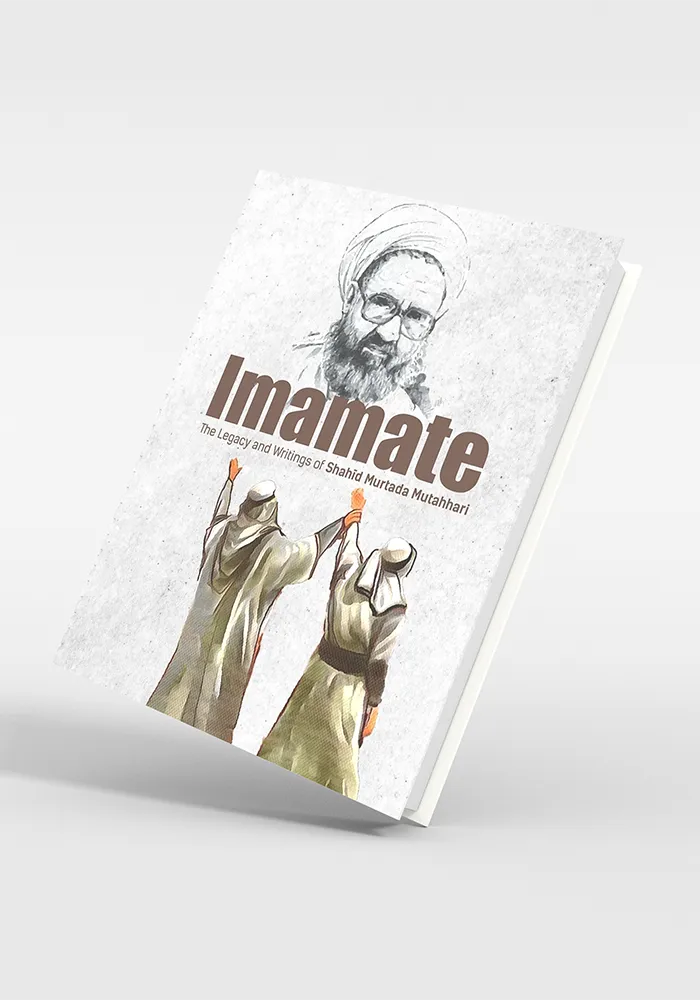
Imamate: The Legacy and Writings of Āyatullāh Murtaḍā Muṭahharī
Occasion for presenting this book:
12 Ordibehesht / 2 May: Martyrdom of Ustad Mortaza Motahhari – Teacher’s Day
Book Bibliographic Details:
Author: Ayatullah Murtadha Mutahhari
Publisher: Al-Burāq
Length: 218 Pages
Language: English
ISBN: 978-1956276084
Publication Date: November 15, 2021
About the Book:
In his book about the Imamate, Muṭahharī begins with the idea that the word Imām itself is not sacred. The Imām is the leader and the head of the people. In religious terminology, the ancients define the Imamate as general leadership in the matters of this world and religion. After these quick introductions, Muṭahharī speaks about three ranks of Imamate that depend on the role given to the Imām. These three ranks are drawn from the Prophet’s (s) roles in the ummah. His first role was being a prophet connected to heaven, Allah, the realm of the unseen, and revelation. In this regard, he was an explainer of the things he received from heaven. In addition, the Prophet (s) had another role, which was adjudicating between the Muslims. The Prophet (s) usually adjudicated based on apparent proofs in all but exceptional cases, judging according to objective standards. The Prophet (s) had another role related to being the ruler of the Muslims, the leader of Islamic society, the guardian of the affairs of the Muslims, and the head of the state. In this regard, the Prophet (s) practiced his duties based on Allah’s permission.
Muṭahharī emphasizes the point that in the presence of the Prophet (s), there is no room to ask about the identity of the head of state and the political and social leader of the ummah. When the infallible who is guided by heaven is present, no one can precede him in ruling. Based on this clarification, Muṭahharī establishes three ranks of the Imamate that depend on the Imām’s roles.
The idea of religious authority comes from the fact that the noble Prophet (s) did not have the chance to explain the entirety of Islam to the entirety of the ummah. New issues came up due to the expansion of the Islamic world, the Muslims’ mixing with other nations, and the development of the civil rule of the state and society. These factors made the ummah need a period of time when it would rely on a scholarly authority. This authority had to be one that received Islam in its complete form from the Prophet (s). This role was given to the Imām after the Prophet (s). In this book, Shahīd Muṭahharī expands on the Imamate from various angles in a highly accessible manner.
About the Author:
Ayatullah Murtaza Mutahhari (1919–1979) was a towering intellectual powerhouse who served as a vital bridge between the traditional Islamic seminary and the modern university. A brilliant philosopher, theologian, and social reformer, he was a key disciple of Allameh Tabatabai and Ayatollah Khomeini, dedicating his life to presenting Islam as a rational, dynamic system capable of solving contemporary social and political challenges. Mutahhari’s prolific body of work – ranging from deep philosophical treatises on Divine Justice to insightful critiques of Western ideologies and discussions on women’s rights – is celebrated for its clarity, logical rigor, and refusal to shy away from difficult questions. As a leading intellectual architect of the Iranian Revolution, his legacy remains foundational for anyone seeking a sophisticated synthesis of ancient spiritual tradition and modern intellectual inquiry.
Where to find it:
You can find the book at one of the online bookstores below:
- Al-Buragh Publication
- House of Taha
- Shia Books Australia
- Amazon
editor's pick

news via inbox
Subscribe to the newsletter.