Everlasting Tales of the Quran – Volume 03 Issue 35
Young People of Light in an Age of Darkness: The Story of the Companions of the Cave
In a distant age, when the darkness of polytheism had spread across the Roman lands and a tyrannical king named Daqyanus (Decius) forced people to bow before idols, a group of young, noble and pure-hearted men secretly carried a profound truth within their hearts: faith in the One God.
At the beginning of their story, Allah describes them in a remarkable way:
أَمْ حَسِبْتَ أَنَّ أَصْحَابَ الْكَهْفِ وَالرَّقِيمِ كَانُوا مِنْ آيَاتِنَا عَجَبًا
“Or did you think that the Companions of the Cave and the Inscription were among Our most wondrous signs?” (Surah al-Kahf, 18:9)
These young men were six in number. They were among the ministers and close advisers of Daqyanus: Maxalmina, Tamlikha (Yamlikha), Martunus, Dhu Nawas, Sarinus, and Kashfutatut. Outwardly, they appeared to be loyal to the king, but inwardly their hearts were illuminated by faith in God.
The Annual Festival and the Moment of Awakening
Every year, Daqyanus held a grand festival at which all the nobles were required to offer sacrifices before his idols. During one such festival, while the king was wearing his crown, news arrived that a tribe had been defeated. The king trembled with fear, and his crown fell from his head.
At that very moment, Tamlikha quietly said to his companions: “If this man is the god of the earth, why does he tremble at the news of such an event? Our God is the One who created the heavens and the earth.” Through gestures and exchanged glances, they made a pact with one another. Without bowing before the idols, they quietly left the gathering.
Their Encounter with the King
The news reached Daqyanus. He summoned the young men and saw that they had abandoned their official robes and were prepared to defend their faith. The Qur’an describes this moment:
وَرَبَطْنَا عَلَىٰ قُلُوبِهِمْ إِذْ قَامُوا فَقَالُوا رَبُّنَا رَبُّ السَّمَاوَاتِ وَالْأَرْضِ لَن نَدْعُوَ مِن دُونِهِ إِلَهًا
“And We strengthened their hearts when they stood up and said: ‘Our Lord is the Lord of the heavens and the earth. Never will we call upon any deity besides Him.’” (Surah al-Kahf, 18:14)
Daqyanus said to them: “You are young. It would be a great shame for you to be killed.”
He gave them one night to reconsider their beliefs and return to his religion. But they had already made their decision. Under the cover of darkness, they took their horses, distributed their wealth among the poor, and fled the city.
The Shepherd and the Faithful Dog
On their journey through the mountains, they came across a shepherd. They presented their faith to him, and the shepherd also embraced the faith. He said:“I will come with you, but I must first return the people’s sheep.”
He returned the sheep and then came back. However, his dog, Qitmir, followed the young men.
No matter how many stones they threw to make the dog turn back, it refused to leave them. According to narrations, the dog said:“Do not be afraid of me. I love the friends of God.”
Entering the Cave of Banjalus
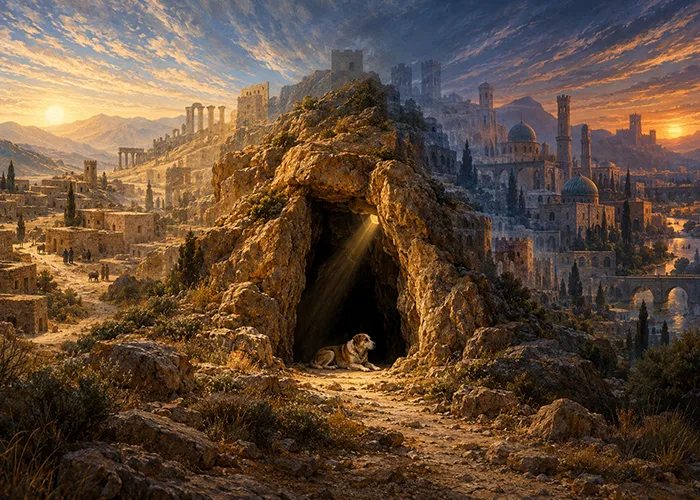
The young men eventually reached Mount Banjalus and entered a cave. They performed their prayers, and at that very moment, Allah caused them to fall into a deep sleep. The Qur’an describes the scene:
وَكَلْبُهُمْ بَاسِطٌ ذِرَاعَيْهِ بِالْوَصِيدِ
“And their dog stretched out its forelegs at the entrance of the cave.” (Surah al-Kahf, 18:18)
Allah caused them to turn from side to side so that their bodies would remain preserved.
This divinely ordained sleep lasted for more than three centuries:
وَلَبِثُوا فِي كَهْفِهِمْ ثَلَاثَ مِائَةٍ سِنِينَ وَازْدَادُوا تِسْعًا
“And they remained in their cave for three hundred years, adding nine more.” (Surah al-Kahf, 18:25)
Awakening After 309 Years
By the will of Allah, they awoke. They thought that they had slept for only a day or part of a day. They were hungry, so Yamlikha went into the city carrying an old coin to buy some food. But the city was no longer the city they remembered. People were openly speaking of Prophet Jesus (pbuh), son of Mary, and of Allah. Even the city gates had changed. When the baker saw the ancient coin, he said:“You must have found a treasure!”
Yamlikha was taken before the believing king of that time, Bidrus. He explained what had happened, but nobody initially believed him. The king and the scholars eventually decided to accompany him to the cave.
Returning to the Cave and Their Final Prayer
As they approached the cave, Yamlikha said:“Wait here so that my companions will not become frightened.” He entered the cave and told them what had happened during the 309 years.
The young men thanked Allah and asked Him to take their lives, because they did not wish to become involved in the trials and disturbances of the new age. Allah accepted their prayer and caused their souls to depart. The king and the people entered the cave and found the lifeless bodies of the young men. A disagreement arose over how they should be honoured. The Qur’an says:
قَالَ الَّذِينَ غَلَبُوا عَلَىٰ أَمْرِهِمْ لَنَتَّخِذَنَّ عَلَيْهِمْ مَسْجِدًا
“Those who prevailed in the matter said: ‘We will surely build a place of worship over them.’” (Surah al-Kahf, 18:21)
Who Was Daqyanus?
In Islamic sources, Daqyanus is described as a polytheistic Roman king. Some researchers have identified him with the Roman Emperor Decius, who in around 250 CE required people to offer sacrifices to the Roman gods and persecuted Christians. The Qur’an does not mention Daqyanus by name. Instead, it focuses on the faith and courage of the young men:
إِنَّهُمْ فِتْيَةٌ آمَنُوا بِرَبِّهِمْ وَزِدْنَاهُمْ هُدًى
“Indeed, they were young men who believed in their Lord, and We increased them in guidance.” (Surah al-Kahf, 18:13)
Why Did They Not Remain in Society After Their Awakening?
The story of the Companions of the Cave is not merely a story about sleep, time, or a miraculous event. At its heart is a lesson about faith, courage, and remaining steadfast when truth is under pressure. The young men had already sacrificed their wealth, position, security, and homeland for the sake of their faith. When they awoke after 309 years, they found themselves in a completely transformed society. Their mission had been fulfilled: Allah had preserved them as a sign of His power and as an example for generations to come.
Their final departure from this world can therefore be understood not as an escape from society out of fear, but as the completion of a remarkable divine sign. Their story reminds believers that time changes societies, rulers, and circumstances, but sincere faith in Allah remains unchanged.
- Their Divine Mission Had Been Fulfilled
The Companions of the Cave were an “Ayah” (sign) and a tangible miracle demonstrating the truth of the Resurrection and the life after death. At the time of their awakening, during the reign of the believing king Bidrus, society was deeply divided over the reality of bodily resurrection, with some people considering the resurrection of the dead to be impossible.
When the Companions of the Cave awoke and their survival after 309 years of a sleep resembling death became known, the proof was established for everyone. The Qur’an describes the purpose of this event:
وَكَذَٰلِكَ أَعْثَرْنَا عَلَيْهِمْ لِيَعْلَمُوا أَنَّ وَعْدَ اللَّهِ حَقٌّ
“And thus We caused them to be discovered so that they might know that the promise of Allah is true.” (Surah al-Kahf, 18:21)
Once this purpose had been fulfilled, their historical mission had come to an end.
- They No Longer Belonged to the New Age
They were people from more than three centuries earlier. Their families, friends, social connections, and entire way of life had disappeared. Living in a city whose culture and lifestyle had no connection with the world they had known would have been neither practical nor desirable for them.
A narration recorded in Tafsir al-Qummi relates that when Tamlikha told his companions about their 309-year sleep and the transformation of the world around them, they all raised their hands in prayer and said:“Our Lord, now that You have shown the people the sign of faith, return us to our former state and take our lives, so that we may not become involved in the trials and strange circumstances of this new world.” Allah accepted their prayer.
- The Presence of Prophets (pbut) and Guides in That Era
The Companions of the Cave were not Prophets (pbut) or Imams (pbut) entrusted with a divinely legislated religious system, whose responsibility was to guide the entire society or establish a government. Rather, they were “believing young men who struggled for the sake of faith” (fityah).
By the time they awoke, Christianity had become openly established, and religious guides and monotheistic scholars were present in society. Therefore, there was no need for them to assume the role of direct public guides, rulers, or religious teachers.
- Being Preserved for the Era of the Appearance
According to some narrations, Allah caused them to enter a deep sleep once again so that they would be preserved for the Era of the Appearance of Imam al-Mahdi (AJ) and would become among his companions.
Lessons from the Story
- Personal and Spiritual Development
- The greatest lesson of the Companions of the Cave is the preservation of one’s identity and faith in the most corrupt of societies. They demonstrated that the majority is not necessarily an indication of truth, and that a person should not simply follow a misguided society.
- After declaring their beliefs, they did not simply sit back and wait. At the same time, they did not act recklessly or without planning. They requested time, distributed their wealth, planned their escape, and then placed their trust in Allah:
فَأْوُوا إِلَى الْكَهْفِ يَنشُرْ لَكُمْ رَبُّكُم مِّن رَّحْمَتِهِ
“So take refuge in the cave; your Lord will spread His mercy over you.”
- Even after 309 years of sleep, and while suffering from extreme hunger, their first concern was to ensure that the food they obtained was wholesome and lawful:
فَلْيَنظُرْ أَيُّهَا أَزْكَىٰ طَعَامًا فَلْيَأْتِكُم بِرِزْقٍ مِّنْهُ
“Let him look for which food is purest and bring you some provision from it.”
This demonstrates that the purity of what a person consumes is an important condition for preserving the light of faith.
- Principles of Management and Conduct
- According to the narrations, before leaving the city, they distributed their wealth and possessions among the needy. In this way, they not only freed themselves from worldly burdens but also helped a society that was suffering under oppression.
- Educational and Social Lessons
- The Qur’an’s description of them as “فِتْيَة” (young men) highlights their spirit of transformation, courage, and openness to the truth. Young hearts, because they may have fewer deep attachments to worldly interests, can be more receptive to truth.
- Along this journey, the noblemen of Rome formed an alliance with a simple shepherd. The basis of their companionship was faith, not wealth, social status, or position.
- The companionship of the dog Qitmir, and the Qur’an’s specific mention of its presence at the entrance of the cave:
وَكَلْبُهُم بَاسِطٌ ذِرَاعَيْهِ بِالْوَصِيدِ
“And their dog stretched out its forelegs at the entrance of the cave.”
provides a profound lesson about appreciating loyalty and the influence of companionship with righteous people. Even an animal associated with the righteous can attain an honoured place in history through its companionship with them.
- Intellectual and Monotheistic Lessons
- Whenever an environment becomes so corrupt that it is no longer possible to live faithfully within it, migration (Hijrah) -even if it means undertaking a difficult journey or seeking refuge in a secluded cave- may be preferable to remaining and gradually becoming coloured by that corruption.
- The awakening of the Companions of the Cave after 309 years provides one of the most tangible educational examples of belief in the Resurrection and the revival of the dead after death.
Qur’anic Source
- Surah al-Kahf, verses 9-26.
Narrational and Exegetical Sources
- Tafsir al-Qummi : by Shaykh Ali ibn Ibrahim al-Qummi (a scholar of the 3rd-4th centuries AH), vol. 2, pp. 31-34.
- Bihar al-Anwar : Allamah Muhammad Baqir al-Majlisi, vol. 14, Chapter 28: The Story of the Companions of the Cave and al-Raqim, pp. 408-440.
- Tafsir Majma’ al-Bayan : Shaykh al-Tabrisi, commentary on verses 9–26 of Surah al-Kahf, vol. 6, pp. 695–715.
- Tafsir Nur al-Thaqalayn : Abd Ali ibn Jum’ah al-‘Arusi al-Huwayzi, vol. 3, pp. 242–262.
- Al-Irshad : Shaykh al-Mufid (d. 413 AH), vol. 2, p. 383.
- Al-Ghaybah : Shaykh al-Tusi (d. 460 AH), p. 475.
- Al-Kashif : Allamah Muhammad Jawad Mughniyah, vol. 5, p. 109.
- Tafsir al-Mizan : Allamah Sayyid Muhammad Husayn Tabataba’i, vol. 13, pp. 268–274.
- Mukhtasar Basa’ir al-Darajat : Hasan ibn Sulayman al-Hilli (9th century AH), p. 178.
- Bihar al-Anwar : Allamah al-Majlisi, vol. 53, p. 90 (Chapter on al-Raj’ah, Hadith 95); and vol. 52, p. 346.
- Tafsir al-‘Ayyashi : Muhammad ibn Mas’ud al-‘Ayyashi, vol. 2, p. 32.
The Narration Concerning the Debate of Imam Ali (ع) with Ra’s al-Jalut
A well-known narration describes a debate between Imam Ali (ع) and Ra’s al-Jalut, or Jewish scholars, during the caliphate of Umar ibn al-Khattab. The narration discusses details including the names of the ministers, the name of the king, and the correspondence between 300 solar years and 309 lunar years. It is recorded in the following sources:
- Kamal al-Din wa Tamam al-Ni’mah : Shaykh al-Saduq (d. 381 AH), vol. 1, pp. 31-36.
- Qisas al-Anbiya’ : Qutb al-Din al-Rawandi (d. 573 AH), pp. 254-262.
- Bihar al-Anwar : Allamah al-Majlisi, vol. 14, p. 411 (Hadith 1), and vol. 10, p. 118.
- Tafsir al-‘Ayyashi : Muhammad ibn Mas’ud al-‘Ayyashi, vol. 2, p. 321.
editor's pick

news via inbox
Subscribe to the newsletter.