
Fatwa Panel of the Week – Volume 03 Issue 24
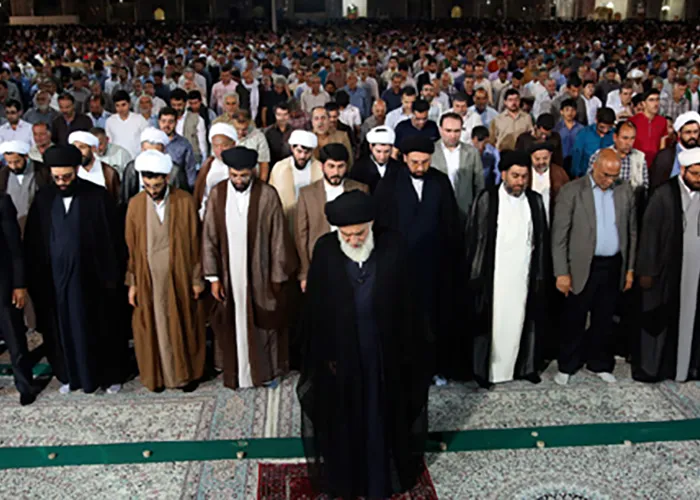
Congregational Prayer-Part-3
According to the fatwas of the Grand Religious Authorities: Shaheed Ayatollah Sayyed Ali Khamenei, Ayatollah Sistani, and Ayatollah Makarem Shirazi (may Allah prolong their blessings):
Fatāwā presented without citing a differing opinion or a specific reference are the common rulings shared by all of the three respected Marāji‘. In cases where the ruling of one Marjaʿ differs from that of the other two, it is indicated in a footnote under the same number, mentioning the Marjaʿ by name.Bottom of Form
Following the Imam in the Verbal Acts of Prayer
A) Takbīrat al-Iḥrām (Opening Takbīr)
- The follower (maʾmūm) must not recite the Takbīrat al-Iḥrām before the congregational prayer leader (imām). Rather, according to obligatory precaution, he should wait until the imām has completed his Takbīr.
Ayatollah Sistani: It is a recommended precaution that the follower should not say the Takbīr until the imām has finished reciting it.
- Once the imām has begun reciting the Takbīr, those standing in the rows behind may recite their Takbīr, provided that the people in the front rows are ready to do so and there is not a significant delay before their Takbīr.
B) Recitation of Sūrat al-Ḥamd and Another Sūrah
- The follower must recite all the adhkār (remembrances and recitations) of the prayer himself, except for Sūrat al-Ḥamd and the additional sūrah in the first and second rakʿahs, which are recited by the imām on behalf of the congregation. However, if a person joins the congregation in the third or fourth rakʿah, he must recite Sūrat al-Ḥamd and another sūrah himself.
- In Ṣalāt al-Ṣubḥ (Fajr) and in the first two rakʿahs of Maghrib and ʿIshāʾ prayers:
- If the follower can hear the imām’s recitation, even if he cannot distinguish the words, he must not recite Sūrat al-Ḥamd and another sūrah.
- If he can hear only part of the words, then according to obligatory precaution, he should also refrain from reciting.
- If he cannot hear the imām’s voice, it is recommended that he quietly recite Sūrat al-Ḥamd and another sūrah. If he unintentionally recites aloud, there is no problem.
Ayatollah Makarem Shirazi: If the follower hears the imām’s recitation in Fajr, Maghrib, or ʿIshāʾ prayers, he must refrain from reciting Sūrat al-Ḥamd and another sūrah. If he cannot hear the imām’s voice, it is permissible for him to recite them, but he should do so quietly.
- In the first and second rakʿahs of Ẓuhr and ʿAṣr prayers, according to obligatory precaution, the follower should not recite Sūrat al-Ḥamd and another sūrah. Instead, it is recommended that he engage in dhikr (remembrance of Allah).
C) Going Ahead of or Falling Behind the Imām in the Adhkār
- Apart from Takbīrat al-Iḥrām, if the follower recites the other adhkār of the prayer before or after the imām, the prayer remains valid. However, it is a recommended precaution that whenever the follower knows the proper timing of the imām’s dhikr, he should not recite it before the imām.
Following the Imam in the Physical Actions of Prayer
General Principle
- The follower (maʾmūm) must perform the actions of the prayer simultaneously with the imam or slightly after him. If he deliberately goes ahead of the imam or lags so far behind that he can no longer be regarded as following the imam, the congregational aspect of his prayer is invalidated, and his prayer continues as an individual prayer (furādā).
Rulings Concerning Rukūʿ (Bowing)
- If a follower mistakenly goes into rukūʿ before the imam:
- He must rise from rukūʿ and then bow again together with the imam. In this case, the congregational prayer remains valid.
- If he does not return to the standing position and remains in rukūʿ, his prayer is valid as an individual prayer.
- If a follower mistakenly raises his head from rukūʿ before the imam:
- If the imam is still in rukūʿ, he must return to rukūʿ and then rise together with the imam. This additional rukūʿ does not invalidate the prayer.
- However, if he returns to rukūʿ but the imam raises his head before the follower reaches the position of rukūʿ, the prayer is invalid.
Rulings Concerning Sujūd (Prostration)
- If a follower mistakenly goes into sujūd before the imam, he must raise his head and then perform the prostration together with the imam. His congregational prayer remains valid.
- If a follower mistakenly raises his head from sujūd before the imam and notices that the imam is still in prostration, he should return to sujūd. If he does not reach the imam’s prostration before the imam rises, his prayer remains valid. However, if this occurs in both prostrations of the same rakʿah, the prayer becomes invalid.
- If a follower mistakenly rises from rukūʿ or sujūd before the imam and, due to forgetfulness or thinking that he will not catch up with the imam, does not return, his prayer remains valid.
Ayatollah Sistani: If a follower mistakenly raises his head from rukūʿ before the imam and the imam is still in rukūʿ, then-according to precaution-he must return to rukūʿ and rise together with the imam. In this situation, the additional rukūʿ, despite being a pillar (rukn) of the prayer, does not invalidate the prayer. If he intentionally refuses to return, then according to precaution his congregational prayer becomes invalid, although the prayer itself remains valid. However, if he returns to rukūʿ but the imam raises his head before the follower reaches the state of rukūʿ, then according to precaution the prayer is invalid.
Rulings on Mistakes in Following the Imam and Identifying the Congregational Prayer Leader
- Mistake in Identifying the Imam
If a follower (maʾmūm) makes a mistake in identifying the leader of congregational prayer —for example, he believes he is following ʿAlī, but later discovers that the imam was actually
Aḥmad:
- If Aḥmad fulfilled all the conditions required for leading the prayer, including justice (ʿadālah), and the follower’s intention was not restricted to following a specific individual, the congregational prayer is valid.
- However, if his intention was specifically to follow a particular person, the congregational prayer is invalid.
- In such a case, if he has not performed any act that would invalidate the prayer (such as adding an extra pillar (rukn)), his prayer remains valid as an individual prayer (furādā).
The Follower’s Duty When the Imam Makes an Unintentional Mistake
A) Reciting Qunūt in the Wrong Place
- If the imam mistakenly recites Qunūt in a rakʿah where Qunūt is not prescribed:
- The follower should not recite the Qunūt.
- However, he must not go into rukūʿ before the imam.
- Rather, he should wait until the imam finishes the Qunūt and then continue the prayer together with him.
B) Reciting Tashahhud in the Wrong Place
- If the imam mistakenly recites Tashahhud in a rakʿah where Tashahhud is not prescribed:
- The follower should not recite the Tashahhud.
- However, he may not stand up before the imam.
- Instead, he should wait until the imam completes the Tashahhud and then continue the prayer together with him.
editor's pick

news via inbox
Subscribe to the newsletter.