
Fatwa Panel of the Week – Volume 03 Issue 23
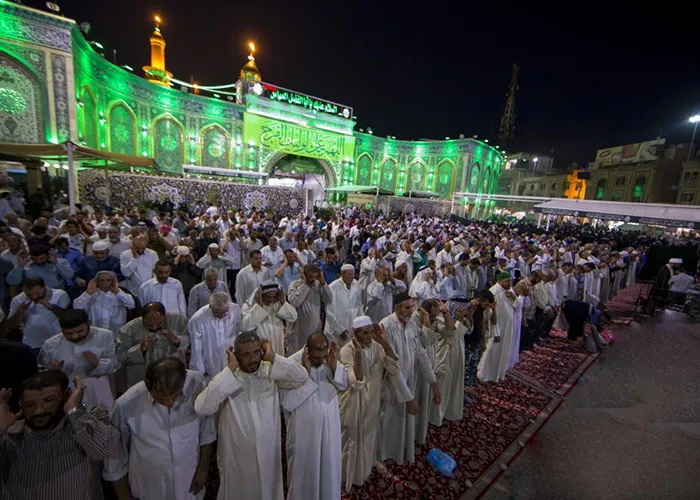
Congregational Prayer – Part 2
According to the fatwas of the Grand Religious Authorities: Ayatollah Sayyed Ali Khamenei, Ayatollah Sistani, and Ayatollah Makarem Shirazi (may Allah prolong their blessings):
Fatāwā presented without citing a differing opinion or a specific reference are the common rulings shared by all of the three respected Marāji‘. In cases where the ruling of one Marjaʿ differs from that of the other two, it is indicated in a footnote under the same number, mentioning the Marjaʿ by name.
Conditions for Congregational Prayer
For the validity of following an Imam in congregational prayer (Ṣalāt al-Jamāʿah), the Imam must meet the following conditions:
- Personal Qualifications of the Imam
- The Imam must be sane, just (ʿādil), a Twelver Shia, and of legitimate birth.
- As a matter of precaution, the Imam should be an adult (bāligh).
- The Imam must recite the prayer correctly.
Ayatollah Sistani: The Imam of congregational prayer must be an adult, sane, a Twelver Shia, just, of legitimate birth, and must perform and recite the prayer correctly.
Ayatollah Makarem Shirazi: The Imam of congregational prayer must be adult, sane, just, of legitimate birth, and a Twelver Shia, and he must recite the prayer correctly. Every person is presumed to be of legitimate birth, whether Muslim or non-Muslim, unless proven otherwise.
- If the follower (maʾmūm) is a man, the Imam must also be a man.
- If all the followers are women, a woman may lead their congregational prayer.
- Conditions Related to the State of Prayer
- A person praying while standing cannot follow someone who is praying while sitting or lying down.
- However, a person who is praying while sitting may follow an Imam who is also praying while sitting.
- Following an Imam with a Valid Excuse
It is permissible to follow an Imam who is praying with tayammum, jabīrah wuḍūʾ (ablution performed over a bandage or dressing), or whose prayer is performed with a ritually impure body or clothing due to a valid legal excuse.
Ayatollah Makarem Shirazi: If the Imam is praying with tayammum or jabīrah wuḍūʾ, it is permissible to follow him. However, if he is praying in impure clothing out of necessity due to a valid excuse, then according to obligatory precaution, one should not follow him.
- Doubt Concerning the Imam’s Justice
If a person previously knew the Imam of congregational prayer to be just (ʿādil) and later becomes doubtful as to whether he still possesses that quality, it remains permissible to follow him in congregational prayer.
Conditions for the Validity of Congregational Prayer (Ṣalāt al-Jamāʿah)
For a congregational prayer to be valid, the following conditions must be observed:
- Position of the Imam and the Followers
- The follower (maʾmūm) must not stand ahead of the Imam. As a matter of obligatory precaution, it is preferable for the follower to stand slightly behind the Imam.
Ayatollah Sistani: However, if there is only one male follower, it is permissible for him to stand level with the Imam.
Ayatollah Makarem Shirazi: As an obligatory precaution, the follower should not stand level with the Imam; rather, he should stand slightly behind him. This position should be maintained throughout the prayer, including during bowing (rukūʿ) and prostration (sujūd).
- The Imam’s place should not be significantly higher than that of the followers. A slight elevation (less than one handspan) is permissible.
- Continuity of the Rows (Connection of the Congregation)
- The distance between the Imam and the follower, or between one row and the next, must not be excessive.
- As an obligatory precaution, the distance between the place of prostration of a follower and the standing place of the Imam (or the row in front) should not exceed one average step, approximately one metre.
- Absence of Barriers
- There should be no wall, curtain, or other barrier between the Imam and the followers, or between the rows, that breaks the connection of the congregation.
- However, a curtain separating the men’s and women’s sections does not invalidate the congregation.
- Rulings Related to the Place of Prayer and the Rows
- If the prayer is held on sloping ground and the slope is within normal limits, the congregational prayer remains valid.
- A follower may stand in an elevated place, such as a mosque rooftop, provided that such an arrangement is considered customary.
- Additional Rulings Regarding Congregational Connection
- If a non-adult child serves as the link maintaining the continuity of the rows, and his prayer is valid, reliance upon that connection is permissible.
- If the front row disperses because its members complete their prayer or individually separate from the congregation (furādā), the congregational prayer remains valid as long as the continuity is not broken by an excessive gap.
Duties of the Follower (Maʾmūm) in Congregational Prayer
- Following the Imam in the Opening Takbīr and Other Recitations
- The follower must not pronounce the Takbīrat al-Iḥrām (the opening “Allāhu Akbar”) before the Imam. According to obligatory precaution, he should wait until the Imam has completed the Takbīr.
Ayatollah Sistani: The follower must not say the Takbīrat al-Iḥrām before the Imam. However, it is a recommended precaution not to pronounce it until the Imam has completed his Takbīr.
- After the Imam has begun the Takbīr, if those in the front row are ready for prayer and are about to pronounce their Takbīr, a person standing in a subsequent row may say the Takbīr without waiting for the front row to complete theirs.
- Apart from Sūrat al-Ḥamd and the additional sūrah, the follower recites all other adhkār (remembrances and recitations) of the prayer himself. However, if he joins the congregation during the third or fourth rakʿah of the Imam’s prayer, he must recite Sūrat al-Ḥamd and the additional sūrah himself where required.
- Ruling on the Follower’s Recitation of Sūrat al-Ḥamd and the Additional Sūrah
- In Ṣalāt al-Ṣubḥ (Fajr) and in the first two rakʿahs of Maghrib and ʿIshāʾ, if the follower can hear the Imam’s recitation, he must not recite Sūrat al-Ḥamd or the additional sūrah himself.
- If he cannot hear the Imam’s recitation, it is recommended (mustaḥabb) that he recite them quietly.
In the first and second rakʿahs of Ẓuhr and ʿAṣr, according to obligatory precaution, the follower should not recite Sūrat al-Ḥamd or the additional sūrah. Instead, it is preferable that he engage in dhikr (remembrance of Allah).

news via inbox
Subscribe to the newsletter.