Topic of the Week – Volume 03 Issue 23
The Greatest Media Campaign in the History of Islam
Seyed Hashem Moosavi
Introduction
Today, major global organisations spend millions of dollars on advertising and media campaigns just to deliver a simple message. Yet more than fourteen centuries ago, in the scorching desert of Hijaz at Ghadir Khumm, a message was proclaimed that had to reach all of humanity until the end of time, without the internet, satellites, or printing presses.
Imagine yourself in the summer of the tenth year after Hijrah. The sun of Hijaz is blazing over a barren place called Ghadir Khumm. More than one hundred thousand people are returning from the Prophet’s final pilgrimage in his company. Then a divine command is revealed:
يَا أَيُّهَا الرَّسُولُ بَلِّغْ مَا أُنزِلَ إِلَيْكَ مِن رَّبِّكَ،
“O Messenger, convey in full what has been sent down to you from your Lord.”
(al-Ma’idah, Verse 67)
The order is given to halt. Those who have gone ahead are called back, and those behind catch up. Everyone senses that a decisive announcement is about to be made, one so vital that, according to the Qur’anic verse, « وَإِن لَّمْ تَفْعَلْ فَمَا بَلَّغْتَ رِسَالَتَهُ؛if it were not delivered, the entire mission of twenty-three years would remain incomplete.
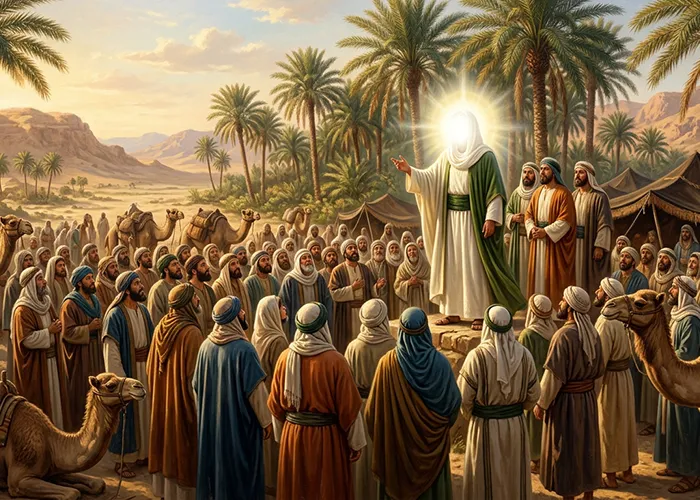
In that burning midday heat, the Prophet Muhammad (peace and blessings be upon him and his family) stood atop a pulpit made from camel saddles and delivered a long and historic sermon. At that unforgettable moment, he raised the hand of Ali ibn Abi Talib (peace be upon him) and declared: «من کنت مولاه فهذا علی مولاه؛ “Whoever has me as his master and leader, Ali is now his master and leader.” With that proclamation, he introduced not only his successor, but also a lasting model of leadership, guardianship, and just governance for all generations.
This was no ordinary ceremony of introduction. It was the launching point of the greatest and most extraordinary media campaign in Islamic history. In that campaign, every Muslim present, by the Prophet’s explicit instruction that- “those present must convey it to those absent, and fathers must pass it on to their children until the Day of Resurrection”- was entrusted with the role of a reporter and a responsible medium, so that this truth would never be buried beneath the dust of time, but would remain a living current running through history.
Ghadir marks the birth of a media model that chose family bonds and face-to-face transmission as the most powerful social network in history.
Section One: Revisiting the Prophet’s Media Protocols in the Event of Ghadir
Now that the importance of Ghadir’s message is clear, a crucial question arises: how was this monumental message delivered in a way that engaged tens of thousands of listeners on the spot and ensured its transmission to future generations? A close reading of the Prophet’s conduct on the day of Ghadir reveals that he did far more than give a speech; he employed precise and deliberate communication methods, executing a carefully designed media protocol.
- Technique One: Creating Silence and Media Focus
After the pilgrimage rites had ended, a vast human network of more than one hundred thousand people moved toward Ghadir Khumm at the Prophet’s instruction. Even twelve thousand pilgrims from Yemen – whose route did not naturally lead northward – joined this course so they could be present. When the crowd reached Ghadir, the order to stop was given. Those in front returned, and those behind arrived at the gathering point. A raised platform was then constructed from stones and camel saddles so that all distractions would be removed and the audience’s full attention could be secured.
- Technique Two: Securing Public Acknowledgment and Feedback
Before delivering the central message, the Prophet (pbuh) first drew an explicit acknowledgment from the crowd: «ألستُ أولى بكم من أنفسكم؟؛ “Am I not closer to you than you are to yourselves?” This question prepared the listeners mentally and spiritually for what would follow. In the language of communication theory, it established alignment with the audience before the core message was released.
- Technique Three: Issuing a Universal Mandate for Transmission
The final passage of the sermon represents the summit of media strategy in that age:
معاشر الناس انی ادعها امامة و وارثة فی عقبی الی یوم القیامة و قد بلغت ما امرت بتبلیغه حجة علی کل حاضر و غائب و علی کل احد ممن شهد اولم یشهد،ولد اولم یولد فلیبلغ الحاضر الغائب وَ الْوَالِدُ الْوَلَدَ اِلَی یَوْمِ الْقِیَامَةِ
the Prophet (pbuh) declared that this matter of leadership and succession would endure until the Day of Resurrection, and that those present must convey it to those absent, and parents must pass it on to their children until the day of judgment.
(Bihar al-Anwar, Part of the Ghadir Khumm Sermon of Prophet Muhammad (pbuh))
In this way, the message of Ghadir was not left to a select elite; it was entrusted to the entire community.
By these words, the Prophet (pbuh) shattered any notion of media monopoly. He did not restrict transmission to a specialised class of preachers or scholars. Instead, he turned the sermon of Ghadir into what we might today call a viral message, one that every individual in society bore responsibility to carry forward.
Section Two: The Enemy’s Psychological Operations
When this carefully designed communication strategy is placed beside the Prophet’s universal command to transmit the message, another truth becomes clear: wherever the truth is not conveyed with precision and persistence, the door opens to distortion and fabrication.
In media history, the danger is not always outright denial of a fact; sometimes something even more destructive occurs, the manipulation of meaning and the manufacture of parallel narratives.
Once those who had witnessed Ghadir failed to take their duty of transmission seriously, the stage was set for truth to be reverse engineered. Two dangerous layers of psychological operation then emerged.
A) The Layer of Distortion: Redirecting the Message
Many opponents of Ghadir could not deny the event itself or the famous declaration«مَن کُنتُ مَولاه» “Whoever has me as his master, Ali is his master,” because the number of eyewitnesses was too great. So, they turned instead to semantic distortion. The key word mawla, which in that context clearly signified authority, guardianship, and leadership, was reduced to the softer meaning of friendship or affection.
This is precisely what modern media theory calls framing. The event was placed inside the frame of “an expression of love” so that its political and governing force could be neutralised. The silence of those who had witnessed the pledge of allegiance and the public congratulations lent legitimacy to this distorted reading, allowing a harmless and flattened version of Ghadir to replace its central core: divinely guided leadership and governance.
B) The Layer of Fabrication: Producing Parallel Narratives
In the media vacuum created by the silence of sincere companions, parallel stories were produced to overshadow the grandeur of Ghadir and shift attention away from it. Invented reports praising others were circulated so that, in the public mind, Ghadir would appear not as a singular divine appointment, but merely as one ordinary episode among many during the pilgrimage journey.
Section Three: The Consequences of Media Silence in the Face of Distortion and Fabrication
These two layers, distorting meaning and fabricating parallel narratives, were not merely theoretical or historical problems. Over time, they produced deep social, doctrinal, and political consequences. Before turning to our responsibility today, we must first understand the weight of those consequences.
- The Loss and Confusion of Later Generations
When the “media of Ghadir” fell silent and the chain of face-to-face transmission was broken, one of the greatest cognitive ruptures in Islamic history began to unfold. Children who should have heard the authentic story of Ghadir in their homes from their fathers, the very eyewitnesses entrusted to convey it, grew up instead in an atmosphere of silence and heavy informational boycott.
The terrible consequence of that clouded and silent environment was social conformity on a massive scale. Distortion sank so deep that only fifty years after the Prophet’s passing, the tragedy of Karbala became possible. In other words, yesterday’s media silence prepared the ground for tomorrow’s religious justifications, until the killing of the Prophet’s own grandson could be framed in the name of religion, jihad, and the defence of political order, and large segments of the public accepted it.
- Turning an Absolute Truth into a Fog of Doubt
An event witnessed by more than one hundred thousand people and proclaimed openly by the Messenger of God should have remained one of the clearest and most unquestionable realities in Islamic history. Yet the direct consequence of weak transmission, passive republication, and a retreat into private understanding was that this transparent truth was slowly sacrificed.
By creating doubt, manipulating words, and shifting priorities, rival strategies managed to reduce Ghadir from a foundational and life-giving principle into a minor historical issue. As a result of this media passivity on the side of truth, the bright sun of Ghadir was hidden behind clouds of selective interpretation, and for many sincere truth-seekers, this lucid declaration became a matter of controversy, ambiguity, and suspicion.
- The Separation of Politics from Guidance
By suppressing or reshaping Ghadir’s political message, the model of governance built on guardianship, justice, and moral authority, a profound blow was dealt to the very body of Islamic civilisation. The management of society, politics, and power was diverted from its divinely guided course. Once the inseparable bond between spiritual guidance and political leadership was broken, religion was pushed back into the private sphere of personal devotion, while the arena of power was handed over to those driven by worldly ambition.
The practical result of this separation was the gradual and alarming return of pre-Islamic aristocratic tendencies, with the same tribal and class-based spirit, now dressed in the new robes of hereditary and authoritarian rule.
Section Four: Ghadir in the Present Age, How Can We Be Ghadir’s Reporters Today?
A review of these consequences shows that Ghadir is not merely a historical episode left behind in the past. It is a living truth with direct relevance to our cultural, social, and media responsibilities today. That is why we must now move from history into the heart of contemporary life and ask: if the Prophet (pbuh) commanded that the message of Ghadir be kept alive until the Day of Resurrection, how should we sustain that campaign in the age of modern technology?
Here are several practical and effective steps for fulfilling the role of Ghadir’s communicators today. These steps are a direct response to the harms described earlier: if distortion begins in the absence of an authentic narrative, then the revival of Ghadir must begin with the production of clear, compelling, and continuous storytelling.
- Break the Frame of Distortion: Focus on Imam Ali’s Human and Administrative Model
One of the best ways to neutralise historical distortion is to reinterpret Ghadir in the language of today’s human needs. The modern world longs for justice, integrity, anti-corruption, and respect for human dignity. Instead of merely recirculating long and repetitive texts, we can extract powerful passages from Imam Ali’s letters and sermons, especially from Nahj al-Balaghah, such as his instruction to Malik al-Ashtar, and present them in elegant, contemporary formats. In doing so, the governing vision of Ghadir and the Alid model of leadership become clearer and more compelling.
- Use Micro-Content: Create for Short Attention Spans
Today’s audience, especially Generation Z, rarely engages with multi-page texts. People on digital platforms and social media are looking for content that is quick, clear, and impactful. Short videos with compelling subtitles, concise audio clips, and creative infographics can explain a disputed historical issue or revive a forgotten virtue in a tone that is both warm and well-documented.
- Present Ghadir Beyond Sectarian Boundaries: Produce International Content
According to the Qur’an, the Prophet’s mission is universal. Ghadir should therefore not be confined within narrow sectarian or geographic borders. As a practical step, impactful statements by non-Muslim thinkers about the unique character of Imam Ali (pbuh) can be translated and published in different languages. Presenting him as a symbol of justice and humanity opens one of the most effective pathways for introducing the event of Ghadir to a global audience.
- Tell the Story Through Art and Literature
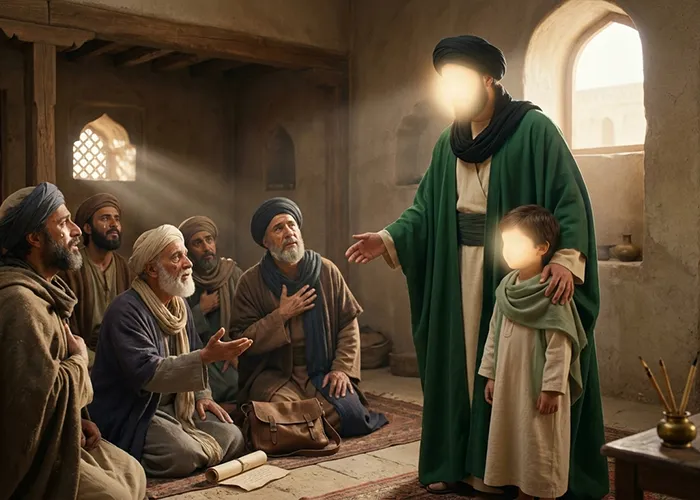
Ghadir is rich in drama, intensity, beauty, and human feeling. Writers, poets, designers, and artists all have a role to play in keeping its message alive. A short story told from the perspective of a child present at Ghadir, an engaging comic strip for young readers, or a simple motion graphic can often communicate its message far more effectively than conventional methods.
- Build Social Momentum on the Ground, Strengthened by Digital Sharing
Digital outreach should never make us neglect the real world; the two should reinforce one another. Community campaigns inspired by love for Imam Ali (pbuh) can shape public space in meaningful ways. For example, people could be encouraged on the day of Eid al-Ghadir to perform an act of kindness, offering discounts, forgiving a debt, providing free medical consultation, or giving sweets to children, and then share that act online. In this way, society’s mental image of Ghadir becomes tied to a lived experience of justice, generosity, and compassion.
Final Reflection
The essence of this discussion is that Ghadir is not merely a historical event or a ceremonial commemoration. It is a lasting model for conveying truth, resisting distortion, and embracing media responsibility. If weakness in truthful narration once created the conditions for distortion and fabrication, then any neglect today in explaining Ghadir wisely, beautifully, and effectively can reproduce the same void.
That is why today’s digital media tools can be seen as a continuation of the pulpits of Ghadir, platforms that, if used consciously and responsibly, can keep alive the message of guardianship, justice, and guidance. In this field, no one should remain a mere spectator; every pen, every voice, and every meaningful action can become part of our shared duty to carry Ghadir forward.
editor's pick

news via inbox
Subscribe to the newsletter.