
Exploring Islamic Jurisprudence – Volume 03 Issue 42
Purity in Islamic Jurisprudence (12)
Rulings, Method, and Conditions for the Validity of Ablution (Wudu’)
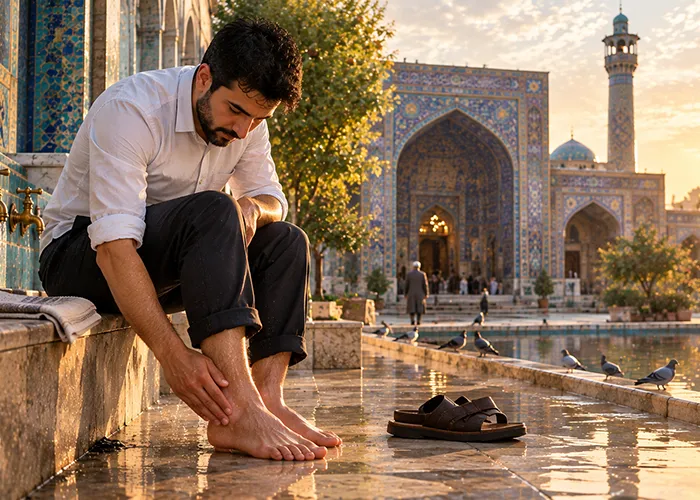
With the help of the Almighty God and upon concluding the discussion on impurities (najasat) and purifying agents (mutahhirat), we begin a new chapter of practical jurisprudence with the most crucial prerequisite for prayer and worship: Ablution (wudu’).
As stated at the beginning of the chapter on purity, ritual purity in Islamic jurisprudence is divided into two primary categories: purity from outer impurity (al-taharah min al-khabath) – the cleansing of the body, clothing, and objects from physical impurities – and purity from spiritual impurity (al-taharah min al-hadath) – the spiritual and inner purification of a person, which serves as a prerequisite for the validity of acts of worship such as prayer. Building upon the foundation laid in the first section and having concluded the chapter on physical impurities and purifying agents, we now enter the second section: purity from spiritual impurity. This state of purity is attained through three acts of worship – ablution (wudu’), ritual bath (ghusl), and dry ablution (tayammum) – the first step of which is examining the rulings and conditions for the validity of wudu’.
Jurisprudential Criteria and Legal Rulings
A) Obligatory Acts of Ablution (Wudu’)
1. Washing the face:
From the natural hairline at the top of the forehead down to the tip of the chin in length, and across the width covered between the tip of the thumb and the tip of the middle finger. Washing must proceed from top to bottom.
(Note: For individuals who are bald or have a receding hairline, the criterion is the average hairline of a standard person in society).
2. Washing the arms:
From the elbows down to the fingertips (first the right arm, then the left arm). Washing the arms must also proceed strictly from top (elbow) to bottom (fingertips).
3. Wiping the head (mash):
Wiping the front part of the head (the upper part of the forehead) with the wet palm of the right hand. It is not necessary to wipe the scalp directly; wiping the hair on the front portion of the head is also sufficient, provided the hair is not excessively long.
4. Wiping the feet:
Wiping the top of the foot with the wet palm from the tips of the toes up to the instep (ka’bayn). First the right foot with the right hand, and then the left foot with the left hand.
B) Essential Conditions for the Validity of Wudu’
- Purity of water and ablution organs:
Water used for wudu’ must be absolute (ma’ mutlaq) and pure (tahir), and the organs washed or wiped must also be pure at the time of washing or wiping.
- Lawful use of water and location:
The water and its container must not be usurped (ghasbi).
- Absence of obstructions:
There must be no barrier (such as glue, oil paint, nail polish, gelish, acrylic nails, or waterproof creams) preventing water from reaching the skin or hair on the wudu’ organs.
- Sequence (tartib) and continuity (muwalat):
Observing the proper order of acts (face, right arm, left arm, head, feet) and performing the actions continuously so that previously washed organs do not dry before completing the next step.
Practical Notes and Differences in Edicts (Fatawa)
1) Extent of wiping the foot: to the instep or to the ankle joint?
- Grand Ayatollahs Shaheed Khamenei and Makarem Shirazi:
Wiping the foot from the toes up to the instep (top of the foot) is sufficient, though extending it to the joint (the ankle bone) is a recommended precaution.
- Grand Ayatollah Sistani:
Wiping the foot must extend from the tips of the toes to the foot joint (the articulation connecting the foot to the lower leg).
2) Washing arms and face a second or third time:
- Washing once is obligatory, washing a second time is permissible, and washing a third time (if done with the intention of wudu’) is prohibited (haram) and invalidates the ablution.
- Key distinction for the second wash: The criterion for the first or second wash is not the passing of the hand or pouring of water; rather, the criterion is the complete washing of the organ. Therefore, if someone pours water over their arm three times until it is fully washed, this entire sequence counts as a single (first) wash.
3) Obstructions to wudu’, such as acrylic nails, eyelashes, and modern cosmetics:
- Grand Ayatollahs Shaheed Khamenei and Makarem Shirazi:
Acrylic nails and artificial eyelashes prevent water from reaching the skin, and if removing them is possible (even with cost or patience), their removal is obligatory. If removal is genuinely impossible, a splint ablution (wudu’ al-jabirah) must be performed, and by obligatory precaution, dry ablution (tayammum) should also be combined with it.
- Grand Ayatollah Sistani:
If the barrier (such as acrylic nails) cannot be removed or causes severe hardship, splint ablution must be performed. However, if acrylic nails were applied without necessity during a non-prayer time, by obligatory precaution, the individual must perform splint ablution combined with tayammum, and later perform the missed prayers (qada’) after removing the barrier.
Pedagogical, Ethical, and Spiritual Messages
- Outer purity as a prelude to inner purity:
Wudu’ is not merely a physical wash; rather, the intention of seeking proximity to God (qurbah) transforms it into a profound act of worship that illuminates the soul and perfects prayer.
- Conservation and avoiding wastefulness in water consumption:
The sacred law of Islam emphasises that wudu’ should be performed with a minimal volume of water. Wasting water during ablution is discouraged, and jurists highlight that the amount of water used for wudu’ can be as little as a handful or a single glass.
Frequently Asked Questions
A) Do moisturising creams, sunscreens, or natural skin oils obstruct wudu’?
If the cream has been absorbed into the skin and leaves no layer preventing water penetration, the wudu’ is valid. Standard natural skin oils and sweat also do not constitute barriers.
B) What if one notices nail polish or glue on the hand or nail during or after prayer?
If the barrier was on an organ that must be washed (face and arms) or wiped, the wudu’ is invalid, and after removing the barrier, the wudu’ must be repeated and the prayer re-offered.
C) Is it permissible to dry the wudu’ organs after finishing?
Yes; drying the face and arms after completing wudu’ is completely fine, although leaving the moisture to dry naturally yields spiritual reward. However, organs designated for wiping (head and feet) must be dry before wiping, or their moisture must be minimal enough that the wetness of the hand predominates.
D) What should one do if there is doubt about whether tap water or a container is usurped (ghasbi)?
Unless one has certainty that the water or location is usurped, one relies on the presumption of validity and permissibility. Performing wudu’ in public places, offices, and parks is valid.
E) What is the ruling if one doubts whether they have performed wudu’ or whether their wudu’ has been invalidated?
(Rule of presumption of continuity and purity / Istishab):
- Doubt regarding the original performance of wudu’ (before prayer):
If a person knows they were unpurified (muhdith) and doubts whether they performed wudu’ or not, they must perform wudu’.
- Doubt regarding the invalidation of wudu’:
If a person knows they performed wudu’, but doubts whether an act invalidating it (such as sleep or passing wind) occurred or not, they presume their wudu’ remains intact, and their ablution is legally and validly preserved.
- Doubt regarding wudu’ after prayer:
If one doubts after completing prayer whether they had wudu’ prior to the prayer, the prayer they performed is valid, but wudu’ must be performed for subsequent prayers.
editor's pick

news via inbox
Subscribe to the newsletter.