Everlasting Tales of the Quran – Volume 03 Issue 29

The Desperate Pharaoh in the River of Determination
Imagine being chosen to bring the greatest and most powerful empire of your time to its knees, yet at that very moment, your tongue fails you and words refuse to come out. The story of Prophet Moses (pbuh) begins precisely at this point – with a profound paradox. He was chosen to call the most arrogant ruler on earth toward the truth, while carrying the heaviest burden upon his tongue. Moses (pbuh) had an apparent physical difficulty: a speech impediment. Yet this impediment never became a barrier to his firm determination.
The Burning Coal and the Secret of the Heavy Tongue
According to historical narrations, when Moses (pbuh) was a child, he once pulled Pharaoh’s beard in the palace and struck his face. Pharaoh, both enraged and fearful of what the future might hold, suspected that this child could be the very threat that would bring down his kingdom. Therefore, he decided to test the child’s intelligence and determine whether he posed a real danger. Lady Asiya suggested a test to prove that Moses was merely a child without the ability to distinguish between things.
Two containers were placed before Moses (pbuh): one filled with sparkling jewels, and the other filled with glowing, burning coals.
The little hand of Moses first moved toward the jewels, but as if destiny redirected the path of his fingers. The child picked up a piece of burning coal and placed it in his mouth.
The intense heat of the fire on his tender tongue sent a cry echoing through the halls of the palace. The flames were extinguished, but from that day onward, words no longer flowed easily from Moses’ throat. The words became trapped behind his teeth, and he developed a noticeable speech difficulty – a weakness that, in a palace renowned for the eloquence and rhetoric of the Pharaoh’s court, could have branded any young person with the mark of “incapacity.”
Fear Beneath Mount Sinai and Turning to Prayer
Years passed, and Moses (pbuh) grew into a young man. After years of migration and shepherding in Midian, on his journey back, he saw the divine manifestation of fire at the foot of Mount Sinai and heard a call summoning him to the greatest mission on earth:
“اذْهَبْ إِلَىٰ فِرْعَوْنَ إِنَّهُ طَغَىٰ” (طه، ۲۴)
“Go to Pharaoh; indeed, he has transgressed.”
(Qur’an 20:24)
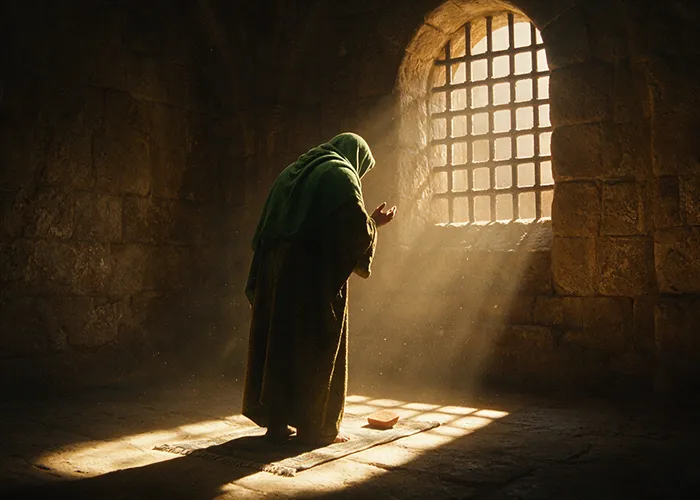
At that moment, the first thing that came to Moses’ mind was that same old weakness. He was being asked to speak before the most powerful king of his era. The fear caused by the knot in his speech weighed heavily upon his heart. Moses (pbuh) turned toward the heavens and, with a heavy tongue but a heart filled with faith, prayed:
“رَبِّ اشْرَحْ لِي صَدْرِي * وَيَسِّرْ لِي أَمْرِي * وَاحْلُلْ عُقْدَةً مِّن لِّسَانِي * يَفْقَهُوا قَوْلِي” (طه، ۲۵–۲۸)
“My Lord, expand my chest for me, ease my task for me, and untie the knot from my tongue, so that they may understand my speech.”
He also openly expressed this concern in Surah Ash-Shu‘ara:
“وَيَضِيقُ صَدْرِي وَلَا يَنْطَلِقُ لِسَانِي…” (الشعراء، ۱۳)
“And my chest becomes tight, and my tongue is not fluent in speech…”
For this reason, he asked Allah to send his brother Aaron (Harun), who was more eloquent in speech, to accompany him:
“وَأَخِي هَارُونُ هُوَ أَفْصَحُ مِنِّي لِسَانًا فَأَرْسِلْهُ مَعِيَ رِدْءًا…” (القصص، ۳۴)
“And my brother Aaron is more eloquent than me in speech, so send him with me as a supporter and helper…”
Allah never told him: “Because you have a speech difficulty, you are unfit for this mission.” Rather, He accepted his determination and faith and said:
“قَدْ أُوتِيتَ سُؤْلَكَ يَا مُوسَىٰ” (طه، ۳۶)
“O Moses, your request has been granted.”
Standing Before the Palace of Words and Pharaoh’s Mockery
The day Moses (pbuh) entered Pharaoh’s palace, everything stood at the height of grandeur. Pharaoh sat arrogantly upon his throne, and the court’s eloquent speakers were prepared to ridicule and belittle this young man. In order to diminish Moses’ mission, Pharaoh targeted this very physical weakness and mockingly said:
“أَمْ أَنَا خَيْرٌ مِّنْ هَٰذَا الَّذِي هُوَ مَهِينٌ وَلَا يَكَادُ يُبِينُ” (الزخرف، ۵۲)
“Am I not better than this man who is insignificant and can hardly express himself clearly?”
Yet the truth within Moses (pbuh) was far greater than the limitation of his tongue. Pharaoh took pride in the smoothness of his speech, but his inner being was empty. Moses, with a tongue that struggled, yet with a heart expanded and connected to revelation, spoke with a power far beyond mere eloquence. The strength of his words did not come from outward fluency, but from inner sincerity and courage.
With that same heavy tongue, Moses shook the foundations of a tyrannical empire.
Conclusion: The Qur’an’s Timeless Standard and Its Reflection in the World of Knowledge
The story of Prophet Moses (pbuh) is a timeless declaration for every young person who believes that a physical limitation will prevent them from achieving success. The Holy Qur’an explicitly rejects outward, racial, and physical standards as measures of human worth.
A person’s true value is not determined by the perfection of the body, but by taqwa (God-consciousness), perseverance, purity of heart, and strength of will. This eternal principle is beautifully expressed in the Qur’an:
“إِنَّ أَكْرَمَكُمْ عِندَ اللَّهِ أَتْقَاكُمْ“
“Indeed, the most honored of you in the sight of Allah is the most righteous of you.”
(Qur’an 49:13)
The history of science -both in the West and throughout Islamic civilization- is filled with remarkable individuals who, like Moses (pbuh), refused to let physical limitations define their destiny.
- Stephen Hawking: The renowned theoretical physicist who lived with amyotrophic lateral sclerosis (ALS). Though his body gradually became motionless, he transformed modern cosmology through his groundbreaking theories.
- Thomas Edison: The prolific inventor who was largely deaf. Rather than viewing his hearing loss as a disadvantage, he regarded it as a source of deeper concentration that enabled his extraordinary achievements.
- Sharif al-Murtada (‘Alam al-Huda): The distinguished Muslim scholar who was blind, yet directed one of the greatest libraries of his era and dictated numerous influential works entirely from memory.
- Ayatollah Sayyid Abd al-Husayn Sharaf al-Din: A prominent scholar whose severe visual impairment never prevented him from producing enduring masterpieces in Islamic theology and scholarship through dictation.
- Al-Zamakhshari: The celebrated linguist and Qur’anic exegete who, despite having a wooden leg, traveled thousands of kilometers in pursuit of knowledge and authored the monumental Qur’anic commentary Al-Kashshaf.
Final Reflection
A physical limitation has never been an obstacle to genuine greatness.
Allah entrusted the mission of liberating an entire nation to a young prophet who struggled with speech, demonstrating that the true measure of a human being lies not in physical perfection, but in the greatness of the soul, the steadfastness of faith, and the strength of one’s determination.
The lives of these scholars bear witness to the very same truth: when the eyes cannot see, the heart and the intellect may perceive even more clearly; and even those who walk with difficulty can travel extraordinary distances on the path of knowledge.
References
Qur’anic References
- Moses’ supplication concerning the knot in his tongue: Surah Ta-Ha (20:25–28)
- Moses’ expression of anxiety and request for Aaron’s assistance: Surah Ash-Shu’ara (26:12–13)
- Aaron’s greater eloquence in speech: Surah Al-Qasas (28:34)
- Allah’s acceptance of Moses’ prayer: Surah Ta-Ha (20:36)
- Pharaoh’s mockery of Moses’ speech: Surah Az-Zukhruf (43:52)
- The Qur’anic criterion of human excellence: Surah Al-Hujurat (49:13)
Classical Islamic Sources
(Regarding the narration of the burning coal during Moses’ childhood)
- Tafsir al-Qummi, by Ali ibn Ibrahim al-Qummi, commentary on Surah Ta-Ha.
- Majma’ al-Bayan fi Tafsir al-Qur’an, by Al-Tabarsi, Vol. 7, commentary on Surah Ta-Ha.
- Tafsir Nemooneh (The Exemplary Commentary), by Ayatollah Naser Makarem Shirazi, Vol. 13.
- Bihar al-Anwar, by Allama al-Majlisi, Vol. 13, Stories of the Prophets, chapter on Prophet Moses (pbuh).
Biographical Sources
- My Brief History, by Stephen Hawking (Bantam Books).
- Travelling to Infinity: My Life with Stephen, by Jane Hawking (2007).
- Edison: A Life of Invention, by Paul Israel (John Wiley & Sons, 1998).
- Edison, by Edmund Morris (2019).
- Rijal al-Tusi, by Shaykh al-Tusi.
- Siyar A’lam al-Nubala’, by Shams al-Din al-Dhahabi, Vol. 17.
- Rawdat al-Jannat fi Ahwal al-‘Ulama’ wa al-Sadat.
- Hayat Ayatollah Sharaf al-Din (Sharaf al-Din), by Professor Mohammad Reza Hakimi.
- The introductions to Al-Muraja’at and Al-Nass wa al-Ijtihad.
- Wafayat al-A’yan, by Ibn Khallikan, Vol. 4.
editor's pick

news via inbox
Subscribe to the newsletter.