
Religious Outreach Experiences – Volume 03 Issue 09
When a Few Meters of Distance Taught Me a Lesson of a Lifetime
For me, missionary journeys have never been merely geographical movements; each trip has also been a journey in understanding and perspective. One such experience, still vivid in my mind, was a trip to Mexico.
In one of the northern cities of the country, not far from the United States border, there stood the only Shi‘a mosque in that area, a small, quiet, and somewhat forgotten place. Due to the absence of a resident scholar, the mosque remained closed most of the week. Only on Sundays would it open its doors for a brief program introducing Islam to non-Muslim school students, usually led by a few well-meaning individuals with limited religious knowledge.
When I first entered that mosque, I felt a strange mixture of loneliness and hope. We established the first congregational prayer with only a handful of worshippers, a small but sincere group. Gradually, word spread through the local Shi‘a community that a scholar was present and congregational prayers had begun. Day by day, more people came. Dhuhr and ‘Asr, Maghrib and ‘Isha, the rows slowly began to form. A mosque that had once been silent was now breathing again.
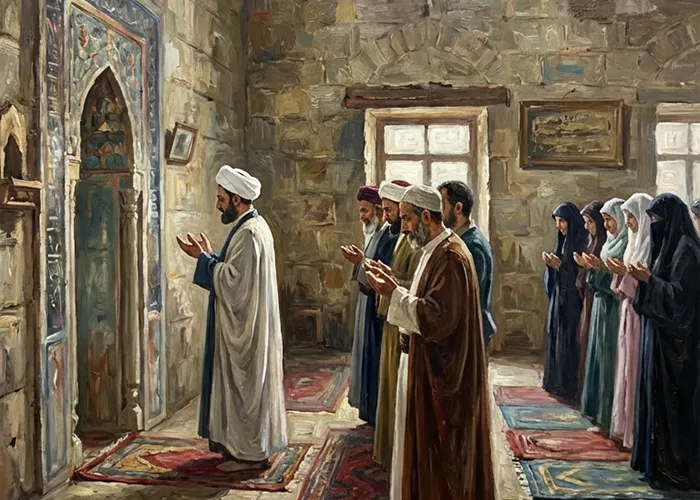
One evening, after the program ended, I sat with a few of the mosque’s regular attendees. We were speaking about the growing participation when one of them showed me a photograph of that night’s prayer congregation on his phone. I looked at the image with a smile, but the smile lasted only a few seconds.
In the picture, I noticed something that both surprised and saddened me. The row of sisters praying was positioned at a very large and unusual distance behind the row of brothers, a gap far greater than what is normally acceptable.
I asked those who regularly prayed behind me, “Is the distance always this wide, or is it just tonight?”
With confidence, they replied, “No, it’s always like this. As you said, the sisters’ row must be behind the men, and they are behind the men.”
Outwardly, the answer seemed correct. But inwardly, it revealed something deeper. They had understood the general rule, that women stand behind men, but they had not grasped the subtlety of how close the rows should remain connected. They understood “behind,” but not the importance of continuity and unity in congregational formation.
At that moment, something became very clear to me:
In religious outreach, especially when working with new Muslims or believers with minimal foundational knowledge, we cannot rely on assumed understanding. Even the most basic acts of worship, such as prayer, must be taught with precision, clarity, and careful attention to detail.
That night, I had trusted those who were more consistently present in the front rows. I assumed that if something was incorrect, they would notice and gently correct it. I had not considered that they themselves might lack full awareness or perhaps did not feel personally responsible for addressing it.
I was reminded of the practice of the Prophet Muhammad (peace and blessings be upon him and his family). When teaching prayer, he did not suffice with verbal instruction alone. He stood before the people, prayed in front of them, and said: “Pray as you have seen me pray.”
In Islam, teaching is not merely the transfer of information; it is the transmission of method, attentiveness, and sensitivity to correctness.
The following day, before prayer, I gently and respectfully explained the importance of maintaining connected rows in congregational prayer. Not with criticism. Not with reproach. But with warmth, emphasizing that the beauty of congregational prayer lies in the unity of hearts and rows alike.
That photograph was not just an image; it was a lasting lesson. It reminded me that in religious guidance, nothing should be assumed to be “obvious.” Even the most basic matters require care.
Sometimes, a few meters of distance between two rows can teach lessons that take years to learn.
Three Lessons from This Experience
- Never assume prior understanding: When working with new Muslims or communities with limited access to structured learning, foundational rulings must be explained clearly and thoroughly. Assumptions create gaps.
- Practical demonstration is more powerful than verbal instruction: As the Prophet (pbuh) taught prayer through action, showing the correct method often leaves a deeper impact than simply describing it.
- Collective responsibility must be cultivated: Standing in the front row is not the highest virtue; feeling responsible for the correctness of the community’s worship is greater still. In a healthy faith community, every individual shares in safeguarding the integrity of collective worship.
editor's pick

news via inbox
Subscribe to the newsletter.