Topic of the Week – Volume 03 Issue 09

The Strategy of Resilience
An Analysis of Lady Khadijah’s Crisis Management During the Boycott in Shi‘b Abī Ṭālib
Seyed Hashem Moosavi
Introduction
An Anchor of Tranquility Amid the Turbulence of Shiʿb Abī Ṭālib
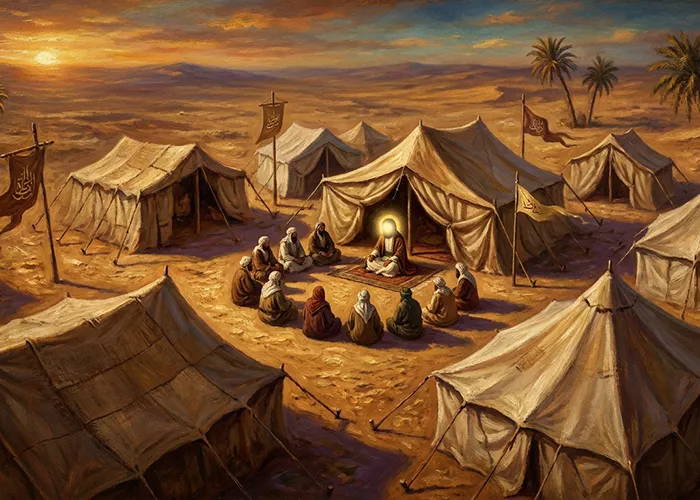
In narrating the early history of Islam, attention is often drawn to the visible scenes of public proclamation and open confrontation. Yet behind these defining moments lay unseen forms of leadership and silent sacrifices without which the Islamic movement could not have survived. Among the most remarkable of these roles was that of Lady Khadijah (peace be upon her) in managing the severe crises of the earliest years of the Prophetic mission, a time when the destiny of the Muslim cause hung by a thread, and the forces of falsehood chose “economic terrorism” as their weapon to break the resolve of the believers and extinguish the call of the Prophet Muhammad (peace and blessings be upon him and his family), erecting invisible walls of boycott around Shiʿb Abī Ṭālib.
Mecca in that era was suffocated by organized pressure and systemic oppression. This atmosphere reached its peak during the years of confinement in Shiʿb Abī Ṭālib, when the nascent Muslim community faced acute deprivation and constant threat. In the midst of this crisis, the name of a woman shines forth, not merely as the wife of the Prophet (pbuh), but as a strategist of resilience. Lady Khadijah al-Kubrā (peace be upon her), the First Lady of Islam, exchanged the grandeur of wealth for the hardship of siege so that the sapling of tawḥīd would not wither in the storm of famine. Once the leading figure of trade in the Hijaz, she became, at the height of crisis, the anchor of tranquillity for the Messenger of God (peace and blessings be upon him and his family) and the backbone of the Muslim community’s sustenance.
This article seeks to examine, through an analytical lens, the unparalleled role of this noble woman in managing the crises of early Islam, demonstrating how her faith-driven and intelligent leadership provided the essential foundation for the survival of the monotheistic movement in its most vulnerable hour.
Transforming the Function of Wealth: From Commercial Capital to a Defensive Budget
One of the most strategic dimensions of Lady Khadijah’s (peace be upon her) role during the crisis of Shiʿb Abī Ṭālib was what may be described as a “transformation in the function of wealth”, that is, converting commercial capital into a defensive budget for the survival of the monotheistic front. At a time when Quraysh formalized a pact prohibiting all trade and economic interaction with Banū Hashim and the Muslims, personal wealth was no longer merely an instrument of comfort or commercial growth; it became a vital pillar of resistance.
- From “Accumulation of Wealth” to “Purposeful Distribution”
Before the advent of Islam, Lady Khadijah (peace be upon her) was one of Mecca’s most prominent economic figures, a discerning and successful merchant whose trade caravans extended as far as Syria and Yemen. Historical sources such as Ṭabaqāt Ibn Saʿd and Sīrat Ibn Hishām attest to the breadth of her commercial activity. Yet after embracing faith in the Messenger of God (peace and blessings be upon him and his family), the philosophy of wealth in her life underwent a profound transformation. In a remarkable and conscious act, she placed all her wealth and property at the disposal of the Prophet (pbuh).
Addressing her cousin Waraqah ibn Nawfal, she is reported to have said, “Convey to Muhammad (peace and blessings be upon him and his family) that all my wealth and capital, all my agents and employees who managed my trade, and everything registered in my name and under my authority, I have given it all to him. From this day forward, I and everything that belongs to me belong to Muhammad.”
(al-Majlisī, Biḥār al-Anwār, vol. 40, p. 14)
This was not an emotional gesture born of a passing moment. It was a deliberate and strategic decision intended to financially support the nascent Islamic mission in its earliest years, and later, at the height of crisis, to convert private capital into collective sustenance.
The unparalleled nature of her sacrifice and its decisive economic role in the growth of Islam prompted the Prophet (peace and blessings be upon him and his family) to declare:
«ما نَفَعَنی مالٌ قَطُّ ما نَفَعَنی مالُ خَدیجَة؛
“No wealth ever benefited me as much as the wealth of Khadijah.” (al-Ṣadūq, al-Amālī, p. 468)
This statement indicates that Lady Khadijah’s wealth was not placed merely at the personal disposal of the Prophet (pbuh); rather, it was dedicated to a divine project, a project that, during the economic siege of Shiʿb Abī Ṭālib, was in desperate need of financial support.
Among the most authoritative sources referring to the complete expenditure of her wealth in this cause is Tafsīr al-ʿAyyāshī, which reports, “Lady Khadijah (peace be upon her) placed all her wealth at the disposal of the Prophet (peace and blessings be upon him and his family), and during the days of the boycott, all of it was spent.” (al-ʿAyyāshī, al-Tafsīr, vol. 2, p. 279)
Through the generous expenditure of her wealth, Lady Khadijah preserved the early supporters of Islam, who stood at the very beginning of their path against their enemies, thereby preparing the ground for the flourishing of Islam and its community (Ibn Shahr Āshūb, Manāqib Āl Abī Ṭālib, vol. 4, p. 211).
Indeed, by virtue of her selfless giving, Lady Khadijah (peace be upon her) stands as a luminous embodiment of the noble verse:
« الَّذِینَ یُنفِقُونَ أَمْوَالَهُمْ فِی سَبِیلِ اللّهِ ثُمَّ لاَ یُتْبِعُونَ مَا أَنفَقُواُ مَنًّا وَلاَ أَذًی لَّهُمْ أَجْرُهُمْ عِندَ رَبِّهِمْ وَلاَ خَوْفٌ عَلَیْهِمْ وَلاَ هُمْ یَحْزَنُونَ؛ “Those who spend their wealth in the way of God and then do not follow up what they have spent with reminders of generosity or injury, for them is their reward with their Lord; no fear shall be upon them, nor shall they grieve.” (Qur’an 2:262)
- Securing Basic Necessities Under Total Sanctions
The boycott imposed by Quraysh was not merely a verbal threat. It was a written covenant, hung upon the wall of the Kaʿbah, in which the tribes pledged not to trade with Banū Hāshim, not to sell to them or buy from them, and even to sever social and familial ties.
Under such conditions, the Muslims’ direct access to the markets of Mecca became nearly impossible. Historical reports, including those found in al-Ṭabarī’s Tārīkh and Ibn al-Athīr’s al-Kāmil fī al-Tārīkh, describe the severity of famine and food shortages within Shiʿb Abī Ṭālib, to the extent that the cries of hungry children could be heard beyond the valley.
In this suffocating environment, Lady Khadijah’s (peace be upon her) crisis management operated on multiple levels:
A) Purchasing Through Intermediaries
Certain fair-minded individuals or compassionate relatives, among them Ḥakīm ibn Ḥizām, Lady Khadijah’s cousin, would discreetly or semi-publicly procure goods and deliver them into the valley.
Prominent historians such as Ibn Isḥāq and Ibn Hishām report that provisions reached the Shiʿb only with great difficulty. Abū Ṭālib and Lady Khadijah would pay exorbitant sums, purchasing supplies through intermediaries (such as Ḥakīm ibn Ḥizām) at several times their normal price in order to save Banū Hāshim from starvation (Ibn Hishām, al-Sīrah al-Nabawiyyah, vol. 1, pp. 350–360).
Such efforts were impossible without substantial financial backing. It was Lady Khadijah’s capital that enabled these intermediary networks to function.
B) Accepting Inflated Prices
As noted in Ibn Hishām’s account, due to market monopolization and political pressure, goods were sold at several times their real value. Quraysh deliberately inflated prices to intensify economic pressure.
In such an environment, only those with significant financial reserves could secure even the bare minimum of sustenance. By expending her wealth, Lady Khadijah neutralized this artificially imposed pressure and prevented famine from breaking the resolve of the Muslim community (al-Majlisī, Biḥār al-Anwār, vol. 19, p. 16).
C) Prioritizing Consumption
Historical reports also indicate that scarce resources were managed carefully, with vital needs, particularly those of children and the elderly given priority. This reflects not reckless spending, but conscious crisis management.
The late Martyr Murtadha Motahhari, in his analysis of Lady Khadijah’s financial priorities, emphasizes that her wealth did not function as a mere instrument of propaganda. Rather, it acted as a “barrier against collapse”, a lifeline that preserved Muslim lives during the years of siege. In his view, without this financial support, the economic pressure exerted by Quraysh could have physically and materially crushed the nascent Islamic community at that critical juncture (Sīrah Nabawī, Sadra Publications, p. 248).
From Economic Capital to “Capital of Survival”
In Shiʿb Abī Ṭālib, Lady Khadijah’s wealth was transformed from commercial capital into what may rightly be called “capital for survival.” By abandoning the logic of accumulation, accepting heavy costs under imposed inflation, activating intermediary supply networks, and patiently enduring financial depletion, she effectively managed a small yet decisive model of faith-based resistance economics.
Had this financial backing, and the prudence accompanying it not existed, the risk of material collapse for the early Muslim community would have been very real.
For this reason, Lady Khadijah’s (peace be upon her) role, alongside figures such as Abū Ṭālib (peace be upon him) must be analysed at the level of a strategic support commander in the crises of Islam’s formative years: a leader who transformed personal wealth into a defensive budget, thereby safeguarding the survival of the monotheistic movement.
Managing Resilience and Preserving the Morale of the Faith Community
One of the most critical dimensions of crisis management is the preservation of psychological cohesion and the prevention of collective demoralization. During the siege of Shiʿb Abī Ṭālib, hunger and material deprivation were only part of the ordeal. The more concealed, and perhaps more dangerous threat was psychological erosion: the gradual spread of despair and the weakening of hope within the fragile, emerging Muslim community.
In such an atmosphere, Lady Khadijah’s (peace be upon her) role was not merely economic. She became one of the principal pillars of resilience management within the monotheistic front.
Her spiritual and emotional support can be observed in several key dimensions of her life:
- Calming the Leader: Emotional Support for the Messenger of God (peace and blessings be upon him and his family)
In every crisis, the psychological stability of the leader guarantees the stability of the community. During the confinement in the Shiʿb, the Prophet Muhammad (peace and blessings be upon him and his family) bore not only the responsibility of spiritual guidance but also the immense burden of securing the safety and future of the community. Social pressure, continuous threats from Quraysh, and the painful sight of suffering women and children inevitably created an exhausting and emotionally draining environment.
Prophetic traditions record that the Messenger of God repeatedly acknowledged Lady Khadijah’s unwavering support. Among the most famous statements in her praise is his declaration:
«آمَنَتْ بی إذ کَفَرَ بی الناس، و صَدَّقَتْنی إذ کَذَّبَنی الناس، و واسَتْنی بمالِها إذ حَرَمَنی الناس»
“She believed in me when the people disbelieved; she affirmed me when the people denied me; and she supported me with her wealth when the people deprived me.” (al-Ṭabarī, Muḥibb al-Dīn, al-Riyāḍ al-Naḍrah, Beirut: Dār al-Gharb al-Islāmī, 1996, vol. 1, p. 109)
This statement is not merely a record of financial assistance. It reveals that Lady Khadijah was an emotional, spiritual, and psychological sanctuary for the Prophet (pbuh).
From the very first days of revelation, when the weight of the divine encounter descended upon him to the later years of persecution, particularly during the siege of Shiʿb Abī Ṭālib, when the harsh words and hostile accusations of the polytheists cast shadows of sorrow upon his blessed face, it was Khadijah who dispelled the darkness. With calm assurance and unwavering conviction, she soothed his heart, strengthened his resolve, and made the burden lighter for him (al-Balādhurī, Ansāb al-Ashrāf, vol. 1, p. 407).
- Role Modelling for the Families Confined in the Shiʿb
Resilience management does not stop at the level of leadership; it requires role modelling within the social body itself. In Shiʿb Abī Ṭālib, women and children bore the heaviest burden. Scarcity of food, insecurity, and the severing of social ties placed extraordinary pressure upon families.
Lady Khadijah (peace be upon her), who had once lived in comfort and enjoyed an eminent social standing, now endured the same hardships alongside the poorest of the Muslims. This deliberate identification with the vulnerable carried a powerful message:
- Crisis dissolves class boundaries within the front of faith.
- Resistance is not the privilege of a particular social stratum.
- Suffering, when embraced voluntarily in the path of faith, is transformed into dignity.
Historical reports indicate that during the years of confinement, Lady Khadijah spent all her wealth to the extent that after the boycott ended, nothing remained of her former fortune. Her passing shortly thereafter, in the year that would later be known as the “Year of Sorrow” (ʿĀm al-Ḥuzn), reflects the immense physical and emotional toll of that period.
Yet beyond financial analysis, the deeper significance lies in the social message of her conduct: a woman who could have leveraged her wealth to secure personal relief instead chose consciously to stand in solidarity with the believing community, claiming no special privilege for herself. This behaviour became a living example for the other women of the Shiʿb, an example of patience, dignity, and hope under pressure.
- Resilience as Social Capital
Resilience is not merely individual patience; it is a community’s capacity to preserve identity, hope, and cohesion under strain. In Shiʿb Abī Ṭālib, three elements of collective resilience are clearly visible:
- Sustaining hope in the Divine promise
- Strengthening internal solidarity
- Preventing fragmentation and social division
Lady Khadijah played a vital role on all three levels. Her calm and steadfast presence beside the Prophet (pbuh) instilled reassurance. Her simplicity of living erased class distinctions. Her unwavering faith kept hope for the future alive.
For this reason, the year of her passing, coinciding with the death of Abū Ṭālib (peace be upon him) was named by the Prophet (pbuh) the “Year of Sorrow.” The loss was not merely the loss of a wife; it was the loss of one of the principal pillars of the movement’s support structure.
Historical reports suggest that after the Year of Sorrow, Quraysh’s harassment became more overt and aggressive, to the extent that the Prophet (pbuh) was compelled to seek a new base of support in Ṭāʾif. This development indicates that the protective framework in Mecca could no longer sustain the mission. The Islamic movement, in order to survive, had to transition from intra-tribal resistance to the establishment of an independent community.
Though marked by grief, this transition opened a new horizon, paving the way for the Pledge of al-ʿAqabah and ultimately the Hijrah to Madinah.
From this perspective, the Year of Sorrow can be seen simultaneously as a time of profound grief and as a decisive turning point in the historical unfolding of Islam, a year that demonstrated how profoundly the presence of a faithful and strategic leader can determine the survival of a civilizational movement.
Concluding Reflections: A Lasting Legacy , From Shiʿb Abī Ṭālib to the Present
The Queen of Baṭḥāʾ, Lady Khadijah (peace be upon her), taught history a timeless lesson: when wealth is aligned with values, it becomes a form of soft power capable of neutralizing even the harshest sanctions. Through the intelligent stewardship of her resources and her patient solidarity with the vulnerable, she demonstrated that the path to victory lies in uniting “elite wealth” with “collective need.”
Her life revealed that economic privilege, when guided by faith and purpose, can transcend self-interest and become a shield for a civilization in its most fragile hour. In Shiʿb Abī Ṭālib, she did not merely spend money; she transformed capital into conviction, assets into endurance, and personal prosperity into communal survival.
Today, the legacy of Khadijah al-Kubrā (peace be upon her) in crisis management is more relevant than ever. Her model teaches that economic sacrifice joined with rational steadfastness forms the key to navigating severe social and political impasses.
She departed from this world, yet she etched into the conscience of Islamic history a permanent roadmap for breaking deadlocks and safeguarding transformative movements. Her legacy remains a living testimony: that faith-guided strategy, anchored in generosity and wisdom, can sustain a mission even when the world closes its doors.
editor's pick

news via inbox
Subscribe to the newsletter.