مدخل إلى الفقه الإسلامي السنة الثالثة العدد 47
Purity in Islamic Jurisprudence (17)
Tayammum: Emergency Ritual Purification and Substitute for Wuḍu’ and Ghusl (Part 2)
Frequently Asked Questions and Rulings (Istifta’at)
A) The Substance and Purity of the Location for Tayammum (What Can One Perform Tayammum Upon?)
- Is it permissible to perform tayammum upon cement, mosaic, asphalt, and polished building stones such as marble and granite?
There are differences of opinion among the grand jurists on this matter:
- Grand Ayatollahs Shaheed Khamenei and Makarem Shirazi: They consider tayammum upon cement, mosaic, and polished stones to be valid. However, tayammum upon asphalt is not permissible due to the presence of tar within it, except in cases of extreme emergency where no other option exists.
- Grand Ayatollah Sistani: He considers tayammum upon marble and other polished stones to be valid. Furthermore, if natural earth or stone is unavailable, tayammum upon cement and mosaic is also permissible.
- What is the ruling on performing tayammum upon a plastered wall, baked brick, and earthenware?
If earth, stone, gravel, or dust suitable for tayammum is unavailable, performing tayammum upon baked brick, earthenware, and plastered or lime-washed walls is valid.
- Can one perform tayammum upon dust accumulated on a carpet or clothing?
The consensus among all jurists is that tayammum upon dust found on a carpet, clothing, or similar items is permissible only when no earth or stone can be found whatsoever. In addition, the dust must be sufficient in quantity that it is customarily referred to as “dusty ground,” and when the hand strikes it, some of the dust must transfer to the hand.
- Must the earth or stone used for tayammum be completely pure (tahir) and dry?
The location of tayammum must be ritually pure (tahir); tayammum upon impure earth or stone is invalid. However, complete dryness is not a strict condition regarding moisture. Therefore, if the earth is slightly damp, provided it does not form muddy clumps and does not stick to the hand, tayammum upon it is valid, though dry earth holds greater priority and virtue.
B) Method of Performance, Barriers, and Special Rulings
- If there is a plaster cast, a bandage, or an unavoidable barrier on the forehead or the back of the hands, how is tayammum performed?
If removing the barrier is impossible or causes harm and injury, the person must wipe directly over the barrier. This form of tayammum is known in jurisprudence as tayammum jabirah.
- Does wearing eyeglasses, a ring, or a watch pose a problem during tayammum?
Anything that prevents the wiping action from reaching the required area must be removed prior to tayammum. Consequently:
- Rings and watches must be removed from the hands.
- Eyeglasses must also be removed so that the forehead can be wiped completely.
C) Timing, Continuity, and Effects of Purification via Tayammum
- Can other acts of worship be performed using a tayammum originally done for an obligatory prayer?
As long as the tayammum has not been nullified and the legal excuse persists, an individual may perform any act requiring ritual purity with that same tayammum, such as:
- Other obligatory prayers;
- Recommended (mustaḥabb) prayers;
- Make-up (qaḍa’) prayers;
- Funeral (mayyit) prayers;
- And other acts conditioned upon ritual purity.
- If a person finds water or their excuse is resolved after praying with tayammum, must they repeat the prayer?
If the prayer was performed within its prescribed time and with a valid tayammum, that prayer is entirely sufficient, and neither repetition (i’adah) nor make-up (qaḍa’) is obligatory.
- What is the ruling if water is found during the prayer?
Jurists hold the following views on this issue:
- Grand Ayatollahs Khamenei and Makarem Shirazi: If the worshipper has already entered the bowing (ruku’) of the first unit (rak’ah), they continue the prayer, and it remains valid.
- Grand Ayatollah Sistani: If the prayer was commenced with tayammum, even if water is found immediately after saying the opening takbir (takbirat al-iḥram), they continue the prayer and it is valid; though if ample time remains, breaking the prayer and performing wuḍu’ with water is considered recommended precaution.
- If a person knows or has strong probability of accessing water during the prayer time, can they pray with tayammum at the very beginning of the time?
Such a person should not pray with tayammum at the start of the time. Rather, they must wait as long as there is hope of the excuse being resolved, and if water is not available by the end of the time or a suitable moment, they should then establish the prayer using tayammum.
- What is the ruling regarding tayammum in place of recommended baths (ghusl mustaḥabb), such as the Friday bath (ghusl al-jum’ah)?
There is a difference of opinion among the jurists:
- Grand Ayatollahs Shaheed Khamenei and Sistani: The legitimacy of tayammum replacing recommended baths has not been established; therefore, if water is unavailable, the person does not have to perform the recommended baths.
- Grand Ayatollah Makarem Shirazi: A person may perform tayammum in place of a recommended bath with the intention of raja’ (hoping for divine favour and reward).
- Which verses of the Quran state the ruling of tayammum?
The ruling of tayammum is explicitly stated in two verses of the Holy Quran:
- Verse 6 of Surah al-Ma’idah
- Verse 43 of Surah an-Nisa’
In Verse 6 of Surah al-Ma’idah, Almighty God states:
“…And if you do not find water, then seek clean earth and wipe over your faces and hands with it. God does not intend to make asupra you any difficulty, but He intends to purify you and complete His favour upon you that you may be grateful.” (5:6)
Similarly, Verse 43 of Surah an-Nisa’ states:
“…And [if you] find no water, then seek clean earth and wipe over your faces and hands [with it]…” (4:43)
These verses demonstrate that the ruling of tayammum is a manifestation of mercy, leniency, and the removal of hardship within Islamic legislation, ensuring that in the absence of water or when legal barriers prevent its use, humanity’s channel of devotional connection with the Creator remains active.
- If a person doubts whether their excuse (such as illness or lack of water) has been resolved, remains their tayammum valid?
The consensus of all grand jurists is that until a person attains certainty that their legal excuse has ended, they must presume the persistence of the excuse. Therefore, their tayammum remains valid, and they may perform their acts of worship based upon it.
Educational, Ethical, and Spiritual Messages
- Earth: A Symbol of Humility and a Reminder of Human Reality
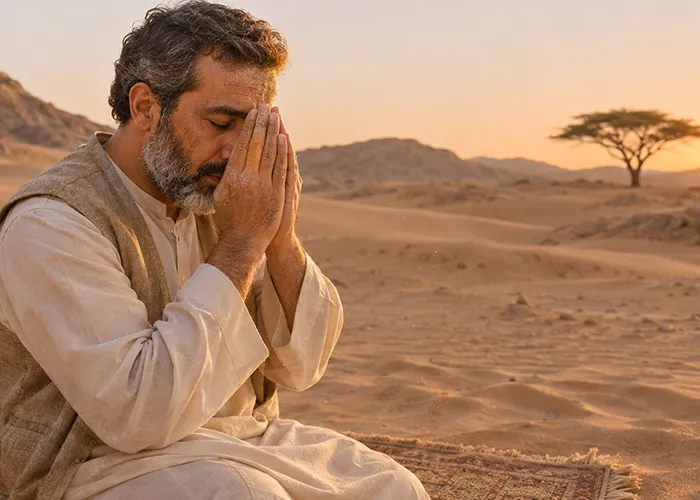
Water is the symbol of life, purity, and freshness; whereas earth serves as a symbol of modesty, humbleness, and the reminder of human creation. When a person places their forehead—the most honorable part of the body—upon the dust and performs tayammum with it, they symbolically set aside pride and arrogance, directing their attention toward the core reality of their existence. This act serves as a poignant reminder that humanity was created from dust and shall ultimately return to it.
- Continuity of Devotion and Unbroken Connection with God
Tayammum illustrates that within the logic of Islam, the path of worship and connection with God is never closed. When water is unavailable or its use is harmful, God out of His mercy and grace designates earth as its substitute so that believers are not deprived of the grace of worship. Thus, tayammum stands as a clear manifestation of religious leniency and a sign of the truth that the divine threshold remains ever open to worshippers, ensuring that difficult circumstances never become an obstacle to closeness and devotion.
editor's pick

news via inbox
Subscribe to the newsletter.