Everlasting Tales of the Quran – Volume 03 Issue 41
The Story of the Holy Land: From the Migration of the Friend of God to the Ascension of the Beloved (1)
The Migration of Prophet Abraham (pbuh) and the Seed of Monotheism in the Blessed Land
Leaving the Land of Nimrod and the Divine Command to Migrate
The shadows of smoke and the ashes of the great fire of the Nimrodites still hung heavily over Babylon. Prophet Abraham (peace be upon him), the hero who had shattered the idols, had emerged safely from the raging flames, but the stronghold of the Nimrodites was no place for faith to dwell.
The divine command came: Prophet Abraham (peace be upon him), accompanied by his wife Sarah and his nephew Lot (peace be upon him), set out on a journey to leave the land of idols behind. The divine command directed them toward a land of olive trees, greenery, and abundant blessings—a land that God had made a refuge for the righteous:
وَنَجَّيْنَاهُ وَلُوطًا إِلَى الْأَرْضِ الَّتِي بَارَكْنَا فِيهَا لِلْعَالَمِينَ
(Surah al-Anbiya, 21:71)
“And We saved him and Lot and brought them to the land which We had blessed for all peoples.”
This was the first time in the history of the prophetic missions that the land of Palestine (the Levant) was formally immortalised in the heavenly Scripture with the title: “the land which We had blessed.”
Entering Canaan and Raising the Tent of Monotheism
Prophet Abraham (peace be upon him) travelled through the valleys and hills of the Levant and set foot upon the land of Canaan -present-day Palestine. In the region of al-Khalil (Hebron), south of Jerusalem, he raised his tent and established a place of worship dedicated to the One God.
This was a land thirsting for spirituality. Among the indigenous peoples -the Canaanites- Prophet Abraham (peace be upon him) became known for his justice, hospitality, and call to monotheism. He raised his hands in supplication and asked God to grant him a righteous and guiding offspring in this land:
رَبِّ هَبْ لِي مِنَ الصَّالِحِينَ
(Surah al-Saffat, 37:100)
“My Lord, grant me [a child] from among the righteous.”
The soil of Palestine was being prepared to receive one of the greatest divine trusts: to become the cradle of a lineage of Prophets (pbut).
The Angels in the Tent of al-Khalil and the Glad Tidings of Generations
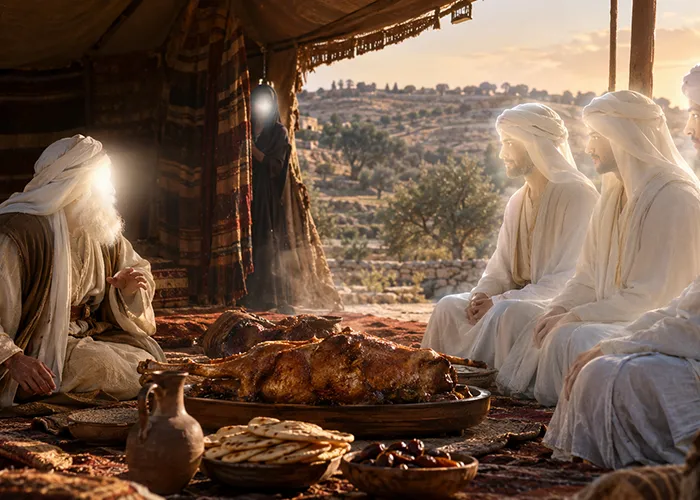
Years passed, and Prophet Abraham (pbuh) and Sarah (pbuh) reached old age. One day, three heavenly messengers -angels sent by God- arrived at Prophet Abraham’s (peace be upon him) tent in human form, unknown to him. In accordance with his customary generosity, Prophet Abraham (peace be upon him) prepared a roasted calf for them. But he noticed that they did not reach out their hands toward the food.
Fear entered Prophet Abraham’s heart, but the angels reassured him and brought them miraculous glad tidings in the land of Palestine:
وَلَقَدْ جَاءَتْ رُسُلُنَا إِبْرَاهِيمَ بِالْبُشْرَىٰ قَالُوا سَلَامًا ۖ قَالَ سَلَامٌ… وَامْرَأَتُهُ قَائِمَةٌ فَضَحِكَتْ فَبَشَّرْنَاهَا بِإِسْحَاقَ وَمِن وَرَاءِ إِسْحَاقَ يَعْقُوبَ
(Surah Hud, 11:69, 71)
“And indeed, Our messengers came to Abraham with good news. They said, ‘Peace.’ He said, ‘Peace.’ … And his wife was standing by and laughed, so We gave her the good news of Isaac, and after Isaac, of Jacob.”
It was here, in this very land, that the rocks and trees of al-Khalil would bear witness that from the lineage of Isaac and his grandson Jacob (Israel), generations of Prophets (pbut) would rise in this land.
An Eternal Resting Place: A Legacy for All History
Prophet Abraham (peace be upon him) lived for many years in this land, travelling between Makkah and Palestine. Yet eventually, it was in this sacred land that he passed away. His blessed body was laid to rest in the heart of the city of al-Khalil.
With the passing of Prophet Abraham al-Khalil (peace be upon him), Palestine was no longer merely an ordinary geographical region. This land had become the custodian of the seed of monotheism, the resting place of the father of the Prophets (pbut), and fertile ground for the great events that would follow -from the exodus of Moses and the conquest under Joshua, to David’s battle with Goliath, the glory of Solomon, the miracles of Jesus, and the ascension of the Seal of the Prophets (peace and blessings be upon him and his family).
Crossing the Desert and Beyond the Hills of Canaan
Longing for the Promised Land
Centuries after Prophet Abraham (peace be upon him), and following the migration of the descendants of Jacob to Egypt, evening shadows fell across the Sinai Desert. The Children of Israel, who had witnessed with their own eyes the miracle of the parting of the sea and the destruction of Pharaoh, had been travelling for weeks through the wilderness under the leadership of Moses (peace be upon him).
On the northern horizon, the green hills and lush mountains of the Levant and Palestine could be seen—a land that seemed to carry the fragrance of olives and honey, and which was the legacy of their great forefather, Prophet Abraham (peace be upon him).
Moses (peace be upon him) stood among his people. He looked upon the weary yet argumentative faces of a people who had spent years crushed beneath the whips of Egypt and who still carried the remnants of a slave mentality within their souls. Moses (peace be upon him) raised his hand and conveyed the divine command:
يَا قَوْمِ ادْخُلُوا الْأَرْضَ الْمُقَدَّسَةَ الَّتِي كَتَبَ اللَّهُ لَكُمْ وَلَا تَرْتَدُّوا عَلَىٰ أَدْبَارِكُمْ فَتَنْقَلِبُوا خَاسِرِينَ
(Surah al-Ma’idah, 5:21)
“O my people! Enter the Holy Land which Allah has ordained for you, and do not turn back, lest you become losers.”
A fleeting sense of excitement arose in their hearts, but entering fortified cities required reconnaissance. Moses (peace be upon him) selected twelve leaders and scouts, one from each of the twelve tribes of the Children of Israel and sent them to survey the heart of Palestine.
Dreams That Were Shattered Behind the Walls of Canaan
For days, the scouts travelled through the hills and valleys of Palestine. They encountered an exceptionally fertile land, with flowing springs and fruit-laden trees. Yet what shook their hearts was the people who built and inhabited that land.
The city of Jericho (أريحا) and the strongholds of the Jebusites (یَبوسیان) -identified in the story with Jerusalem- stood upon the hills. Stone walls several metres high, massive watchtowers, and physically imposing, tall people armed with bronze weapons -the Canaanite and Amalekite peoples- dominated the region. They were a warrior people, formidable in stature, and possessed of an established urban civilisation.
When the scouts returned to the camp of the Children of Israel, ten of them trembled with fear. Instead of delivering a message of hope, they began to exaggerate and spread rumours: “We were like tiny grasshoppers compared with them! Their cities reach up to the heavens, and their inhabitants are invincible!”
Terror and panic spread throughout the camp of the Children of Israel like fire through dry grass. The cries and lamentations of men and women filled the air. In a single moment, they forgot all the miracles of the sea and their deliverance from Pharaoh. Turning to Moses (peace be upon him), they spoke in fearful submission:
قَالُوا يَا مُوسَىٰ إِنَّ فِيهَا قَوْمًا جَبَّارِينَ وَإِنَّا لَن نَّدْخُلَهَا حَتَّىٰ يَخْرُجُوا مِنْهَا فَإِن يَخْرُجُوا مِنْهَا فَإِنَّا دَاخِلُونَ
(Surah al-Ma’idah, 5:22)
“They said, ‘O Moses! Indeed, there are mighty people in it, and we will never enter it until they leave it. But if they leave it, then we will enter.’”
The Rift in the Command Tent: The Battle Between Trust and Fear
Amid that terrified assembly, only two of the scouts –Joshua son of Nun and Caleb son of Jephunneh– refused to abandon their trust in God. They tore their garments and stood before the angry and frightened crowd, seeking to shatter the false aura of invincibility surrounding the inhabitants of the cities:
قَالَ رَجُلَانِ مِنَ الَّذِينَ يَخَافُونَ أَنْعَمَ اللَّهُ عَلَيْهِمَا ادْخُلُوا عَلَيْهِمُ الْبَابَ فَإِذَا دَخَلْتُمُوهُ فَإِنَّكُمْ غَالِبُونَ ۚ وَعَلَى اللَّهِ فَتَوَكَّلُوا إِن كُنتُم مُؤْمِنِينَ
(Surah al-Ma’idah, 5:23)
“Two men from among those who feared God, upon whom Allah had bestowed His grace, said: ‘Enter upon them through the gate; when you enter it, you will surely prevail. And place your trust in Allah, if you are truly believers.’”
Joshua cried out: “Their walls may be strong, but their spirit is empty before your faith! Take only the first step!”
But the mentality of slavery and the wounds of historical humiliation had overcome the rational judgment of the Children of Israel. Instead of placing their trust in God, they insulted their leader and uttered their humiliating and historically consequential response -the response of a people who preferred the habits of slavery to the responsibilities of freedom:
قَالُوا يَا مُوسَىٰ إِنَّا لَن نَّدْخُلَهَا أَبَدًا مَّا دَامُوا فِيهَا ۖ فَاذْهَبْ أَنْتَ وَرَبُّكَ فَقَاتِلَا إِنَّا هَاهُنَا قَاعِدُونَ
(Surah al-Ma’idah, 5:24)
“They said: ‘O Moses! We will never enter it as long as they remain there. So go -you and your Lord- and fight. We will remain sitting here.’”
A Rejection of the Mentality of Slavery: The Punishment of the Wilderness
Moses (peace be upon him), heartbroken and grieved by such ingratitude, withdrew from his people. He realised that this generation, despite having witnessed dozens of miracles, had become so deeply affected by the psychological wounds of the Pharaoh’s era that it was no longer capable of setting foot in “the Holy Land.” Moses (peace be upon him) raised his hands in supplication:
قَالَ رَبِّ إِنِّي لَا أَمْلِكُ إِلَّا نَفْسِي وَأَخِي ۖ فَافْرُقْ بَيْنَنَا وَبَيْنَ الْقَوْمِ الْفَاسِقِينَ
(Surah al-Ma’idah, 5:25)
“Moses said: ‘My Lord, I have authority over none but myself and my brother, so separate us from the disobedient people.’”
The divine response came. The course of events was decreed: a land that was to be entered with faith, dignity, and courageous struggle would remain forbidden to a people who had chosen fear and humiliation.
قَالَ فَإِنَّهَا مُحَرَّمَةٌ عَلَيْهِمْ ۠ أَرْبَعِينَ سَنَةً ۨ يَتِيهُونَ فِي الْأَرْضِ ۚ فَلَا تَأْسَ عَلَى الْقَوْمِ الْفَاسِقِينَ
(Surah al-Ma’idah, 5:26)
“He said: ‘Indeed, it shall be forbidden to them for forty years; they will wander throughout the land. So do not grieve over the disobedient people.’”
The Enigma of the Tīh and the Emergence of a New Generation
The gates of Palestine were closed to them. The Children of Israel became trapped in the vast and seemingly endless desert known as al-Tīh. Each day, they would set out in the hope of reaching their destination, yet when the sun went down, they would find themselves once again at the very place where they had begun that morning. For forty long years, the barren and rocky wilderness became their prison without walls.
During those forty years, divine wisdom quietly accomplished its purpose. The older generation -the generation that had learned humiliation beneath Pharaoh’s whips and had been frightened by the Amalekites and Canaanites- gradually disappeared beneath the sands of the wilderness.
Alongside them, amid the hardship and harshness of the desert, a new generation came into being: young people who had never seen Pharaoh, who had been born free, who had experienced the rigours of desert life, and whose hearts had been strengthened by faith and trust in God.
After the passing of the old generation and the deaths of Moses and Aaron (peace be upon them), this new and highly motivated generation, under the command of Joshua’s son of Nun, broke the spell of the forty-year wandering. They crossed the Jordan River, overcame the resistance of the Canaanite strongholds through their faith and determination, and, for the first time, entered the sacred soil of “the Holy Land” with dignity and honour.
Educational and Moral Lessons
• The Principle of Migration for the Preservation and Development of Faith
At times, spiritual growth and the preservation of monotheistic faith become extremely difficult in a corrupt and misguided environment. Migration from a “Nimrod-like environment” toward “blessed and secure lands” can be the first step in purifying the soul and creating an environment in which a righteous generation can be nurtured.
• The Power and Blessing of Parents’ Prayers for Future Generations
The sincere supplication of Prophet Abraham (peace be upon him),
رَبِّ هَبْ لِي مِنَ الصَّالِحِينَ
“My Lord, grant me [a child] from among the righteous,”
demonstrates that the foundations of upbringing can begin even before birth, through the parents’ intentions, prayers, and purity of purpose.
• Generosity and Good Character as a Setting for Divine Glad Tidings
Prophet Abraham’s (peace be upon him) generous hospitality toward his unexpected guests -the angels- demonstrates that great divine openings and unexpected glad tidings may often come in the wake of good character, generosity, and hospitality.
• Healing the Psychological Wounds of Slavery and Humiliation
A people who have lived for years under oppression and tyranny may develop a deep sense of inferiority. External miracles alone cannot necessarily heal a humiliated spirit. A society seeking to regain its dignity may also need “to rebuild its mental framework and inner convictions.”
• The Danger of Passivity and Waiting Without Taking Action
The response of the Children of Israel -“Go, you and your Lord, and fight; we are sitting here”- is a striking example of a distorted understanding of trust in God.
True tawakkul requires human beings to take practical action and then seek God’s assistance. As the two faithful men said: “Enter through the gate… and you will prevail.” It is not a matter of remaining passive and placing the entire responsibility upon leaders or waiting for miracles.
• The Divine Pattern in Nurturing a New Generation: The Wisdom of the Forty Years of Tīh
Sometimes, correcting a deeply rooted structural problem or an established culture of fear requires active patience and investment in the next generation.
The fearful older generation gradually disappeared in the wilderness, making way for young people who were free, resilient, hardworking, and trusting in God—until they became capable of entering “the Holy Land.”
Sources
The Holy Qur’an
- Surah al-Ma’idah, verses 21–26
- Surah al-Anbiya, verse 71
- Surah al-Saffat, verse 100
- Surah Hud, verses 69–73
Hadith and Historical Sources
- Tafsir al-Mizan, commentary on verses 21–26 of Surah al-Ma’idah
- Majma‘ al-Bayan fi Tafsir al-Qur’anby al-Tabrisi, commentary on Surah al-Ma’idah
- Qisas al-Anbiyaby al-Rawandi
- Tarikh al-Ya‘qubiby Ahmad ibn Abi Ya‘qub al-Ya‘qubi
- Tafsir al-Mizanby Allamah Tabataba’i, commentary on verse 71 of Surah al-Anbiya
- Tafsir Nemunehby Ayatollah Makarim Shirazi, commentary on verses 69–73 of Surah Hud
- Tarikh al-Tabariby Muhammad ibn Jarir al-Tabari, Volume 1
- al-Kamil fi al-Tarikh by Ibn al-Athir, Volume 1
editor's pick

news via inbox
Subscribe to the newsletter.